Anti-social: It's fads, not friends, which now dominate our feeds

 Getty Images
Social media platforms used to be about communication between friends – now many are increasingly short video entertainment hubs. The business model is to increase the time people spend on their apps and increase ad revenue. But is there already a consumer backlash?
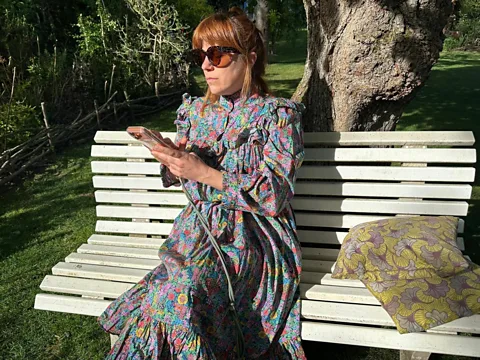
Aurélia fixes herself a coffee, sits down in her beautiful garden not far from Paris and goes on Instagram "to relax." First up: "a guy I like a lot who does interior design. He's in Venice at the moment." She's into interior design, and has even just had two bird drawings by the 19th Century English designer William Morris tattooed on her arms. She scrolls down. Two kittens having a fight. "I love animals so I get a lot of animals. That's how it works, social media. You click on bananas and they give you bananas."
There are ads too – although they look just like the other posts – for a robot-vacuum cleaner, a diet and bed linen (with Morris-inspired designs). But no friends. She has 198 on Instagram but she says "it's completely changed. I practically don’t see any friends' posts anymore." She’s pretty much given up posting herself. "I don't think anyone sees them anymore anyway."
While there remain committed social, amateur posters on Instagram and especially Facebook, the switch from communicating with people you know to scrolling through professionally made content from people you don't, is even more pronounced among young users.
Kylian, 16, is in vocational training to become a chef. He's on TikTok and Youtube a lot, he says. "I like looking at videos more than photos or messages. I watch videos made by people I don't know. I don’t post at all. I'm a rather shy person. I stay in my bubble. I watch and that’s all. I keep my reactions to myself."
"I spend a lot of time scrolling through videos made by content-creators," says Lucie, also 16. "They're more interesting than the posts of people I know." She doesn't post except sometimes "stories" which disappear after 24 hours.
Whether it's TikTok, Snapchat, Facebook and Instagram, we are a long way from the "digital town square" of personal interaction that social media was even just a few years ago.
 John Laurenson
In France, annual official Barometre du numerique 2026 shows 49% of social media users are "active only occasionally". In the UK, an Ofcom report published in April showed a year-on-year drop of users who actively post from 61% to 49%. In the US, a Morning Consult survey of June last year found 28% reported posting less often than the previous year. Just 33% now post daily compared to 57% who use it for entertainment daily. The gap is a lot wider still for Gen Z – 18% active for 74% passive.
Vanessa Lalo, a Paris-based clinical psychologist specialising in on-line behaviour, says "users have become more conscious that the traces you leave (on social media) stay there forever and some no longer want to maintain social media relations that can be superficial. Some don’t want the exposure to criticism that might be a risk when you post or the feeling that their post will seem poor alongside all the professional content".
However, Lalo adds, people haven’t stopped posting, rather they are posting different things and in different places. "On TikTok, for example, young people publish a lot of content but it's more funny parodies and remixes of existing material. The goal is to make people laugh, not to tell people about their lives."
That still happens, she says, but it’s moved from social media platforms like Instagram and Facebook to messaging sites like WhatsApp. There's also been a move towards private groups on Instagram and Snapchat. "These are much more intimate places where you're not bombarded with ads and content made by influencers," she says.
"What we're seeing is social media splitting in two," says social media consultant Matt Navarra, author of the Geekout Newsletter. "Big platforms like Instagram and TikTok are becoming more about entertainment and discovery. WhatsApp is becoming the place people go to actually be social. The catch is, those kinds of spaces are harder for companies to make money from."
It was TikTok that helped to pioneer an algorithm that figures out from the moment you start scrolling what you like, and then fills your feed with material calculated to keep you on the app for the longest possible time.
Now, says Matt Navarra, "Meta has built what it calls an AI system for unconnected content recommendations on Facebook and Instagram, which basically means, they're increasingly showing you stuff from people you don't follow because the machine thinks you're going to like it. It's not biased towards, is it a professional creator? Is it a brand? Is it a friend? If they can see that you've engaged with a friend a lot, you might see a lot more of their content. It's just that who you are friends with, who you follow, has become irrelevant in a way."
This all means that small businesses, that have long used social media for free promotion have to up their game.
"There's a real opportunity for some small businesses," says Matt Navarra. "A bakery, florist, salon or local café can still break through if they have a good story, strong visuals or behind-the-scenes content people want to watch. But it also means the job has changed. Small business owners are being pushed to become presenters, editors, trend spotters and content creators, on top of actually running the business."
Social media is evolving into something passive like television, albeit television that adapts as you zap. Or rather which knows you so well that it doesn't seem to matter that much that it's taken the remote control. You give the platform information about yourself that it uses for commercial gain and, in return, it gives you content tailored to please you for free.
The transition from truly social media to entertainment platform does seem to be paying off. "The social platforms continue to be monetised predominantly by ad revenue. That is still the core business model. And ad revenue continues to grow," says Matt Navarra. Global social media ad revenue is expected to reach $317 billion (£236bn) in 2026, up from $277 billion (£206bn) last year. Meta is the biggest winner. Its ad sales already increased 22% year-on-year in 2025. Ad sales are expected to hit $243 billion (£181bn) this year, enough to overtake Google for the first time.
AI powered digital ad targeting is becoming ever more effective and precise. "The social platforms allow companies to put ads amongst the content that you're scrolling through. Every third or fourth scroll is an ad. And they are the world's best ad targeting engines. They know so much about your interests because of what you've looked at, liked, engaged with, what you've chosen to follow, the time you've spent in certain areas of the app, things like that," Navarra says.
"So advertisers will go in and say: 'I want to place an ad next to people in the UK who are between thirty and sixty years old and who are interested in DIY' and the social platforms will have that information and will place the ads accordingly."
The price will depend on the number of impressions (clicks) the advertiser wants and how tight the criteria are. It costs more to place ads in the social media feeds of people who buy horses than people who buy ice-cream.
More like this:
Might there be a backlash coming? Don't many people go on to social media to see how friends are reacting to their posts or comments before settling down to scroll through professionally made content?
Whether it's the shrinking social motivation to get on these apps or something else, the amount of time people spend on social media plateaued at an average of 141 minutes in 2025, down slightly from 143 minutes in 2024. However, this is only part of the story, as the number of people using social media and the total time humanity spends on these apps continues to rise. For Gen Z it’s higher still. Around five hours a day in the United States where, for this demographic, social media has also become the primary search engine and shopping tool.
Meanwhile, for those who miss what are fast becoming the old days when social media enabled you to share a bit of your life, a joke or a point of view with people you more-or-less knew, there are tools within platforms, says Matt Navarra, that allow you to choose to see mainly friends and family content. "People can flick to a feed that gives them that," he says. "But most people don't."
--
If you liked this story, sign up for The Essential List newsletter – a handpicked selection of features, videos and can't-miss news, delivered to your inbox twice a week.
For more on business and beyond, follow us on LinkedIn.
