This monkey selfie will protect you from AI slop

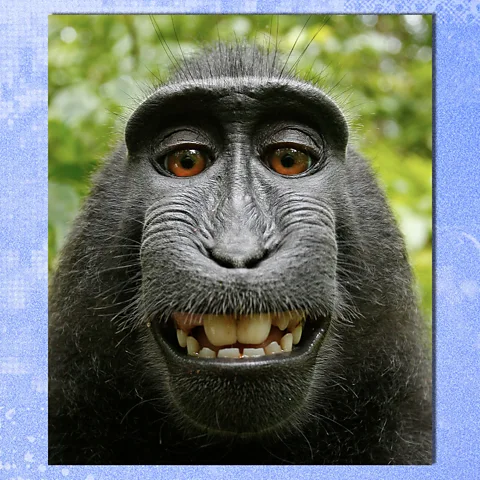 David Slater/ Caters New/ BBC
What happens when something that isn't human makes art? A series of bizarre court battles trying to answer that question centred around this image. Ultimately, it will influence what ends up on your screens and headphones forever.
It was a humid day in the Indonesian jungle, and photographer David Slater was following a group of crested black macaques, a critically endangered and particularly photogenic species of monkey.
He wanted pictures, but the macaques were nervous. So, Slater put his camera on a tripod with autofocus on and a flashbulb, allowing the monkeys to inspect it. Just as he hoped, they started playing with his gear. Then one of them reached up and hit the shutter button while staring directly into the lens. The result was a selfie, taken by a monkey. And its toothy grin inadvertently answered a basic question that sits at the heart of technology.
What came next was nearly a decade of legal battles around an unusual dispute: when something that isn't human makes a work of art, who owns the copyright? Thanks to AI, that's become an issue with some deep implications for modern life – and what it means to be human.
One of the most alarming predictions about AI is that corporations will replace the human-created music, movies and books you love with an endless stream of AI slop. But the US Supreme Court just upheld a decision about AI and copyright which suggests that future may be harder to pull off than the tech industry hoped. The path is still uncertain, and right now, the legal system is the site of a battle that will shape what you read, watch and listen to for the rest of your life. It all traces back to that one little monkey.
Monkey business
The monkey took that selfie in 2011. For a brief, blissful period, Slater enjoyed global attention from the picture, but the troubles began when someone uploaded the photo to Wikipedia, from where it could be downloaded and used free of charge. He asked the Wikimedia Foundation to take it down, arguing it cost him £10,000 (worth about $13,400 today) in lost sales. In 2014, The organisation refused, arguing the photo was in the public domain because it wasn't taken by a person.
The row prompted the US Copyright Office to issue a statement that it would not register work created by a non-human author, putting "a photograph taken by a monkey" first in a list of examples. (Slater didn't respond to interview requests, but his representation arranged for the BBC to use the photo in this article.)
The story gets weirder. Soon after, the advocacy group People for the Ethical Treatment of Animals (Peta) sued Slater on behalf of the monkey. The case argued all proceeds from the photo belonged to the macaque that took the picture, but it was really seen as a test case, an attempt to establish legal rights for animals. After four years and multiple court battles, a San Francisco judge dismissed the case. The judge's reasoning was simple: monkeys can't file lawsuits.
"It was kind of the biggest public conversation piece on this topic," says intellectual property lawyer Ryan Abbott, a partner at Brown, Neri, Smith and Khan in the US. "At the time it was very much about animal rights. But it could have been a conversation about AI."
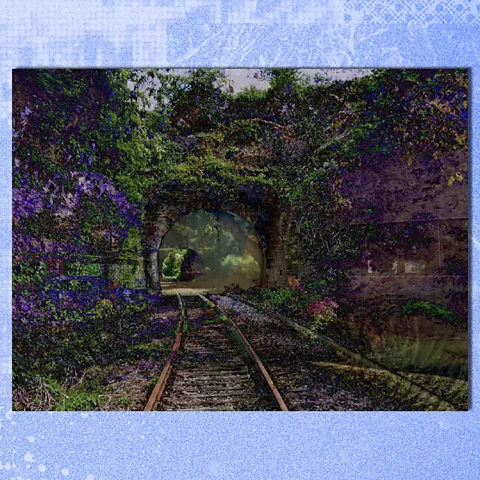 Courtesy of Stephen Thaler
The monkey (either named Naruto or Ella, there's some dispute about which macaque took the picture) certainly couldn't dream of the impact of its moment with the camera. Most people probably couldn't see the long-term implications back then either. But years later, the story that monkey set in motion reared its head again in a similar lawsuit brought by a computer scientist named Stephen Thaler. Except the author wasn't a monkey this time. It was a computer.
Thaler built an AI system he calls Dabus (Device for the Autonomous Bootstrapping of Unified Sentience), sometimes referred to as the Creativity Machine. He devised it more than 10 years ago with now primitive technology. "It's done on a shoestring allowance by one guy in the suburbs of St Louis", Thaler tells me on a phone call.
But this is no ordinary computer program, he says. Thaler believes Dabus and similarly powerful AI systems are conscious. "It's essentially a system that develops its own subjective feelings about what it's sensing and what it's thinking," he says. "And that is sentience."
There's an army of experts who disagree, of course. But Dabus generated an image called A Recent Entrance to Paradise, and Thaler says that Dabus is the sole and exclusive creator of the work. He tried to register the image with the US Copyright Office, but the office declined based on the same logic it used with the monkey selfie. It was the beginning of another legal fight with much broader consequences.
When the US passed the Copyright Act of 1790, we only had to deal with things like writing and drawing. But the invention of photography decades later raised troubling questions. You could argue cameras do the real work, a person just hits a button.
"The Supreme Court looked at this and said, you know, we're going to interpret this purposively," says Abbott, who represented Thaler in a case against the Copyright Office. "Copyright was designed to protect the expression of tangible ideas. And that's broad enough to cover something like photography."
The same logic could apply to AI. "What you really have in photography is exactly the same thing you have here. You have a person issuing instructions to a machine to generate a work," he says. "What's the difference between that and me asking ChatGPT to make an image?"
Think about who made the last movie or show you watched. Writers, directors, actors. Behind them, there's usually a studio that owns the rights. A lot of the movies and shows exist because someone can own them and make a profit. But AI threatens to upend that system. If a machine makes the content, who owns it?
Abbott and Thaler took their lawsuit all the way to the top of the legal system. In March, the Supreme Court declined to hear the case, preserving a lower court ruling in favour of the Copyright Office. If AI creates something, no one can own it. Not the AI, the company running the AI nor the person who used it.
"It definitely forecloses the most dystopian outcome of machines entirely replacing humans [in the world of art and entertainment]," says Stacey Dogan, a professor who studies intellectual property, competition and technology at the Boston University School of Law.
Some predict a future where you just plop down in front of an AI system instead of watching the work of human beings. But without copyright protection for AI-generated work, the business case for building that world takes a major hit. For big entertainment companies like Disney, there's still a huge financial incentive to let humans run the creative process.
Keeping Tabs
Thomas Germain is a senior technology journalist at the BBC. He writes the column Keeping Tabs and co-hosts the podcast The Interface. His work uncovers the hidden systems that run your digital life, and how you can live better inside them.
There are other signs out there too. In March, ChatGPT maker OpenAI shut down Sora, a social media app for AI content, and cancelled a $1bn (about £747m) content partnership with Disney.
Then again, there is some kind of audience for AI slop. As we talked about on a recent episode of the BBC's podcast The Interface, tens of millions of people watched a social media series called Fruit Love Island over the last few weeks, where sexualised AI fruit people fall in love and cheat on each in a reality TV parody. Was this just a meme? Were people hate watching it? Or does this kind of AI content have real staying power? It remains to be seen.
Even proponents of AI are sceptical. "As a consumer, I don't find these wholly AI-generated things compelling. There's something hollow in it," says Jacob Schneider, an intellectual property and technology specialist and partner at the law firm Holland & Knight in the US. "But AI can be incredibly helpful in creative work to be a soundboard and develop ideas. I think it works best as a collaborator, and I hope that's where things go."
There's still one big legal question here though. If no-one can own work that was entirely created by an AI, what about work where there's an equal level of involvement with a human being?
Drawing the lines
The US isn't the only country grappling with these issues. In the UK, the law has taken a different approach, allowing copyright for some fully machine-generated works by assigning authorship to the person who made the "arrangements" for their creation. That means a AI-generated image or text can still be owned, even without a human author in the traditional sense. But even there, the rules are under pressure. Lawmakers are now reconsidering whether that framework still makes sense in the age of generative AI.
Abbott has another lawsuit in the works which could provide a final answer for the US. In 2022, a man named Jason Allen won the Colorado State Art Fair in the US with an image titled Théâtre D'opéra Spatial he generated with the AI tool Midjourney. Allen says he had to prompt the AI 624 times and edited the image with Photoshop.
Now the courts must decide where to draw the line. How much human involvement and intervention is necessary before the law determines a person owns the work? The answer is certainly coming, but we don't have it yet.
More like this:
For you, all this means that anything you create, from photos to drawings and writing, carries a special legal protection that machines can't claim. In a world of endless AI output, your creativity counts as something distinct. When AI helps you along the way, the rules aren't clear.
These cases will keep coming, and the conversation will shift along with them. But the work you love still needs to be made by a person for now, and in part, you can thank an Indonesian monkey with a perfect smile.
--
For timely, trusted tech news from global correspondents to your inbox, sign up to the Tech Decoded newsletter, while The Essential List delivers a handpicked selection of features and insights twice a week.
