Sarwar rules out 'harsh' cuts to bring down benefits bill

 Getty Images
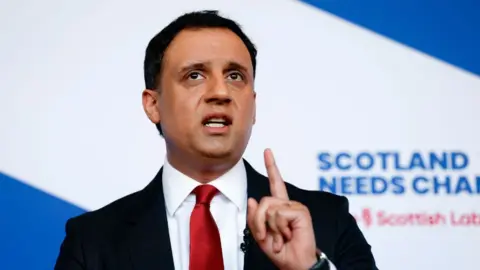
Scottish Labour leader Anas Sarwar has said he wants to bring down Scotland's social security bill – but not with "harsh" cuts to benefits.
Speaking following the launch of his manifesto, Sarwar said he wanted to encourage people back into work to tackle poverty.
He defended his pre-election plans after they were described as "restrained" by the Institute for Fiscal Studies (IFS).
Sarwar also reiterated his opposition to Scottish independence and a second referendum - while not ruling out another vote at an undetermined point in the future.
He was quizzed on his views about social security as it was reported that former Labour minister and Nato chief Lord George Robertson - calling for an increase in the UK defence spending - will warn that "we cannot defend Britain with an ever-expanding welfare budget".
Sarwar told BBC Radio Scotland Breakfast: "I want to drive down the welfare bill, but I'm not going to do that by just having harsh measures in place that don't actually support people and give them social mobility."
He added: "What I want to do is give young people a skill, give them a job, pay them well, and that's the best way of challenging structural poverty."
Both the UK and Scottish governments are contending with soaring welfare bills.
The gap between what the Scottish government spends on social security and what it receives from the UK Treasury via welfare spending is forecast to grow to £1.1bn in 2026-27, rising to £1.2bn in 2030-31, according to the Scottish Fiscal Commission.
This funding gap has to be plugged by moving cash from other areas, increasing taxes or borrowing.
In Sunday night's BBC election debate, First Minister John Swinney claimed there could be an independence referendum as soon as 2028 - if voters delivered an SNP majority.
However, Sarwar insisted independence was not a priority for the vast majority of Scots - echoing the findings of a recent Survation poll for campaign group Scotland in Union.
Repeating his favoured campaign line, Sarwar said the SNP had been allowed 20 years in power, and that he was asking for just five.
"Scotland might choose a different final destination at some point in the future, but in the here and now, let's make Scotland better," he told the BBC.
"And then at some point in the future, if there's a stronger, better Scotland that chooses a different final destination, so be it."

Any referendum would need to be signed off by the UK government. On Sunday, UK Health Secretary Wes Streeting was unequivocal, telling LBC: "We're not having one."
A national opinion survey of 2,136 Scots by Savanta for BBC Scotland News earlier this year found that, when undecided voters were removed, 51% backed independence, while 49% were opposed.
That fits in with a long-standing trend of a roughly 50-50 split on the constitution in polling.
About one in eight respondents (13%) to the BBC Scotland poll said that revisiting the question of independence was among their top three priorities.
By comparison, 62% mentioned the cost of living in their top three issues, with health (50%), the economy (31%) and immigration (29%) the other most popular answers.
Labour's Holyrood manifesto says improving the NHS is its top priority - with plans to reduce waiting times and make it easier to see a GP.
The party ruled out income tax increases in the next parliamentary return, but outlined ambitions to cut tax once the economy has grown.
David Phillips, head of devolved and local government finance at the IFS, described the Scottish Labour manifesto as "a restrained affair" compared to other party's plans.
"It promises neither a big expansion in entitlements under the welfare state, nor a cut in Scotland's taxes – although it is notable that if economic and fiscal conditions improved, the aim would be to reduce taxes rather than increase spending," he said.
"This somewhat pared-back offering means it is harder to point to obvious big 'winners' if the plans were implemented.
"But it also means fewer losers from measures needed to pay for 'giveaways' than the other parties."
