Labour's Scottish manifesto pledges analysed

 Getty Images
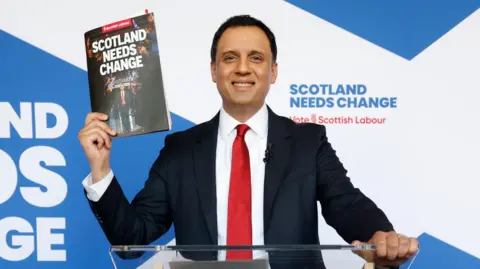
The Labour party's leader in Scotland, Anas Sarwar, has launched his party's 2026 manifesto for the Holyrood election. The full document runs to 98 pages. So, what is the party promising? BBC Scotland journalists have been analysing the pledges.

Fix the NHS
It's not a surprise the NHS features at the top of Labour's plans and there is a pick and mix of proposals in this manifesto.
So how will Labour "fix the NHS"?
Cutting waiting times, guaranteeing GP appointments within 48 hours, and better use of technology are common themes for all the parties.
With plans also to pay social care workers more, provide menopausal clinics and improve NHS dental care, it is unclear how Labour will bring in staff and pay for all these promises.
Cost-cutting proposals to drastically reduce the number of health boards may require a change to the current policy of no compulsory redundancies in the NHS.
Labour want to see better cooperation right across the UK, meaning patients who travel can be seen more quickly, but services are stretched everywhere, and transport, operations, and aftercare come at a cost.
They will compel students to work for the NHS for at least five years after they qualify, which might address some gaps but will not fix the workforce crisis.
Ban mobile phones in classrooms
Scottish Labour are keen to distinguish themselves from the SNP by saying they would ban all mobile phones in classrooms.
Currently, the position in Scotland is that headteachers can ban mobile phones if they wish to - but there is no national policy.
In lieu of a blanket policy, some councils - including Edinburgh - have introduced their own ban on smartphones in class.
But teachers say the practicalities can be more complicated.
They have pointed out that it can be hard to police an outright ban because of the time taken to remove phones, with some pupils refusing to hand them over and some parents insisting their children need phones at certain times of day.
There is also a cost to the pouches used in Edinburgh to store phones during the school day.
Labour's manifesto says taking phones out of classrooms would make schools safer and calmer places for learning.
They would also back a UK-wide ban on social media for under-16s to better protect young people from cyberbullying and harmful online content.
Build 125,000 new homes
Scottish Labour is promising 125,000 new homes during the next parliament - a big increase on what we've seen recently.
They say this will boost the economy and create a fairer Scotland.
During this last parliament, around 100,000 new homes will have been built in Scotland.
But the delivery of affordable homes has been well behind target.
In 2024/25 there were more new-builds than in other parts of the UK, compared to our population size.
But the total number of new homes has fallen steadily in recent years.
So Labour think this pledge will appeal to renters and home-owners alike.
But hitting this target could be challenging - and it means an overhaul of the planning system to "unlock land" and a presumption in favour of what they call "sustainable development".
What's promised means house-builders would have to do much more.
And there's a big question mark whether UK economic conditions, with relatively high interest rates, construction labour shortages, and the current oil price shock would allow it - regardless of planning reforms.

Push power from Holyrood to councils

Devolution in 1999 moved power from Westminster to Holyrood. But since then some have argued local communities across Scotland have lost power too, with, they contend, power being centralised by stealth in Edinburgh.
It boils down to whether councils are subservient to Holyrood or an independent tier of government.
So can power shift meaningfully away from Edinburgh?
Labour promises to push power out of Edinburgh and consult on whether there should be regional mayors.
In the most densely populated parts of Scotland - including Glasgow and the surrounding area - there is certainly an argument that many issues affect the wider region and not just individual local authorities.
But what actual powers would a mayor have? Or would this just be another layer of government? The devil would be in the detail.
Reach net-zero climate emissions by 2045

This is the first of the three manifestos launched so far to unequivocally back the legally-binding target to reach "net-zero" climate emissions by 2045.
"Net-zero" refers to the point where any residual planet-warming greenhouse gases being added to the atmosphere are offset by things like tree planting or technological removals.
Where the Conservatives and Reform have each committed to scrap the "ideological" goal on cost grounds, Scottish Labour says that, without action, it would end up costing the country more in the long term.
That's a view backed by experts at the International Energy Agency and reflects the costs of preparing for and responding to more extreme weather events, rising sea levels, climate migration and so on.
But unlike in previous elections, the climate question is no longer front and centre. In fact, it didn't receive a single mention in Anas Sarwar's manifesto launch speech.
The SNP, Greens and Lib Dems will launch their manifestos later this week.
Grow Scotland's economy
Scottish Labour want to grow the economy - to deliver a fair society.
Many of their other key aims - like improving living standards, reducing poverty, and spreading prosperity to all parts of Scotland - depend on it.
Their growth plan has multiple strands: they want to remove what they call the independence "distraction", boost skills and be a better partner for business.
They pledge to streamline planning, to deliver better infrastructure and homes where they're needed.
Their commitment to clean energy - and new nuclear power stations - aims to help businesses, as well as households, get cheaper bills.
What this plan lacks, perhaps, is a single, overarching theme - like the Scottish Tories' tax cuts, or the SNP's promise that independence will boost the economy. But Labour think their rivals aren't being straight with the voters.
Labour's broader challenge is two-fold.
Their growth pitch relies in part on a strong relationship with the UK government at Westminster, to deliver things like shipbuilding and defence contracts.
But it's barely two months since Anas Sarwar called on Sir Keir Starmer to resign - so can the two patch up their differences, and work well together?
And what happens if the economy doesn't grow much at all over the next few years, thanks to the Iran War?
Help people transition to work
While there is no mention of specific benefits like Universal Credit or Adult Disability Payment, the manifesto does have a line about helping people "transition into work".
The party say they want to remove barriers for people who want to take up work or increase their hours.
They've also highlighted the need to close the disability pay gap, and there are proposals committing £10m to new Changing Places Toilets and creating a standard for accessible information.
But there is a balancing act for Anas Sarwar and Scottish Labour.
As the party in power in Downing Street has found out recently, reform to work, disability benefits, and social security is never easy.
UK Labour faced rebellion on plans to overhaul the benefits system, which came into effect last week.
What Scottish Labour want is for more people to work, but there is a question mark over how to make that happen.
No mention of an independence referendum

On one of the biggest issues in Scottish politics, Labour have nothing to say. Quite deliberately.
Independence doesn't feature in this manifesto at all. Even when some of their political opponents say there could be a second referendum in the next Scottish Parliament (it's important to note the UK government would have to agree to this).
Scottish Labour are hoping that the constitutional debate has moved on from 2014. They believe that voters - regardless of whether or not they want independence - are currently more concerned with, for example, the state of their local hospital.
And they think they can paint other political parties as living in the past if they continue to talk about the constitution.
But there is still evidence to suggest that the independence question motivates voters in Scotland.
And labour politicians still find themselves occasionally facing an awkward question that they don't really see to have an answer for - if the UK is a voluntary union, what's the legitimate way to leave?

