Scottish Greens' manifesto pledges analysed

 PA Images
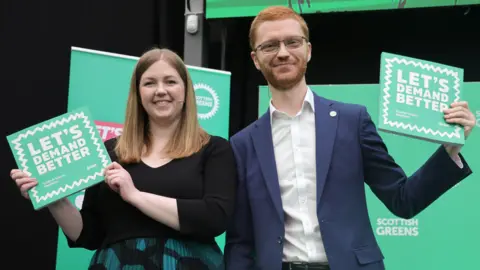
The Scottish Greens' co-leaders, Gillian Mackay and Ross Greer, have launched their party's manifesto for the 2026 Holyrood election. The full document runs to 164 pages. So, what is the party promising? BBC Scotland journalists have been analysing the pledges.

Expand free childcare

The Greens' commitment to extend 1,140 hours of funded childcare to all two-year-olds, and 570 hours from six months to two, will be popular with parents frustrated that the offer in Scotland has not kept up with provision for working families in England.
The SNP government currently provides 1,140 funded hours to three- and four-year-olds, and its manifesto offer of free childcare for younger children will remain income-dependent.
The latest research from campaign group Pregnant Then Screwed found that two-thirds of mothers surveyed in Scotland said childcare costs were the same or more than their income, and around half felt it didn't make financial sense to work.
But expanding free childcare is expensive and complicated, and relies on the private sector to supply places as fast as demand rises.
This can leave some areas as "childcare deserts" where there are not enough staff and nursery premises to accommodate everyone.
Free bus travel for everyone
The Greens want free bus travel for everyone.
They're proud of delivering this for young people while in government with the SNP, and want to go further.
They'd immediately expand free bus travel to anyone under 30.
And they'd cap fares at £2.
They frame this as a cost-of-living AND a climate measure.
They point to examples in Australia, Luxembourg and Malta as places offering free bus travel.
But free travel doesn't count for much if services are poor.
So they want more public control of the bus network, empowering communities to plan routes.
But how much would it cost? The Scottish government already spends £300m a year on free bus travel for children, under-22s, eligible disabled people, and over-60s.
Some estimate free bus travel for all would cost another £300m a year. And setting up a publicly-owned system with around 4000 buses would require big up-front investment.
The Greens are looking to fund that through public Bus Bonds.
At this stage, there's little detail on how that would work in practice.
Recruit more NHS staff
The Greens want to "fundamentally" reform the NHS, but the manifesto is shy on details.
There are familiar themes - to recruit more staff including GPs, nurses and social care workers.
They want new staff in health centres to help with welfare issues like poverty and housing to tackle inequalities.
With money already tight, this would mean a steep rise in the wage bill.
One major commitment is to end all charges for dental treatment, eventually ensuring every dental practice is run by the NHS.
Free dental care was part of the NHS when it was formed in 1948, but it was so expensive and demand so high that patient charges were brought in three years later.
Many people struggle to see an NHS dentist now. Even those who are registered are expected to pay 80% of any treatment for things like fillings, crowns or dentures.
For this to be fully absorbed into the NHS would be hugely costly.
Change school starting age to seven
The Scottish Greens are proposing big changes to education with a focus on copying the Finnish system.
Their manifesto proposes moving the school starting age to seven, as it is in Finland, and introducing a kindergarten-style play-based model before then.
They are also calling for an end to "Victorian era" exams in secondary school, with pupils' work assessed across the whole year instead.
They also want an end to homework in primaries.
Interestingly, though, Finland - while previously a top-scoring country in the internationally comparative Pisa results - has seen a steady decline since 2012.
Their results are still high compared to other OECD countries, but now Singapore, Estonia and parts of China rank far higher.
And one of the reasons the Scottish system has faced such heavy criticism in recent years is that it too has been falling in the Pisa results for some time.
As a result, Scottish ministers commissioned a report to review the education system, which reported back in 2023, calling for an end to S4 exams and a move to focus on coursework - proposals the Scottish government rejected.
Tackle Scotland's housing emergency
The Greens say they want to end homelessness in Scotland by 2040.
Central to this would be the construction of 15,700 social homes every year until 2031.
It's a challenging prospect. There has been a slowdown in the number of new homes being built across Scotland in recent years.
According to some in the construction sector, this is partly a consequence of protracted planning processes.
The Greens' proposals for reforming the planning system don't address backlogs.
Instead, they include powers for councils to force owners of derelict land to sell for housing and the ability to block the construction of student accommodation in favour of long-term housing.
Councils would also be able to refuse permission to developers "with a track record of building sub-standard homes".
Alongside this would be better funding for councils to identify at-risk groups and homelessness prevention.
The Greens' 2040 pledge would be a "statutory target" - a legally binding goal enshrined in future legislation.
This is similar to targets set out to tackle child poverty several years ago.
Statisticians say there has been a downward trend in child poverty since such targets were introduced, but are unclear about whether interim goals have been met.

Scrap council tax
The majority of council budgets comes from the Scottish government in one way or another. The council tax typically makes up less than a fifth of each council's budget.
The Greens propose that councils should have the means at their disposal to raise at least half of their budgets locally.
The party restates its long-standing ambition to scrap the council tax.
It argues councils should have more "general revenue raising powers". In other words, a suite of financial powers to use as they consider appropriate - not a few blunt instruments.
But, of course, the test would ultimately be about how councils used any such powers.
Who would be better or worse off? Would the extra revenue the Greens say this would generate actually lead to better local services, more in tune with what communities want? Or would the wrong decisions harm local economies?
End new oil and gas extraction
The manifesto says the Greens will support an immediate end to new oil and gas extraction.
No surprise there, but the real question is how that can be achieved in a way that doesn't leave thousands of workers without jobs?
Grangemouth and Mossmorran have already shown that transition can be painful and the central argument is that "green" jobs are not being generated at the same rate that oil and gas roles are being lost.
There are essentially two pathways, the first of which is to prolong the life of the oil and gas sector until these alternative jobs are - hopefully - in greater abundance.
What the Greens advocate is the reverse of that, frontloading investment in renewables to deliver a net increase of 40,000 energy jobs by the end of the next parliament. With suggestions that jobs are being lost at a rate of 1,000 a month, that's a lot of new posts.
A doubling of the Just Transition fund to £1bn and creating "direct pathways" for oil and gas workers into renewables are some of the proposals their manifesto offers.
But history has shown that such a massive transition of an industry's workforce is a difficult, if not impossible, task.
Champion trans people
The last Scottish Parliament saw a drawn-out and difficult debate on sex, gender and trans rights.
The Scottish Greens manifesto shows this issue has not gone away.
Back in September, their two leaders, Gillian Mackay and Ross Greer, told the BBC's Scotcast that backing trans rights was a red line for their party.
Today, their support remains clear.
The manifesto says there's a "hate campaign against them", and the Greens want this addressed through school education, anti-bullying programmes, and greater protection under the criminal law.
There's also a pledge to ensuring access to "gender-affirming healthcare", which they claim in their manifesto is effectively denied to some by 200-year-long waiting lists.
This treatment is intended to help people whose gender identity differs from the sex registered at birth.
It's been the subject of intense medical and political debate and has become a polarised culture war issue.
The Scottish Greens also say they'll continue to call on the UK government to remove its block on gender recognition legislation.
In 2023, Holyrood voted to reform the way transgender people in Scotland could obtain a Gender Recognition Certificate, the document that legally changes a person's sex on their birth certificate.
The UK Conservative government blocked this change from becoming law, saying it would adversely impact UK equality legislation.
How gender recognition should work remains unresolved in Scotland and was largely parked as an electoral issue until now. The Scottish Greens manifesto shows it's not been forgotten.
Move police away from dealing with mental health crisis calls
One of the biggest challenges currently facing Police Scotland comes from calls relating to mental health, and the Greens are now the second party to put forward proposals to bring about change.
Last December, the force said it was attending 14,500 mental health calls a month.
It believes it's filling gaps in other parts of the system.
Chief Constable Jo Farrell says the issue is preventing her officers from tackling their core responsibilities and has reached the stage where "we are going to have to do something very different in this space."
The Greens have said they'll "reduce police call-outs and implement a trauma-informed approach by transferring mental health crisis responses from Police Scotland to properly funded community crisis services".
Both proposals would be welcomed by frontline cops if the politicians can find the money to do it.

