Bomb disposal experts may face 'busiest year ever'

 BBC
BBCBomb disposal teams expect to deal with even more unexploded World War Two devices in the future, armed forces officers say.
One Royal Navy bomb disposal team at Devonport in Plymouth, Bravo Diving Unit 1, attended three call-outs to German bombs - two in Plymouth and one in Exmouth - in the first six months of 2026, among a total of 54 incidents and call-outs during that period.
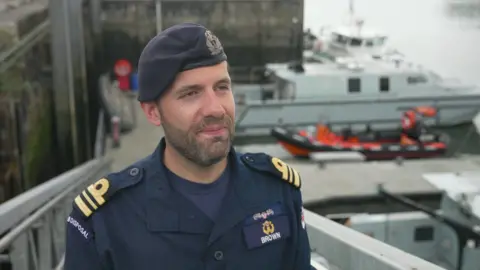
The squadron's commanding officer said an increase in building development work was bound to uncover more and this could turn out to be one of the busiest years ever.
Lt Cdr Ben Brown said: "If you look for them, you're going to find them."
 PA Media
He said: "I think the history of the area is very well documented.
"There was obviously a lot of bombing that took place during the Second World War. So, yes, with more construction, you do tend to find that we will discover more.
"On average, a Royal Navy operator is being called out once every 24 to 30 hours to deal with a task."
Along with Bravo Diving Unit 2 based in Portsmouth, the disposal staff cover a huge patch.
Brown said: "If you were to draw a line between Liverpool and Hull, we cover all of the coastline south of that line, including the River Thames, from the high water mark out to 12 nautical miles, which keeps us fairly busy."
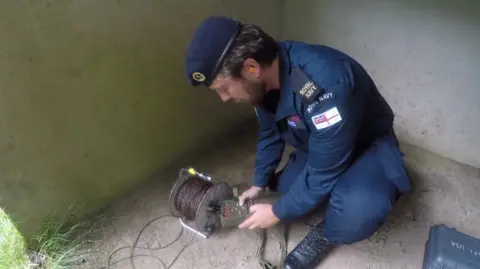
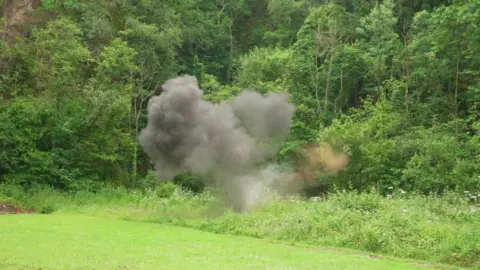
The BBC joined Bravo Diving Unit 1 on a training exercise in a disused quarry in Cornwall.
The team set up a controlled explosion to safely dispose of an empty military shell recovered on a call-out to Barnstaple in north Devon the previous night.
The officer in charge, Lt Matt Bowden, said dealing with so-called legacy unexploded ordnance (UXO) was a big part of the job.
"Every day of the week we go out on the roads, particularly around the South West, dealing with that kind of explosive in the public domain, so fields and beaches, to destroy legacy UXO," he said.
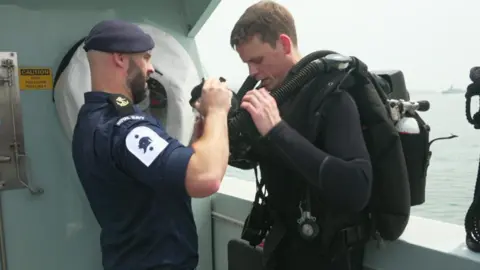
As well as being bomb disposal experts, every member of the unit is also a fully-trained explosive ordnance diver.
On a dive boat out in Plymouth Sound, Leading Diver Tom Oliver showed the 60kg (132lb) rebreather apparatus the team was using that day.
"All of us in the team are trained in this piece of equipment, and we all have to rotate to stay in date," he explained.
And every one of the 17 members of the team volunteered to join the unit.
"I think you've probably got to have one or two screws loose to want to come and do this," said Brown.
"Everyone that's here wants to be here, and that's such a refreshing thing.
"It's a real privilege to be their commanding officer because they are just well motivated and highly-driven individuals."
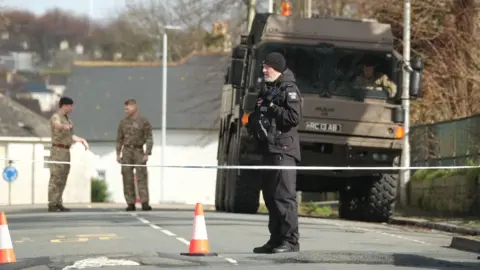
In 2024, a 500kg bomb discovered in the back garden of a residential property in Plymouth, which prompted one of the largest evacuation operations since the end of the Second World War.
It was safely removed by bomb disposal experts from the British Army and Royal Navy, with about 30 of the Armed Forces' most experienced bomb disposal specialists working around the clock.
In January this year, two German bombs were discovered on the same afternoon, with one dredged up in Exmouth Marina and the other found on a building site in the Millbay area of Plymouth.
About 2,500 properties in a 600m (1,312ft) cordon in Exmouth were affected, with people advised to leave their homes and both bombs disposed of at sea.
Follow BBC Devon on X, Facebook and Instagram. Send your story ideas to spotlight@bbc.co.uk.
