The Native marathoner who conquered Boston

 BAA
BAAHe broke records and inspired the name Heartbreak Hill in one of the world's most famous marathons. Now, more than 50 years after his death, travellers can learn about his legacy.
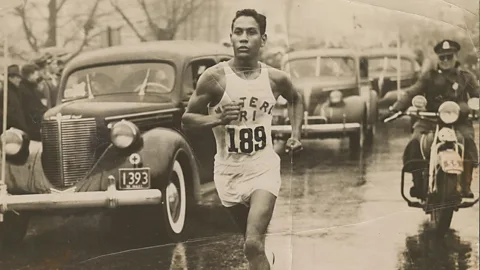
On 20 April 1936, Ellison Brown was running up a steep hill on Commonwealth Avenue. It was mile 20 of the Boston Marathon, and he was entering a critical stretch of the race. As he climbed the calf-aching 3.5% incline, there was an unexpected pat on his back. A second later, the previous year's winner, renowned runner Johnny Kelley, trotted past him. The message was clear: "Nice try, pal".
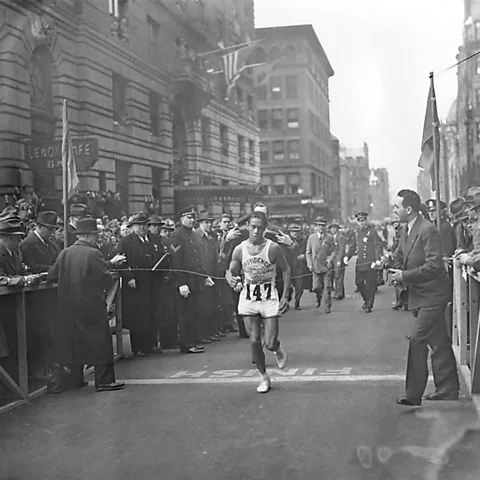
But all of a sudden, Brown surged forward. He sprinted up the half-mile hill and began a neck-and-neck battle with Kelley. The 500,000 spectators lining the course were stunned as they watched Brown cross the finish line first. Few watching had ever seen the fleet-footed 22-year-old, but soon his nickname would grace the front pages of newspapers across the country: "Tarzan" Brown.
Brown's victory was one of the biggest upsets in Boston Marathon history, and today, Kelley's unexpected loss is the reason why this fateful stretch of Commonwealth Avenue is still known as "Heartbreak Hill". Not only was Brown virtually unknown before the race, but the Narragansett tribe member was one of just a handful of Native American racers to ever compete in the world's most prestigious marathon, and the first to ever win.
 BAA
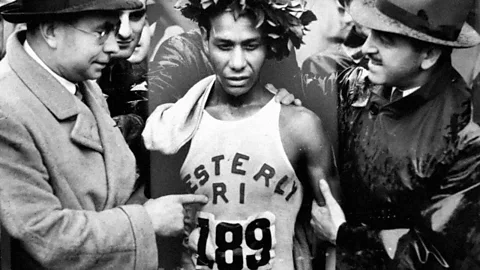
BAAKnown among the Narragansett as "Deerfoot", Brown was a gifted athlete from childhood. Because of his love for running and his ability to swing from trees on a rope, Narragansett friends often compared him to the popular Edgar Rice Burroughs character, until the name "Tarzan" stuck.
"We had no idea who 'Ellison' was," says Anna Brown-Jackson, one of Brown's 10 living grandchildren. "Everybody called him Tarzan."
Brown's 1936 Boston Marathon victory launched a groundbreaking athletic career. As one telling headline declared, he was: "Hailed as First 100 Percent American to Win Boston Marathon." Not only was Brown a champion runner, but he was also became a champion of the Narragansett people, who had been "detribalised" by the state of Rhode Island in the 1880s, along with their neighbouring nations, the Wampanoag and Niantic.
Many historians credit Brown's fame with helping put the Narragansett people back on the map. And now, 90 years after his famous victory, he's finally receiving tangible recognition.
Brown's rise to fame
Brown was born in Westerly, Rhode Island in 1913. He and his seven siblings grew up in desperate poverty and he left school after the seventh grade. To earn money, Brown worked largely as a farm labourer and stonemason, a trade he would continue throughout his life. Yet, his athletic prowess was evident every time he ran, and at the age of 16, he started training with local running coach Thomas Salimeno Sr, better known as "Tippy". In 1935, just after his mother Grace passed away, Brown ran in his first Boston Marathon at the age of 19. During the final stretch, Brown was struggling to run in his old, tattered shoes, so he discarded them mid-race and ran the final seven miles barefoot, finishing 13th.
 Associated Press
Following his unlikely victory the next year, The New York Times declared, that, "Near collapse after setting a fast pace… [an] Indian finishes almost two minutes ahead of [second-place runner William] McMahon". Kelley went on to finish fifth. After being invited to the State House, Brown declared to a cheering crowd: "I did it for Rhode Island."
Brown was quickly conscripted for the US Olympic team, and several months after surging past Kelley on Heartbreak Hill, the two travelled to Europe together to compete on the international stage. According to Brown-Jackson, who was seven years old when her grandfather passed away, he and Kelley never dwelled on the dramatic finish that took place at the Boston Marathon. "[Away from racing], they were really good friends. You had to have a friend back then, during the time of the Depression," she said. "All of them would travel together, and they went to a lot of places and races together."
Held in Nazi-controlled Berlin, the 1936 Olympics remain infamous for their racial undertones. The same year that Jesse Owens took home four gold medals in front of Adolf Hitler and shattered Third Reich notions of Aryan superiority, Brown also competed in the Olympic marathon, but suffered an injury and could not finish the race. He faced a media blowback back home, as well as an expensive surgery, but he continued to run.
After many pundits had written him off, Brown won a rain-soaked Boston Marathon in 1939, shaving nearly five minutes off his 1936 time to finish in 2 hours and 28 minutes, and setting a new course and American record in the process.
 Robert Isenberg
Where travellers can retrace Brown's footsteps
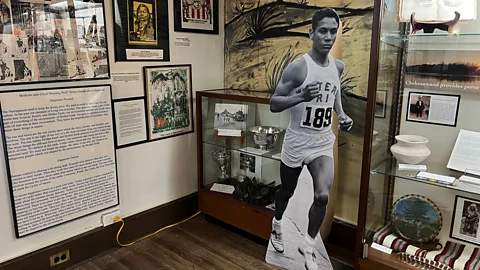
At the Tomaquag Museum in Westerly, Rhode Island, a cardboard cutout of the town's hometown hero stands nearly as tall as his real-life height of 5ft 7in (170cm). Brown's depicted in race gear with a bib marked 189 – the number he wore at the 1936 marathon. As the only museum dedicated to Indigenous history and culture in Rhode Island, the Tomaquag celebrates all of New England's Indigenous communities, but Brown and the Narragansett feature especially prominently.
As visitors enter the museum, a glass case containing one of Brown's trophies, black-and-white portraits of the runner and his laurel crown from his 1936 Boston Marathon victory are displayed. In the gift shop, visitors can purchase a copy of Michael Ward's biography, Ellison 'Tarzan' Brown: The Narragansett Indian Who Twice Won the Boston Marathon.
More like this:
Brown wasn't activist, per se, but his success helped shine a spotlight on the Narragansett community. "He brought international attention," says Sararesa Hopkins, an educator at the museum. "He brought pride and recognition to the Narragansett, even though Rhode Island didn't recognise them."
In 1975, Brown was struck by a van and killed at the age of 61. Though Brown didn't live to see the federal recognition of the Narragansett Indian Tribe reinstated in 1983, he become a beloved figure among the tribe and his celebrity helped elevate the tribe's cause to the national stage.
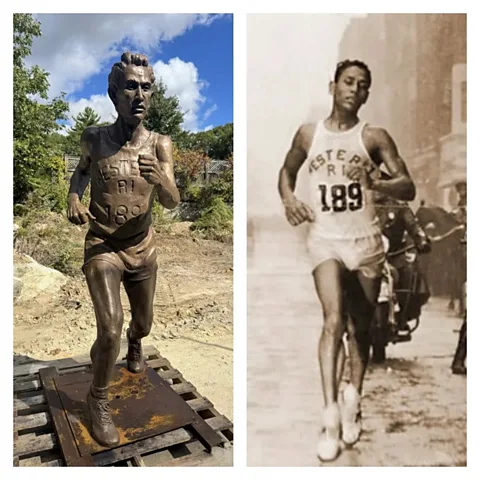 Tarzan Brown Memorial Fund
The year after his death, the first Tarzan Brown Mystic River Run was held in Mystic, Connecticut, nine miles from his hometown. The run is still held every November and celebrated its 50th year in 2025. In 2023, a 3.5-mile (5.6km) walking path in Charlestown, Rhode Island's Carter Preserve, was inaugurated as the Tarzan Brown Trail, and hikers today pass a plaque erected in his honour. And this spring, a bronze sculpture of Brown, portrayed mid-stride, will be erected in Westerly's Wilcox Park.
According to Lorén M Spears, the executive director of the Tomaquag Museum, Brown's legacy has gained momentum over time. As his grand-nephew, Brian Lightfoot Brown, wrote in a tribute: "He was a selfless and devoted man. He was a legend in his own time and an even bigger legend since his untimely death… He had a lot of pride in who and what he was."
Today, as runners begin their ascent up Heartbreak Hill at the world's oldest annual marathon, they'll be greeted with a 7ft-tall (2.1m) statue of Kelley along Commonwealth Ave. Few people in attendance may remember Brown's name, but one will: Spears. She will be there cheering on Thawn Harris, Brown's great-nephew, who will be running the marathon for the first time.
--
If you liked this story, sign up for The Essential List newsletter – a handpicked selection of features, videos and can't-miss news, delivered to your inbox twice a week.
