Close Encounters, UFOs and cover-ups: Why Spielberg's 1977 conspiracy theory classic is so relevant in 2026

 Alamy
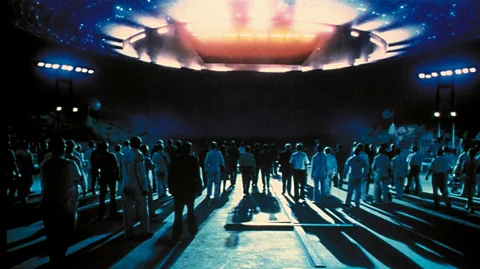
AlamySteven Spielberg's 1977 classic tapped into anxieties about the US government hiding UFO information from the public. It holds the key to the director's highly anticipated new film, Disclosure Day.
When trailers for Steven Spielberg's Disclosure Day confirmed that it deals with extraterrestrials, the internet exploded with speculation that it was a sequel to his 1977 classic, Close Encounters of the Third Kind. The guesswork became so rampant that the press notes for the new film cheekily announce it is "not a sequel to Close Encounters (sorry, internet)".
But it does have very direct ties. Emily Blunt, one of Disclosure Day's stars, has described it as resembling "a third act" along with Close Encounters and ET The Extra-Terrestrial (1982). Spielberg himself linked the films in one of the trailers, saying, "I'm even more inclined now than I was when I made Close Encounters to really believe that we're not the only intelligent civilisation in the Universe."
Some of the echoes are obvious, with friendly creatures from other planets arriving here. But there is a less obvious connection between Close Encounters and Disclosure Day, as both tap into conspiracy theories about the US government hiding evidence of UFOs – or, to use the updated term, UAPs, for Unidentified Anomalous Phenomena.
Those theories go back to the legendary supposed crash of a UFO in Roswell, New Mexico in 1947, and over the years have only intensified, making their way into the mainstream. Today they resonate in light of the Pentagon's recent underwhelming release of information about reported UAP sightings. Timelier than ever, Close Encounters is a key to Disclosure Day, which is all about revealing the truth about UAPs.
 Getty Images
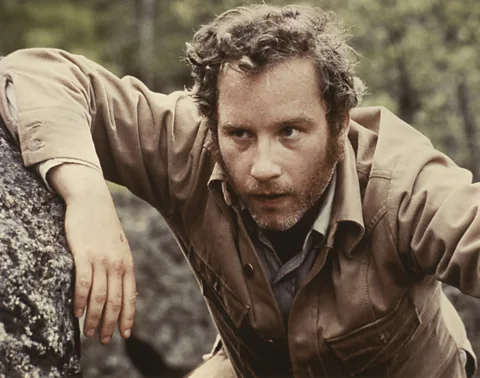
With its bold, expansive visuals, themes of family distress and the awesome visit of beings from some other planet, Close Encounters holds up as one of Spielberg's most ambitious and dazzling films. Most viewers are likely to remember at least a few indelible images. Richard Dreyfuss as Roy Neary, an ordinary family man who sees a UFO, sits at the dinner table building mashed potatoes into the shape of a giant rock.
That rock is the site where the UFO will land, although he doesn't know it yet. One might recall the arrival of the glowing mothership, the spindly large-headed ghostly-white creatures walking out, and Roy happily joining them on board as he heads off into space. The five music notes scientists use to communicate with extraterrestrials are hard to forget.
'UFOs and Watergate'
But what jumps out watching Close Encounters today is how the government tries to prevent the public from knowing what we have seen to be true. At a community meeting, Roy and Jillian (Melinda Dillon), the mother of a three-year-old who has been taken by the aliens, join others who have seen the UFOs. A US Air Force officer says what they saw was definitely not from space. And the official deceptions go far beyond that lie. Throughout, Spielberg shows the audience evidence of a cover-up still unknown to the characters.
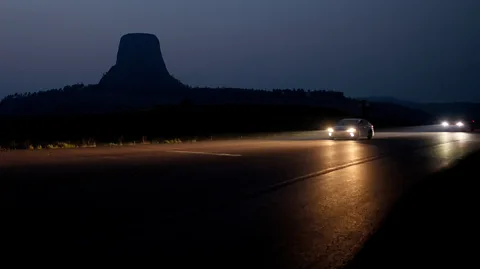
On television, the evening news reports that a train derailment has caused a chemical leak, requiring a 300-mile-(483km) wide evacuation near Devil's Tower, the monumental rock in Wyoming that is the very shape Roy was sculpting in potatoes. That report is just a cover story we've seen officials concoct. We have also seen a huge military operation heading toward Wyoming to prepare the evacuated area as a landing site for the spaceship, and equipment for the operation loaded onto trucks with signage for Baskin-Robbins ice cream and the Piggly Wiggly supermarket chain.
 Getty Images
As Roy and Jillian head to Devil's Tower together, they see dead animals on the roadside – not dead, we find out, but tranquilised by the government to make the chemical spill story plausible. Close Encounters becomes an everyman's attempt to find the truth in the face of massive government secrecy and lies.
In fact, when Spielberg first conceived the film, he described it as "UFOs and Watergate". Through many iterations of the screenplay, it morphed into a family story: Roy leaves his wife and children for space, and Jillian tries to find her lost son. Yet the conspiracy-thriller plotline remains strong. If you can't trust a grocery truck to be heading to a store instead of an alien landing, what can you trust?
Even in ET, amidst all that film's heart-tugging, Spielberg emphatically depicts the government trying to keep its knowledge of extraterrestrials from the public. Nasa scientists and government agents swarm the house where little Elliott and his family have been protecting ET, in order to take and study him. And when ET heads home, with the iconic image of Elliott and his friends riding bikes across the sky to get him to safety, they are running from US government cars.
Art imitating life
As they often do, Spielberg's fantasy films mirror aspects of real life. Jon Towlson, in his 2016 book about Close Encounters, writes that after the film's release, there was "a dramatic increase in reported UFO sightings, although these were not new cases as one might expect, but older reports made by people who had previously been afraid to come forward".
We now know that US government investigations of UFOs go back to 1947 and Roswell, and that similar studies have followed on and off ever since. Some of the subterfuge around that was brought to light in 2017, when the New York Times published a story about "The Pentagon's Mysterious UFO Program," revealing that the US Defense Department had been secretly funding studies of declared sightings. The government really had been hiding something. Whether it was evidence of UFOs or simply the fact that it had been studying the possibilities would have been enough to fuel more conspiracy theories.
 Universal Pictures
Interest has kept ramping up even while answers remain sparse. Nothing much came of Congressional hearings in 2023, which wondered whether UAPs posed a national security treat. More impressive information was revealed in a 2025 Wall Street Journal story about a report released by the Defense Department. The Journal wrote that the report omitted the fact that a disinformation program had spread rumours of UFOs, which was to disguise information Russia might have gleaned from a military facility.
None of this offered convincing evidence of UAPs or alien visitations. Neither did the report the Pentagon released last month, with many images easily explained as flashing lights. But that hasn't stopped true believers. "The stuff that they're releasing is stuff we've known for, like, forever," one of them told the BBC at the time, adding, "But I'm very hopeful that we're heading in the right direction."
More like this:
Disclosure Day lands in that real-life context, at a time of suspicions not only about the government's honesty but about truth and facts themselves. It is an action movie and a sci-fi story but above all a conspiracy thriller in the vein of post-Watergate films from the Close Encounters era.
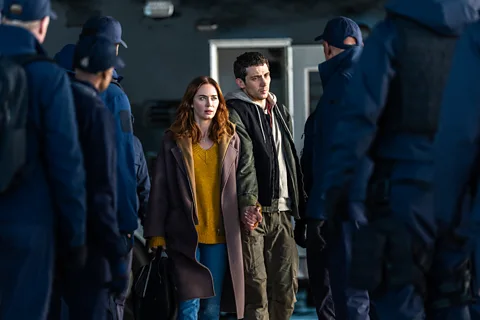
Josh O'Connor's character, Daniel, is a whistleblower employed by the fictional but all too plausible Wardex, a clandestine agency working with the Defense Department, unofficial so it doesn't have to play by any rules. As the trailers have revealed, the government has been guarding decades' worth of evidence of extraterrestrial visitations. Daniel, the hero trying to release the truth, has to go on the run followed by Wardex killers intent on stopping him.
The echoes of 1970s thrillers are clear. In Three Days of the Condor (1975), for example, Robert Redford is a CIA researcher hunted by gunmen because of what he knows. "I just read books," he complains to his CIA bosses, just as Daniel protests, "I'm not a field guy, Hugo. I did the tech, that's all." Hugo (Colman Domingo) is another Wardex whistleblower who has what may be the film's most pertinent line, delivered vehemently: "This 79-year terror campaign of obfuscation, lies and cover-up has to end!"
Spielberg has emphasised as much in a teaser for the film. He says there is now a "critical mass" of people fascinated with the question of whether we are alone in the Universe. "And if someone knows we're not alone, why haven't we been told?"
Disclosure Day is released on 12 June.
--
If you liked this story, sign up for The Essential List newsletter– a handpicked selection of features, videos and can't-miss news, delivered to your inbox twice a week.
