Record number of stewards at Notting Hill Carnival

 BBC
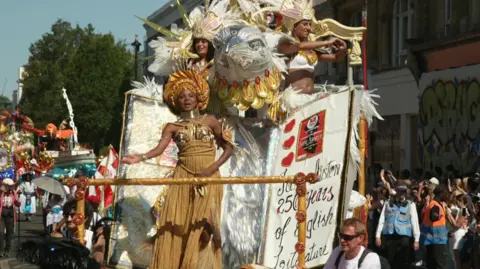
BBCMore than 3,000 stewards will be on duty during this year's Notting Hill Carnival, double the usual number.
Organisers say they are using an extra £4.6m grant from City Hall to bring in increased safety and crowd control measures for the event - the 60th anniversary of the street parade.
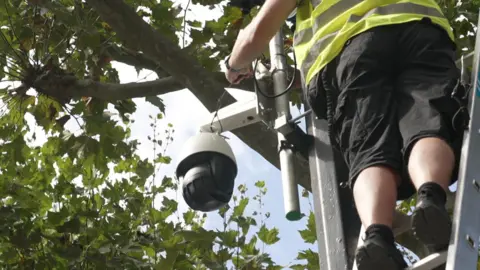
As well as the extra stewarding, there will be more use of specially installed CCTV cameras along the route, more giant signs to alert carnival-goers to possible hold-ups, and a bigger control room to help run the event.
The Metropolitan Police is also expected to use more live facial recognition technology at this year's carnival after deploying two teams last year.
'Big step change'
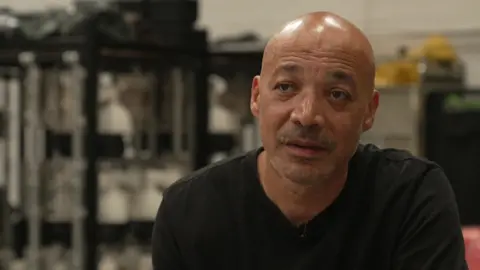
"This is a massive step-change for Carnival," its chief executive Matthew Phillip tells me.
We are sitting in a warehouse on an industrial estate in west London, as crews behind him busily ferry CCTV cameras out on to the route.
"We have taken full control but we are fully supported by the Metropolitan Police Service as well. I think it's important that the public also know that the Met are not walking away, this is a transitional period that we're going to go through."
For years the Met had urged Carnival organisers to focus on crowd safety, even warning of "Hillsborough"-style crushes.
With the extra money awarded by City Hall in March, Phillip believes they have never been better placed to do so.
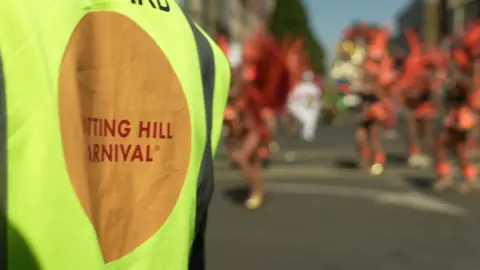
In recent years, Carnival has employed about 1,750 stewards along the route, but that number will double to around 3,500 this year.
"This year we've vastly expanded not just the crowd management team but also the stewarding, which means the crowd management team have a resource to use to do their job. We're not having to rely on support from police to do that all of the time," said Phillip.
The extra stewards will be used to help specialist crowd managers who are located along the route.
"It was all well and good having crowd managers who could spot things and identify things but they didn't have a physical resource to be able to deploy to take action to avert anything, so this year's are very much in a different position where they do have the physical resource also backed up by a lot of technology."
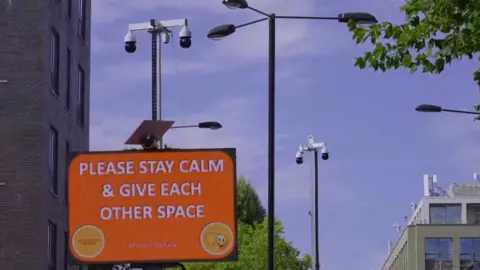
That technology involves increased use of temporary CCTV cameras along the carnival route. Last year there were 20 fixed to buildings and lampposts; this year there will be closer to 90, all linked up to the central control room.
Last year there were also 14 "hiker" signs along the route - linked directly to the control room, which was able to flash messages up warning revellers of delays.
There will be 40 of the signs this year positioned at key points across the west London parade.
"I always use the example if you're stuck on the Tube in the middle of a tunnel," says Phillip.
"It can be quite agitating you don't know what's happening, but if there's messaging and you're being told, 'Look, we're held here, it's going to be five minutes, and then you're going to be on your way,' it just calms people down."
Psychology experts are also being used to help predict crowd movements.
It seems a long way from last year's Carnival preparations, when organisers sent a letter to the Culture Secretary Lisa Nandy calling for "urgent government funding essential to safeguarding the future and public safety of this iconic event".
It came after months of senior police officers in London expressing their concerns about overcrowding at Carnival.
In the end City Hall came up with an emergency £1m in funding for extra security and safety measures. This year Mayor Sir Sadiq Khan pledged another £4.6m in March, allowing organisers more time to plan.
"We've had the time and that's a luxury, really, that we as an organisation haven't had, certainly since I've been in this role. So it's really nice to be able to have plans in place," says Phillip.
"I think everything's kind of locked in place now, which is kind of unusual. This is a very calm time for us. Although it's a big step-change for us, and we've got a lot more things we're implementing, but there's more people doing it.
And to the critics who say the mayor shouldn't be funding Carnival?
"It's an investment, you know, it's an investment in what Carnival gives back to the London economy; I think it's very much justified. That being said, we do want to stand on our own two feet," Phillip added.
Listen to the best of BBC Radio London on Sounds and follow BBC London on Facebook, X and Instagram. Send your story ideas to hello.bbclondon@bbc.co.uk
