Long waits in A&E linked to increased deaths

 PA Media
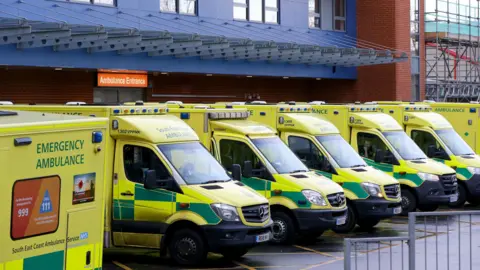
A Kent hospital has recorded more than 1,000 occasions in a single month when patients waited in A&E for more than 12 hours - which hospital managers have linked to increased deaths.
There were 1,315 12-hour A&E waits at Medway Maritime Hospital in Gillingham in May 2026, a 5% rise from April and the highest number of 12-hour waits since January.
Hospital managers have linked increased deaths to A&E delays, frailty care and prolonged waits in emergency care.
Siobhan Callanan, the trust's interim chief executive, said: "We remain focused on reducing long waits and delivering the standard of care our patients deserve."
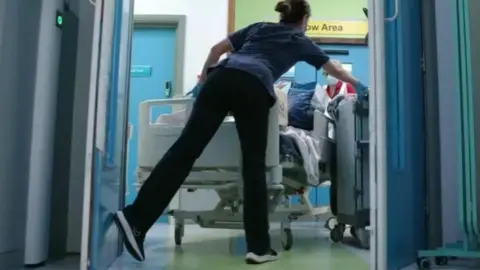
At a recent hospital trust board meeting senior staff were told escalation areas, such as corridors, continued to affect patient privacy, dignity, experience and staff wellbeing.
In May there were 963 occasions when a patient spent more than 45 minutes in an emergency department corridor, compared with 929 in April.
In a recent report the Royal College of Emergency Medicine (RCEM) said the estimated number of deaths linked to long waits in emergency departments across England had surged almost tenfold over the past decade.
Dr Ian Higginson, president of the RCEM, said the number of deaths linked to long stays in A&E were "shocking" and "explicitly show the system is failing the patients it is meant to be caring for".
 Getty Images
The hospital board meeting highlighted that deaths at the trust were around 30% higher than would be expected for patients with similar conditions treated elsewhere in the NHS.
The Summary Hospital-level Mortality Indicator (SHMI) is used to measure how many patients actually died against how many patients would be expected to die, given their age, illnesses, complexity and other risk factors.
While Medway's mortality indicator is higher than expected, it alone does not prove poor care.
However, the figure would be used to identify trusts that may require further investigation.
'Significant efforts'
Callanan apologised for delays and said the trust was working with out-of-hospital partners to get patients home sooner and to end corridor care, which she said was "not the standard of care we want for our patients".
She added: "Thanks to significant efforts by staff, more people are having their planned operations, cancer treatment, and tests and scans within national waiting time standards.
"Our expanding Virtual Hospital is providing round-the-clock hospital care for up to 150 patients at home, supported by remote monitoring technology, helping free up hospital beds for those who need them most."
Follow BBC Kent on Facebook, X, and on Instagram and listen to BBC Radio Kent on Sounds. Send your story ideas to southeasttoday@bbc.co.uk or WhatsApp us on 08081 002250.
