What we know about the Israel-Lebanon ceasefire

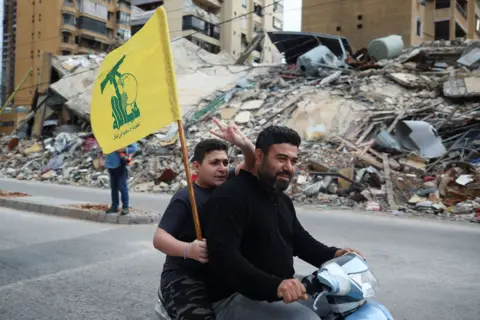 Adnan Abidi / Reuters
US President Donald Trump announced on 16 April that the leaders of Israel and Lebanon have agreed to a 10-day ceasefire, which took effect on the same day.
Trump urged Hezbollah, the Iran-backed militant group in Lebanon which has been exchanging fire with Israel for the past six weeks, to abide by the ceasefire, saying he hoped it "acts nicely and well during this important period of time".
On Thursday, he announced the truce would be extended by three weeks after fresh talks between the countries' envoys in Washington.
Here is what we know about the ceasefire.
What does the agreement say?
The terms of the initial deal specified that the ceasefire would last for 10 days, with the possibility of it being "extended by mutual agreement" if negotiations showed signs of progress.
According to further details provided by the US State Department:
- Israel retains its "right to take all necessary measures in self-defence, at any time, against planned, imminent, or ongoing attacks"
- Lebanon must take "meaningful steps" to prevent Hezbollah and all other "rogue non-state armed groups" from carrying out attacks against Israeli targets
- Those involved recognise that Lebanon's security forces have exclusive responsibility for Lebanon's security
- Israel and Lebanon requested that the US continues to facilitate further direct talks with the objective of "resolving all remaining issues"
The statement added that the truce was a "gesture of goodwill" by Israel intended to enable "good-faith negotiations towards a permanent security and peace agreement" between the two parties.
What has the reaction been?
Israel and Lebanon's leaders have both welcomed the truce, with Israeli Prime Minister Benjamin Netanyahu calling it an "opportunity to make a historic peace agreement".
Lebanese President Joseph Aoun said: "We all stand before a new phase: the transition from working towards a ceasefire to working towards permanent agreements that preserve the rights of our people, the unity of our land, and the sovereignty of our nation."
Hezbollah also signalled a willingness to participate in the ceasefire but said it must include "a comprehensive halt to attacks" across Lebanon and "no freedom of movement for Israeli forces".
When asked about disarmament, senior Hezbollah leader Wafiq Safa told the BBC: "Not until a proper ceasefire, a real one. Not until Israeli withdrawal."
The Iran-backed group, while deeply embedded in Lebanon, is not part of the Lebanese government's security apparatus.
UN Secretary General António Guterres commended the role of the US in facilitating the deal and urged all parties to "fully respect" and "comply with international law at all times".
European Commission chief, Ursula von der Leyen, called the deal a "relief", saying Europe would continue to "call for the full respect of Lebanon's sovereignty and territorial integrity".
Why is Israel occupying southern Lebanon?
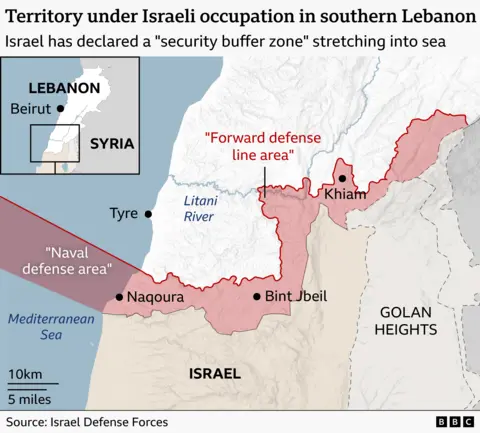
Despite the agreement, Benjamin Netanyahu said Israeli troops would remain stationed 10km-deep (6.2 miles) into southern Lebanon.
UN figures show that across Lebanon, more than 1.2 million people have been displaced, the majority of these from the south.
Israel re-entered southern Lebanon after strikes by Hezbollah in early March, describing the area it is occupying as a "security zone".
"We are there, and we are not leaving," Netanyahu said this week.
Israel's defence minister previously said the occupied area would go up to the Litani River in southern Lebanon - about 30km from the border with Israel.
He also said all houses in Lebanese villages near the Israeli border would be demolished.
In the weeks since the war began, research by BBC Verify has found that more than 1,400 buildings have been destroyed by Israel in southern Lebanon.
Lebanon's defence minister said Katz's remarks reflected "a clear intention to impose a new occupation of Lebanese territory". European nations, Canada and the UN have also criticised Israel's announcement.
A previous ceasefire deal between Israel and Hezbollah - ending 13 months of conflict - still saw near-daily cross-border strikes.
Both Hezbollah and Israel have accused each other of violating the current ceasefire agreement.
On Thursday evening, as talks in Washington were set to get under way, Hezbollah said it had fired rockets at northern Israel in response to an Israeli violation. The Israel Defense Forces (IDF) said it had intercepted the launches.
On Wednesday, Lebanon accused Israel of war crimes after Israeli air strikes killed one journalist and wounded another in southern Lebanon. The IDF denied that it deliberately targeted journalists.
How was the ceasefire negotiated?
Israel and Lebanon held rare direct talks in Washington last week aimed at easing the war, which has seen deadly air strikes on part of the Lebanese capital of Beirut and fighting in the country's south.
Trump said the ceasefire came about after "excellent conversations" with Aoun and Netanyahu, but did not mention whether Hezbollah was directly involved in the talks.
The Israeli leader, while welcoming the truce, also made clear that he was making few concessions on the ground.
Netanyahu said Hezbollah had insisted on two conditions - the withdrawal of Israeli forces from Lebanon, and a principle of "quiet for quiet".
However, it appears the ceasefire announcement took senior figures in Israel by surprise - reportedly even within the government's own security cabinet.
A widely respected Israeli news outlet described Netanyahu convening a security cabinet meeting with just five minutes notice, shortly before the ceasefire announcement was made.
Leaks from that meeting say ministers were not given a vote on the ceasefire.
The truce, which had been set to expire on Sunday, was extended after fresh talks this week.
Announcing the extension on Truth Social on Thursday, Trump said the meeting between envoys "went very well", adding that the US would be working with Lebanon "to help it protect itself from Hezbollah".
Speaking from the Oval Office, Trump said both Aoun and Netanyahu would visit the White House "in the coming weeks".
"We are going to be working with Lebanon to get things straightened out in that country," he said.
"I think it will be a wonderful thing to get this worked out simultaneously with what we are doing in Iran."
Lebanese Ambassador Nada Hamadeh Moawad and Israeli Ambassador Yechiel Leiter also praised Trump for his role in the talks.
Leiter said Israel and Lebanon were united in their aim to rid Lebanon of "this malign influence called Hezbollah".
What does this have to do with the war in Iran?
Israel launched strikes on Lebanon on 2 March in response to those by Hezbollah. This was after the US and Israel attacked Iran – prompting retaliation from Tehran against US allies in the Gulf, and from Iran's proxies, including Hezbollah.
Iran's response included effectively blocking the Strait of Hormuz, through which about 20% of the world's oil and liquefied natural gas (LNG) usually passes. This sent global fuel prices soaring.
When a ceasefire with Iran was announced earlier this month, it was unclear whether Lebanon was involved. Pakistani officials, who helped negotiate the deal, and Iranian officials said it was, but Israel and the US said it was not.
On 17 April, Iran's Foreign Minister Abbas Araghchi announced on X: "In line with the ceasefire in Lebanon, the passage for all commercial vessels through [the] Strait of Hormuz is declared completely open for the remaining period of ceasefire."
But shortly after, Trump said the US naval blockade of Iranian ports would remain in place until a deal is reached. Iran has since said the strait is closed again.
Regarding the negotiation of a peace deal with Iran, Trump told reporters on Thursday that he did not want to "rush" and was under no pressure to end the conflict.
An anticipated second round of Pakistan-brokered talks this week did not happen, although Trump announced an extension to the US-Iran ceasefire.
At least 2,294 people have been killed in Israeli attacks in Lebanon since the latest war began, according to the Lebanese health ministry, whose figures do not differentiate between civilians and combatants. The death toll includes 274 women and 177 children.
Hezbollah attacks have killed two civilians in Israel over the same period, while 15 Israeli soldiers have been killed in combat in Lebanon, Israeli authorities say.
Last week, the Israeli military destroyed the last bridge linking the south to the rest of the country, further isolating the region and renewing fears among many Lebanese that this could lead to a long-term occupation of some areas.
