Clashes continue in Lebanon despite Israel and Hezbollah accepting US partial ceasefire plan

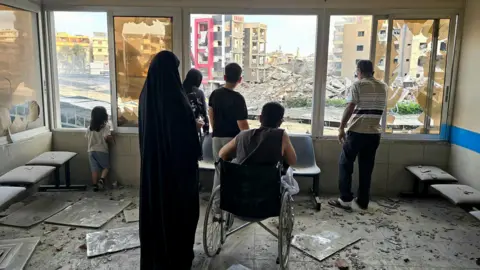 Kawnat Haju / AFP via Getty Images
Clashes have continued in southern Lebanon despite Israel and Hezbollah accepting a US plan for a partial ceasefire.
President Donald Trump said on Monday that he had spoken to both sides and "they agreed that all shooting will stop", after Iran warned Israeli military actions in Lebanon were a threat to the US-Iran ceasefire.
Lebanon said Hezbollah had accepted the plan for it to halt attacks on Israel and for Israel not to attack the Lebanese capital Beirut.
Israeli Prime Minister Benjamin Netanyahu confirmed the agreement. But he said strikes on Beirut would go ahead "if Hezbollah does not stop attacking our cities and civilians", and that Israeli forces would still operate in south Lebanon.
While the ceasefire appears to be largely holding, there was further violence overnight.
Hezbollah said its fighters had targeted Israeli tanks in the southern Lebanese towns of Haddatha and Bayada with missiles and shells.
The Israeli military said it had intercepted two projectiles that had been fired from Lebanon in the early hours of Tuesday. No injuries have been reported.
Lebanon's state-run National News Agency reported Israeli strikes on several southern areas and said a "very violent" explosion from a large-scale demolition rocked the town of Debbine.
On Monday morning, the Israeli prime minister said he had ordered strikes on "terror targets" in Beirut's southern suburbs in response to rocket and drone attacks by the Iran-backed Hezbollah.
That prompted a slew of warnings from Iranian officials, with Foreign Minister Abbas Araghchi saying the US-Iran truce was "unequivocally a ceasefire on all fronts, including in Lebanon" and that "its violation on one front is a violation of the ceasefire on all fronts".
Separately, Iran's Tasnim news agency reported that Tehran could suspend indirect negotiations with the US over Israeli military actions in Lebanon.
The news agency - which is affiliated with Iran's powerful Islamic Revolutionary Guard Corps (IRGC) - also said Iran and its allies could "activate other fronts, including the Bab al-Mandab Strait" at the entrance of the Red Sea.
But in later posts on Truth Social, Trump insisted that talks with Iran were continuing at a "rapid pace" and said he had spoken to both Netanyahu and representatives from Hezbollah.
"I had a very productive call with Prime Minister Bibi Netanyahu, of Israel, and there will be no Troops going to Beirut, and any Troops that are on their way, have already been turned back," the US president wrote.
"Likewise, through highly placed Representatives, I had a very good call with Hezbollah, and they agreed that all shooting will stop - That Israel will not attack them, and they will not attack Israel."
Lebanon was drawn into the war between the US, Israel and Iran on 2 March, when Hezbollah launched rockets into Israel in retaliation for an Israeli strike that killed Iran's supreme leader.
Israel responded with an air campaign across Lebanon and a ground invasion in the south, which has been escalating in recent weeks, even as strikes on Beirut have become far less frequent.
At least 3,433 people have been killed in Lebanon since the start of the war, according to the country's health ministry. Its figures do not distinguish between combatants and civilians.
Israel says 25 of its soldiers and four Israeli civilians have been killed over the same period on both sides of the border.
The US has tried to separate events in Lebanon from the negotiations with Iran, which has long provided Hezbollah with significant ideological, military and financial backing and insists that any agreement must include peace in Lebanon.
On Sunday, a US official said that Secretary of State Marco Rubio had proposed a plan for "gradual de-escalation" there to Netanyahu and Lebanese President Joseph Aoun.
The Israeli military has struck Beirut twice since the ceasefire between Israel and Lebanon came into force on 16 April, most recently on Thursday. But that is a significant reduction on what went before, with reports that the White House was pressuring Israel to limit its military action in Beirut as part of efforts to reach a broader deal to end the war with Iran.
A truce between the US and Iran came into force on 8 April - but it has failed to end the fighting.
Tensions between Iran and the US escalated in the Strait of Hormuz over the weekend. The US has said it hit Iranian military sites over the weekend, while Tehran said it responded by targeting a US base in Kuwait.
The price of oil rose again on Monday following the exchange of strikes. Brent crude, the global benchmark for oil prices, jumped almost $5 (£3.70) a barrel to $97.44 before falling slightly to $95.70.
Prices of the commodity have been volatile since Israel and the US launched strikes against Iran on 28 February, with potential peace deals and further escalations impacting the market.
The three-month-long war has effectively closed the Strait of Hormuz waterway, pushing up global energy costs.
Around a fifth of the world's oil and liquefied natural gas (LNG) supplies usually pass through the strait.
Trump has repeatedly suggested in recent days that Washington and Tehran are close to a permanent deal and that negotiations are progressing, but so far no formal agreement has been reached.
Additional reporting by Michael Race
