Why and how is US blockading Iranian ports in Strait of Hormuz?

 Getty Images
Oil prices have risen to their highest since 2022, following reports that US President Donald Trump is to be briefed by his military on plans for further strikes on Iran.
Brent crude's rise to more than $126 (£94) a barrel, before falling back, continues an upward trend in energy prices as peace talks between the US and Iran appeared to have stalled.
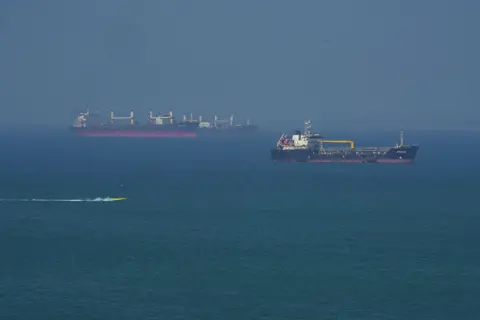
The stalemate means that the Strait of Hormuz, a critical waterway off Iran's coast that Tehran effectively blocked in response to US-Israeli strikes, remains closed.
Earlier in April, US forces announced they would intercept or turn back vessels travelling to or from Iran's coast.
The US wants to restrict Tehran's ability to profit from oil exports in an attempt to put pressure on the country.
What could the US military's plans involve?
The news site Axios reported that US Central Command (Centcom) had prepared a plan for a wave of "short and powerful" strikes on Iran to try to break the deadlock in negotiations, or deliver a final blow before ending the war.
Quoting anonymous sources, Axios said the proposed wave of strikes would be likely to include infrastructure targets.
Another plan focused on taking over part of the Strait of Hormuz so that it could be reopened for commercial shipping, Axios reported, adding that doing so could involve troops on the ground.
On Thursday, a statement attributed to Iranian Supreme Leader Mojtaba Khamenei said that if the US resumed attacks Tehran would respond with "long and painful strikes".
It added that Tehran would secure the Strait of Hormuz and eliminate "the enemy's abuses of the waterway".
Why did Trump decide to blockade Iranian ports?
Trump had hoped to put pressure on Iran by targeting two economic drivers - the huge tolls it was demanding ships pay to pass through the Strait of Hormuz, and its oil revenue.
The US president told Fox News that "we're not going to let Iran make money on selling oil to people that they like and not people that they don't like". He said the goal was letting "all or nothing" pass through the channel.
Iran has responded by calling the blockade "piracy", threatening to retaliate by targeting ports in the Gulf states.
While the ceasefire has survived, fighting has been replaced by a "war of blockades", says BBC diplomatic correspondent Paul Adams, with both sides using force to intercept and seize commercial vessels.
What is a naval blockade?
The US Navy Commander's handbook on naval operations law from 2022 defines a blockade as a "belligerent operation to prevent vessels and/or aircraft of all states, enemy and neutral, from entering or exiting specified ports, airfields, or coastal areas belonging to, occupied by, or under the control of an enemy state".
The UN's maritime agency, the International Maritime Organisation, has said no country has a legal right to block shipping in straits used for international transit.
"I do understand there is a conflict going on there, but there is still no legal basis in international law to take any actions to block any strait used for international navigation," Secretary-General Arsenio Dominguez told the BBC.
Donald Rothwell, professor of international law at the Australian National University, said international law would see the US, Israel and Iran as 'belligerents' as opposed to 'neutrals'.
"This means the US, as a belligerent, can legitimately impose a blockade under international law – specifically, the law of naval warfare," he wrote.
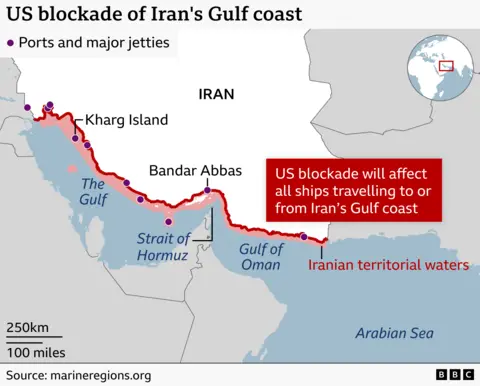
Where is the blockade?
The exact locations of US Navy ships on deployment are not known publicly. That makes it hard to know exactly where the US is intercepting vessels.
However, it is unlikely the US military is positioning its warships close to Iran's coast due to the risk of missile and drone attacks.
Instead the focus of the blockade is likely to be around the Gulf of Oman, a key transit point for much of the world's oil, including Iranian exports.
US forces are likely to be using satellite and commercial intelligence to monitor which ships are leaving Iranian ports, and waiting for them to sail into the open Indian Ocean before intercepting them.
Centcom has said more than 12 warships and more than 100 fighter and surveillance aircraft are involved.
Satellite imagery from 11 April analysed by BBC Verify shows the USS Abraham Lincoln aircraft carrier positioned at the eastern edge of the Gulf of Oman, roughly 200km (124 miles) to the south of the Iranian coast.
This was the closest to the Gulf that BBC Verify had observed the nuclear-powered warship since the start of the war.
Two other nearby warships visible in the imagery are consistent in size and shape with US Navy guided-missile destroyers.
They are likely to be part of the Lincoln's carrier strike group, but BBC Verify can't identify exactly which vessels are visible.
How is the blockade being enforced?
On 29 April, Centcom said it had intercepted 42 commercial vessels attempting to violate its blockade, adding that there were "41 tankers with 69 million barrels of oil that the Iranian regime can't sell".
Earlier in the month, the US attacked and seized an Iranian-flagged cargo ship trying to get past.
The ship, called the Touska, was intercepted in the Gulf of Oman.
Centcom said it had approached the Touska by helicopter, adding marines then rappelled - or descended by rope - onto the ship.
Centcom had previously said it would permit passage of humanitarian shipments including food, medical supplies and other essential goods, subject to inspection.
Trump said that the US would begin destroying mines he accuses Iran of having laid in the strait.
The US president added that "at some point" an agreement on free passage would be reached.
How will Iran and other countries be affected by the blockade?
After the US announced that the leaders of Israel and Lebanon had agreed to a 10-day ceasefire, Iran's foreign minister said that the Strait of Hormuz would be opened.
Shortly after, Trump said the US naval blockade of Iranian ports would remain in place until a deal is reached. Iran has since said the strait is closed again.
Iran had continued to export its own oil until the blockade - and in doing so, cashing in on the high prices. March was the fifth biggest month for oil exports from Iran over the past year-and-a-half.
The blockade could also have major consequences for Iran's oil customers.
In 2022, around 82% of crude oil and other fossil fuels leaving the Strait of Hormuz were bound for Asian countries, according to the US Energy Information Administration (EIA).
China alone is estimated to buy around 90% of the oil that Iran exports. Earlier in April, its foreign ministry called the US blockade "dangerous" and "irresponsible".
Analysts say the blockade may be designed to force Beijing to become more active in peace talks.
A prolonged blockade could further damage the global economy, pushing up petrol and food prices, as well as limiting access to critical materials like aluminium, helium and feedstocks for fertilisers.
The International Monetary Fund (IMF) warned earlier in April that the global economy was at risk of recession if the war continued and high energy prices persisted.
The Fund also said the war's energy shock would hit the UK the hardest of the world's advanced economies.
Civilians in Iran could also be impacted, with the country reliant on grain and wheat imports, creating potential food security issues.
How many ships usually use the Strait of Hormuz?
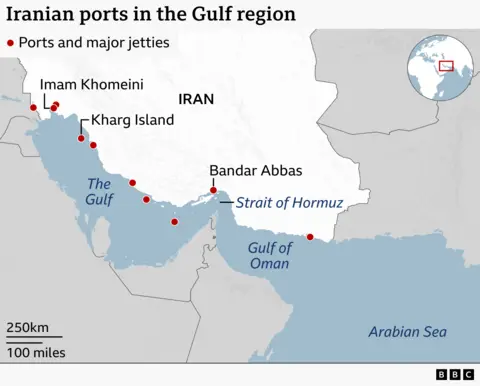
The strait's geography has allowed Iran to use it as leverage throughout this war, using threats to selectively prevent vessels from passing through the narrow waterway.
About 3,000 ships usually sail through the strait each month but this dramatically decreased to just a handful a day during recent hostilities.
The strait is also a vital channel for imports to the Middle East, including food, medicines and technological supplies.
The disruption has created a fuel crisis in Asia, a region heavily reliant on Middle Eastern oil.
Governments have ordered employees to work from home, cut the working week, declared national holidays and closed universities early in order to conserve their supplies.
Are the UK and other countries taking part in the blockade?
Prime Minister Sir Keir Starmer has said UK forces will not be involved in enforcing the blockade but could help open the strait when the blockade ends.
UK minesweepers and anti-drone capabilities will continue operating in the region but British naval ships and soldiers will not be used to block Iranian ports.
Trump has said that other countries would be involved in blockading the strait, but did not say which ones.
According to a State Department cable seen by Reuters, the US has invited partner countries to join a new coalition called Maritime Freedom Construct to enable ships to navigate the strait once the conflict is over.
Additional reporting by Barbara Metzler, Frank Gardner, Dearbail Jordan, Joshua Cheetham and Shruti Menon

Follow the twists and turns of Trump's second term with North America correspondent Anthony Zurcher's weekly US Politics Unspun newsletter. Readers in the UK can sign up here. Those outside the UK can sign up here.
