Noah most likely climbed into culvert through steel bars, inquest hears

 Pacemaker
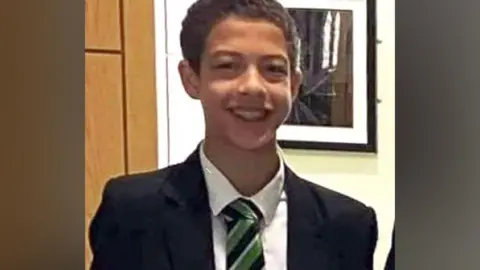
Noah Donohoe most likely climbed into a culvert through steel bars, an inquest has been told.
The 14-year-old was last seen in a residential area of North Belfast in June 2020, and his body was found in an underground water tunnel six days later.
Professor Carolyn Roberts compiled a report for the inquest on hydrological conditions along the tunnel and she told the hearing on Tuesday that she believes Noah entered the system at the culvert inlet.
She said vertical protection bars at the inlet were sufficiently spaced apart to allow an adult to climb through.
The witness said there was a possibility that Noah could have climbed through an unlocked hatch but that was unlikely because it was "very heavy".
Roberts also said it was "very unlikely" that the teenage boy could have entered the drainage system through a manhole.
The witness described the possibility of Noah gaining entry at the lower end of the system closer to where his body was found saying it was "almost impossible".
She said the width of the pipe immediately beyond the culvert entrance was about one metre and Noah could have passed through it by crouching of crawling.
Roberts said the inside of the pipe is quite dark with "glimmers of light" from overhead manhole positions.
She said there was no significant "slime" in that part of the pipe, and the concrete was "relatively smooth".
"I didn't see any trip hazard," she said.
'Shockwave of water'
Commenting on conditions in the downstream tidal part of the pipeline, close to where Noah's body was found beyond the Shore Road, the witness said a high tide in that area would cause "a shockwave of water" to pass through the system.
In her report for the inquest, Roberts found the most likely time for the first high tide in the period after Noah entered the culvert was between 23:30 BST and midnight on 21 June 2020, the day of his disappearance.
Roberts told the inquest previously that it was "very likely" the 14-year-old drowned at this time and location.
The witness said people tend to "succumb relatively quickly" in such an environment as, based on her experience, the cold temperature can contribute to them becoming disorientated.
The witness agreed on Tuesday that there was a possibility that Noah could have died after the midnight high tide.
"It could have been a later tidal cycle," she said.
Asked by a barrister for Noah's mother, Fiona, if she would defer to the evidence of pathology witnesses who told the inquest that there was a possibility that Noah's death could have occurred up to three days after his disappearance, Roberts replied: "Yes."
A barrister for the Police Service of Northern Ireland (PSNI) told the inquest that there is no evidence of Noah being seen above ground from shortly after 18:00 on the day he disappeared, and that the pathology experts found that there was "a window" in which he could have been alive for a number of days.
The lawyer said it cannot be said "on the balance of probabilities" that the young boy was still alive for the duration of that window.
'One of the most tragic I have worked on'
Dr Majorie Turner, who conducted a post-mortem examination on Noah's body, found that his death could have taken place within hours of his disappearance.
Roberts said if Noah was in the culvert for around 24 hours he'd have to sit down in cold water and that situation couldn't be sustained for too long before he would become "very cold".
She said people in these situations find them "terrifying" and they "don't tend to act rationally".
Roberts also explained that she conducted her report in response to instructions from the coroner's court based on the premise that Noah "is believed to have entered the storm drain".
At the conclusion of her evidence, Roberts told the jury and the coroner, Mr Justice Rooney, that the case was "one of the most tragic I have worked on".
The body of the St Malachy's College student was found in the underground tunnel at a location past the Seaview football ground and alongside a Northern Ireland Railway (NIR) maintenance depot, beside the M2.
The location is more than 600 metres downstream from the culvert entrance.
Prior to his disappearance, Noah had discarded or become parted from his phone and rucksack and all the clothing he was wearing, as well as his runners.
He later abandoned his bicycle on a pavement at Northwood Road in north Belfast and was seen naked and going between houses close to the culvert entrance which is on ground adjoining private back gardens.
