More than 3,000 homes planned as part of £1.3bn harbour upgrade

 Belfast Harbour
Belfast Harbour has unveiled plans to invest £1.3bn in upgrading its port facilities over the next 25 years.
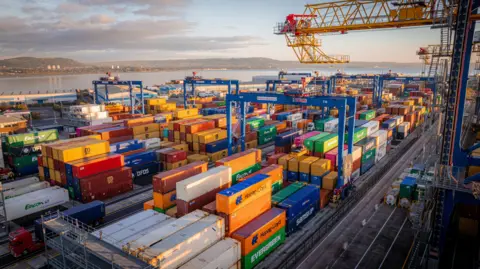
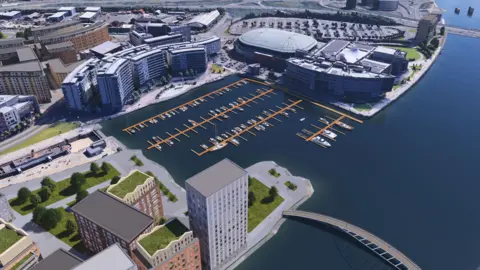
The projects include additional housing and urban regeneration, a land reclamation project, placing a freight terminal on what is currently part of Belfast Lough, and the redevelopment of its marina in Titanic Quarter.
Belfast Harbour says these upgrades are essential to allow it to handle expected increases to trade flows in the coming years.
Chief executive Joe O'Neill said the investment underlines the harbour's role in the wider economy.
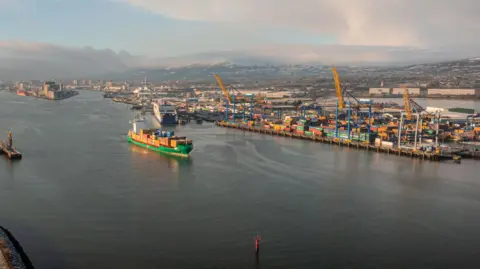
Currently handling 24 million tonnes per year, high growth scenarios could see that more than double to 50 million by 2050.
"We're envisaging we'll spend £1.3bn to provide port capacity for that trade growth. There are very few non-public organisations forecasting that level of investment," said O'Neill
 Belfast Harbour
He said he hopes that Belfast will have the "most modern port capacity of any port" on the island of Ireland by 2050.
"We'll have a vibrant harbour estate with upwards of another 3,500 homes here, a new community connected into the city centre in a very safe and sustainable manner," he added.
What does Belfast Harbour want to build?
That £1.3bn is split across more than 10 projects in the coming decades – from residential housing to new port facilities.
The harbour is already working on a £90m upgrade to its cruise ship port, a development that will also clear additional space for its role supporting the offshore wind industry.
It also plans to expand an existing freight terminal further into Belfast Lough, reclaiming land that's currently underwater for the first time in 25 years.
Further along the plan's timeline, there is an intention to open a maritime skills academy, helping train people for the kind of specialised jobs which will become available as the harbour expands.
 Belfast Harbour
One eye-catching element of the proposals is the upgrade to Belfast's marina next to the Odyssey.
Asked if the expansion could see more super-yachts pulling into Belfast, O'Neill was optimistic.
"Phase one caters for around 65 vessels, by the end of this plan we should have a marina that can accommodate up to 175 vessels," he said.
Although the investment's focus is the port facilities, the harbour estate will also increasingly play host to residential and office buildings.
Infrastructure Minister Liz Kimmins expressed full support for the plan which she said could "significantly increase Belfast Harbour's contribution to our economy and regional connectivity".
'Total spend could reach £2bn'
About1,100 homes have been built in recent years at City Quays 4 and in the recently completed Loft Lines development, with more than 600 additional apartments, along with a lido, to be built through development at Clarendon Wharf.
The masterplan also includes plans for additional building at City Quays.
Regeneration projects on land further from the water, and no longer essential for port operations, will see a further 1,900 properties built across Sailortown and the Titanic Quarter.
Once predicted spend by private developers is factored in, the total spend contained in the masterplan could reach £2bn.
The announcement was welcomed by Terry McKeown of the Sailortown Regeneration Group.
He said the group's long-term aim is to "re-create a vibrant inner-city urban village" in Belfast Docks.
"This master plan offers an opportunity to deliver high-quality, mixed-tenure housing for local communities and we look forward to collaborating on placemaking."
Analysis: What could this investment mean for NI?
It's hard to overstate Belfast Harbour's significance to the local economy.
Research from Ulster University has found that the harbour handles £26.7bn of cargo each year, enabling roughly £9bn in trade activity – that's 15% of Northern Ireland's total economic output sustaining an estimated 150,000 jobs.
Work by Grant Thornton and Ulster University found that this investment could help increase economic output to £12bn annually and support almost 5,500 construction jobs.
Belfast Harbour says this growing economic activity is part of the reason it needs to commit to upgrades.
 Belfast Harbour
Where will the money come from?
It's a good question, but the answer isn't totally clear.
The harbour is self-funded and reinvests all post-tax profits into its facilities.
The first phase of the masterplan, costing around £313m, is already funded, but if the Harbour wants to spend another billion pounds within the plan's timeframe it will need Stormont to pass a new law in a hurry.
Legislative reclassification of Belfast Harbour's accounting status admittedly sounds pretty dull, but it's a technical change to the port's accounting practices which would enable it to borrow money for investment in the way other big businesses can.
All parties at Stormont support the change and the law is currently being drafted – but it isn't clear whether there's enough time left in the current mandate for it to pass into law.
Dr Theresa Donaldson, Chair of Belfast Harbour Commissioners, said a delay would mean some upgrades will have to wait.
"Without this change, we can still deliver, but we will face harder choices regarding the pace and scope of our work.
"With it, we can go further and prepare for the scale of growth that both the economy and our customers require," she said.
