Commission to hold final round of meetings on Drumcree parade

 Pacemaker
The Parades Commission is to hold a final round of meetings on Wednesday before coming to a decision on the Drumcree dispute.
The five-person commission must decide whether to allow the Orange Order to march from Drumcree church in Portadown along the mainly nationalist Garvaghy Road on Sunday.
It is one of the most contentious parade routes in Northern Ireland.
A decision on whether or not to re-route the planned march may not be announced until Friday.
On Wednesday, the commission is due to have separate talks with the Orange Order and a number of political parties including Sinn Féin and the Democratic Unionist Party (DUP).
Councillor Catherine Nelson, who will be apart of the Sinn Féin delegation, said there had been "peace in Portadown for 28 years" and that residents were feeling "fear and anxiety" about a potential parade.
Speaking to Good Morning Ulster, she said: "What has hit me over the last number of weeks is the fear that people have for their children. That they will see the same humiliating scenes that they did in the 1990s."
TUV leader Jim Allister, who will also be part of a delegation, said there was no "cause for fear".
"I don't accept there will be fear or anxiety, why should there be for 60 people walking down a road?" he said.
Allister added if the parade was refused by the commission it would be "untenable in public law".
On Tuesday, discussions were held with the Alliance Party and the Social Democratic and Labour Party (SDLP), as well as the Garvaghy Road Residents Coalition.
The commissioners also spoke to a delegation from the Loyalist Communities Council (LCC), whose members include representatives of loyalist paramilitary groups.
Afterwards, a spokesperson "restated their position that there would be no violence or public disorder emanating from any of the loyalist organisations" as a result of the Drumcree dispute.
Both sides in the dispute have been offered a mediation process to try to find a solution.
A Belfast-based organisation TIDES Mediation NI was appointed last week by the Parades Commission.
In a statement they said "if any party is not comfortable with the mediators, that has to be respected and understood".
The Orange Order has accepted their offer to begin engagement, but the residents coalition wants an international person to be put in charge of mediation.
At the start of this month, the order announced plans for a "limited" parade at Drumcree.
Instead of 400 people and two bands taking part, only 60 members would march along the Garvaghy Road in silence on Sunday 27 September.
The parade is due to start at 13:00 BST at Drumcree church on Sunday and finish at Carleton Street in Portadown town centre by 14:30.
When did the Drumcree dispute begin?
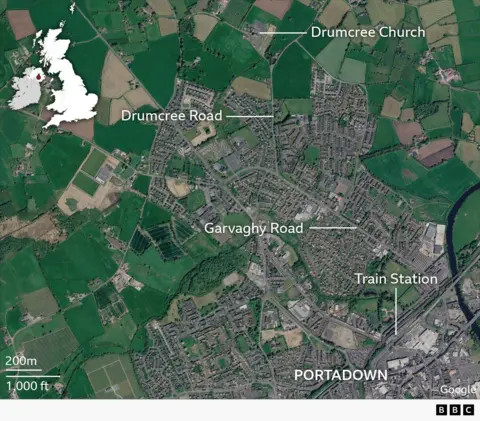
The Drumcree parade dispute began in the mid-1990s and it almost derailed the peace process at the time.
Violence related to the dispute resulted in riots, roadblocks and murders.
When the Orange Order was prevented by police from walking down the route in July 1995 there was a tense stand-off. It was the same for the next three years.
The Parades Commission began operating in 1998 to regulate parades and try to defuse tension around marches.
Its decision not to allow a march down the Garvaghy Road that summer has been challenged by the order for the past three decades.
