Attacks inquiry told of 'no closure' for victims

 Supplied
A campaigner whose father was stabbed to death by a mentally ill stranger has told a public inquiry there is "no closure".
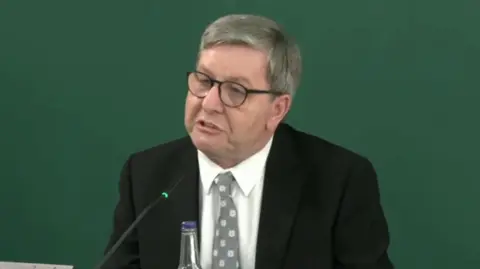
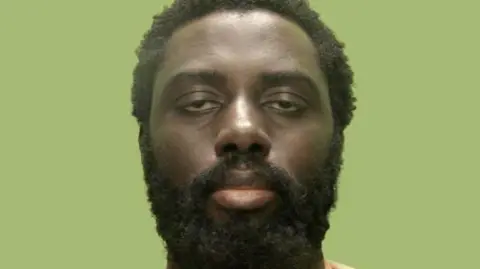
Julian Hendy, who has been supporting the families of the Nottingham attacks victims, gave evidence to an inquiry that is examining the killings carried out by Valdo Calocane - who had paranoid schizophrenia - on 13 June 2023.
After his father, Philip Hendy, was attacked outside a newsagents in Bristol in 2007, Hendy set up a charity and database to track mental health homicides in England and support victims.
On Thursday, Hendy, who has assisted about 300 families, said perpetrators of mental health homicides in many cases were given more consideration than their victims.
Calocane was discharged from mental health services in Nottingham months before he stabbed to death Barnaby Webber, Grace O'Malley-Kumar and Ian Coates.
He also ran over Wayne Birkett, Sharon Miller and Wayne Gawronski, who survived the killer's attacks, but were left with life-changing injuries.
The parents of Barnaby and Grace contacted Hendy - who has been advocate for mental health homicide victims - in the aftermath of the attacks, asking for his support.
 The Nottingham Inquiry
Describing the impact of the fatal incidents on victims, Hendy said some families got "stuck" and could not move on.
"There's no closure. I hate the term 'closure' because there's no closure and I'm a different person now to the one I was before.
"And I think that's true for an awful lot of families," he said.
Hendy - who had worked as an investigative journalist before his father's death - founded the charity Hundred Families with the aim of reducing the number of mental health-related killings in the UK and supporting people affected by them.
He was also commissioned to make a documentary about mental health homicides in relation to a number of cases across the country.
"There were not only similarities in the care of the offender but also in the very dismissive ways that the families were treated in the aftermath," he said.
Hendy added there were "repeated problems" in managing risk, monitoring medication compliance, listening to families and care plans.
All of these issues have arisen in the case of Calocane's care throughout the inquiry.
The inquiry has heard how Calocane was under the care of Nottinghamshire Healthcare NHS Foundation Trust for two years, prior to his attacks, during which time he was sectioned four times under the Mental Health Act and warned he would kill somebody.
'Wall of silence'
In his father's case, Hendy said his dad was leaving a shop in Bristol, in late April 2007, when he was stabbed in the back and in the neck by a man he had never met.
"And he died as I was holding his hand seven days later," Hendy said.
Hendy later learned the man who killed his father had a long history with mental health issues, drug abuse and serious violence, the inquiry heard.
The attacker believed Hendy's father was involved in a conspiracy involved with the Royal Family and former US president George Bush, he said.
In the aftermath of his father's death, Hendy said he was confronted with a "wall of silence".
"When I found out that they [the relevant NHS trust] were going to do an internal investigation, I said I would like to see and they said, 'I can't share it with you without his consent'.
"And I thought, 'he's just killed my dad and now he's able to control how much information I get'.
"That's just bizarre, that is so unfair and it seems to be completely the wrong way round.
"It shouldn't be down to the offender, who has so gravely damaged my family and our community to make a decision on how much information I get," he said.
 Nottinghamshire Police
Hendy added: "There's a clear hierarchy, it seems to me, of the patient comes first and then their [NHS] staff, and then maybe the families of the perpetrators, and then very far down there's the victims."
The inquiry heard the campaigner had been part of a number of advisory committee groups related to mental health homicides since his father's death.
In supporting the families of Calocane's victims, after the killings Hendy attended a meeting between the families and the Crown Prosecution Service (CPS) in November 2023, when the families were told Calocane had a partial defence of diminished responsibility, due to his mental illness.
Ahead of that meeting, Nottinghamshire Police was reluctant for Hendy to attend, the inquiry heard.
He told the inquiry the force had the "wrong end of the stick" and assumed he wanted to make a documentary about the case.
Hendy also said he wrote to NHS England following the Nottingham attacks after the victims' families had not been contacted regarding any internal investigation regarding Calocane's care.
Hendy added he was told by NHS England that it was asked "not to contact the families" by the police, over concerns it could prejudice the police investigation.
Calocane is currently serving an indefinite hospital order at a high-security facility after he pleaded guilty to three counts of manslaughter on the grounds of diminished responsibility, and to three counts of attempted murder.
The inquiry said it was due to publish a review report of more than 500 cases of mental health homicides since 1994.
Chair of the Nottingham Inquiry, retired senior judge Deborah Taylor KC, will consider the report in her findings.
The inquiry continues.
Listen to BBC Radio Nottingham on Sounds and follow BBC Nottingham on Facebook, on X, or on Instagram. Send your story ideas to eastmidsnews@bbc.co.uk or via WhatsApp on 0808 100 2210.
