Killer 'texted brother about murderous thoughts'

 Nottinghamshire Police
A mentally ill man sent text messages to his brother expressing thoughts of murder three years before killing three people in Nottingham, an inquiry has heard.
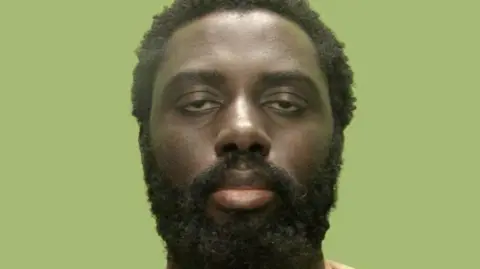
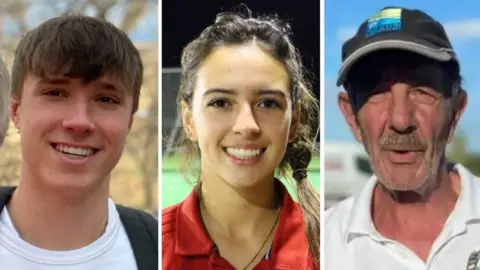
Valdo Calocane, who was diagnosed with paranoid schizophrenia, stabbed to death Barnaby Webber, Grace O'Malley-Kumar and Ian Coates on 13 June 2023 and tried to kill three others.
The Nottingham Inquiry heard in 2020, before his first admission to a psychiatric ward, Calocane had sent messages to his brother about thoughts of violence and "red rum" - murder spelled backwards.
On Wednesday, a former psychiatric ward doctor told the public inquiry she never thought it was "likely" Calocane would end up killing, despite known risks.
The judge-led inquiry was shown a series of messages between Calocane and his brother Elias, from 2020 - before Calocane's first admission under the Mental Health Act to Highbury Hospital - run by the Nottinghamshire Healthcare NHS Foundation Trust.
The trust was responsible for Calocane's care for two years before he was discharged in September 2022, months before he carried out the stabbings.
In text messages sent in early 2020, Calocane told Elias he had been unable to sleep and had "the darkest thoughts".
One message read: "Wanted to hurt... permanently."
 Supplied
In that conversation, Calocane - who has been referred to as VC throughout the inquiry - described to his brother changes to his mood.
The pair discussed their faith and Calocane later added he had previously been thinking about "red rum" - murder spelled backwards.
He wrote: "I know I didn't work myself into this state of mind. I was thinking about red rum not 120 minutes ago.
"Now not only do I not care, I feel appreciation."
In another text, translated from Portuguese, Calocane said: "... because I think they are watching I know I can break their heads with my hands."
Calocane's mother, Celeste, shared those messages with consultant psychiatrist Dr Faizal Seedat, at Highbury Hospital, the inquiry heard.
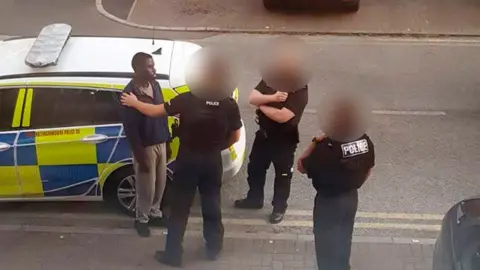
Calocane was first admitted to Highbury Hospital in May 2020 until June, after he broke into a number of flats where he lived at Brook Court, in Radford. He was admitted for a second time in July.
Doctor's warning
Dr Anna Ludvigsen, who was working alongside Seedat at the hospital, was questioned about the messages.
She told the inquiry that as soon as a patient was suspected of having thoughts of wanting to harm someone, that risk would be "considered the highest level".
Ludvigsen said the mention of murder would have "fallen within [her] already high concern".
Counsel to the inquiry Craig Carr asked: "Had you seen that reference, would that not have elevated your concerns?"
Ludvigsen replied: "It would have confirmed the thoughts we as a clinical team already had about his risks when he was unwell."
Asked if there was any discussion with Calocane about that, she said: "Not to my knowledge, but I wasn't present at every meeting that was had with VC."
 Handout
The inquiry also heard Ludvigsen recorded in ward review notes, on 16 July 2020, that Seedat "observed that there seems to be no insight or remorse and that the danger is that this will happen again, and perhaps [Calocane] will end up killing someone".
The BBC previously reported on the killer's medical notes which revealed the doctor's warning during Calocane's second admission to Highbury Hospital.
He was discharged two weeks after those notes were recorded.
Ludvigsen said she "vividly" remembered that particular ward round and admitted she was "shocked" by Seedat's "very, very direct approach".
She told the inquiry Seedat was warning Calocane of what happens when he was unwell in a "frank" conversation, rather than raising concerns about his risk.
"You do realise, you could end up killing someone if this happens again?" she recalled Seedat saying.
Seedat is expected to give his evidence to the inquiry on Thursday.
Tim Moloney KC, representing the bereaved families, said: "Although that context was given, in fact, that level of serious violence that might lead to somebody's death, was [that] something people were concerned about, however Dr Seedat meant it?"
Ludvigsen replied: "Yes."
She added she was already aware of the "high risks involved" with Calocane because during her first encounter with him, he told her he was thinking about "capital punishment".
However, later in her evidence, she said she and others did not think Calocane was likely to kill someone.
Counsel to the NHS trust, Jason Beer KC, said: "At any point did you think that Dr Seedat actually thought that this would be a likely outcome?"
"No, no. None of us did," she said.
'Chaotic' ward
Ludvigsen was asked to work at Highbury Hospital at the onset of the Covid pandemic after doctors were redeployed.
She said it had been "several years since I'd worked in any kind of acute setting".
"I basically got an email from my boss a week before redeploying me to a ward," she said.
She described in her statement how being on the Rowan One ward, where Calocane was admitted, was "extremely difficult and chaotic".
Carr asked: "In light of your limited experience on acute wards, the stress of working during the pandemic, the chaotic and busy nature of the ward, and the limits on your training, did you feel at all out of depth whilst working those four months on the ward?"
She replied: "I felt comfortable within my role in terms of my competence.
"I think I felt out of the depth at the time. I think we all did."
The inquiry continues.
Listen to BBC Radio Nottingham on Sounds and follow BBC Nottingham on Facebook, on X, or on Instagram. Send your story ideas to eastmidsnews@bbc.co.uk or via WhatsApp on 0808 100 2210.
