What next for South East Water after boss quits?

 BBC
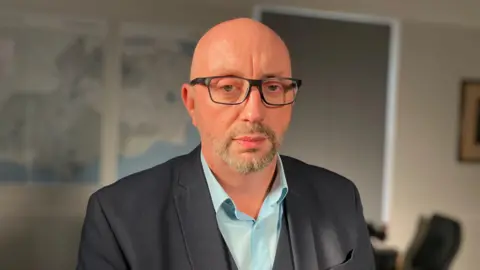
BBCAfter months of pressure, on Friday, as election results rolled in, David Hinton, the boss of South East Water, announced his resignation.
It was what politicians, businesses and homeowners in south-east England had been calling for, but the timing of the announcement has raised a few eyebrows.
Tunbridge Wells MP Mike Martin told BBC Radio Kent that election results day is clearly "a good day to bury bad news".
Political party may have been pitted against political party at the polls, but the David-Hinton-resignation issue had cross-party support.
Since the two-week Tunbridge Wells water supply crisis in December last year, across the region not one viewpoint garnered as much of a consensus as the belief that Hinton should go.
In the short statement announcing Hinton's resignation, interim South East Water (SEW) chair Lisa Clement said: "The board acknowledges and thanks Dave for his many years of loyal dedication and service to South East Water."
Now he has stepped down what does that mean for South East Water's customers? And what can the new, as-yet unnamed, boss of the beleaguered company learn from what went wrong?
Hinton 'the water guy'
I have interviewed David Hinton four times over the past six months. He is a microbiologist by training and it has been clear he is far more comfortable behind the scenes, dealing with the science of delivering water, than in the front-facing roles required of a chief executive.
"I'm a water guy," he once told me, pointing to the fact that he had been in the water industry all his life.
He began his career in the laboratories of South East Water more than 30 years ago and worked his way through the ranks of the company.
For him this was a strength.
When asked in the parliamentary select committee hearing in January why he had not spoken to the media earlier during the pre-Christmas supply problems, he said it was because he had been working at the "heart of the issue" trying to solve the problems at the Pembury water treatment works.
"Are your customers not the heart of the issue?" came the response from the Liberal Democrat MP Sarah Dyke.
Criticised for battening down the hatches and going to his "comfort zone as a scientist", it may be that being "a water guy" has not served David Hinton well when it comes to the job of speaking to politicians, customers and the media.
Hinton has presided over a turbulent time in the history of South East Water.
Since he took the top job nearly six years ago the performance of the water company has deteriorated in key areas.
The average length of time South East Water customers faced the taps running dry quadrupled under his watch.
Those figures do not take into account any of the supply problems over the past six months.
According to the outgoing boss, tying this poor performance data directly to his leadership was undeserved.
He has repeatedly pointed to climate change and population growth, things outside his control, as major factors in the myriad of water supply failures he presided over.
But if the data has been hard to escape for Hinton, the hefty proposed £22 million Ofwat fine, alongside the damning reports from water regulators, have been even more difficult to swerve – although South East Water did try, by seeking an injunction to prevent the publication of a recent Ofwat report.
After multiple supply failures, as pressure mounted on the leadership, the water company launched a six month "accelerated... transformation programme" of engineering works.
Filters were changed in treatment works and pipelines were upgraded.
There have been questions about why it had to take the misery of thousands of customers and a grilling by select committee MPs to plug resilience gaps in the water supply network.
Faversham and Mid-Kent MP Helen Whateley questioned why Hinton had not taken action "at any time before the point at which he's been called on to resign".
What does it mean for customers?
Leading the calls for Hinton to stand down was Tunbridge Wells Liberal Democrat MP Mike Martin.
"Leadership matters," he said, as he welcomed the news of the resignation.
But Hinton's departure is somewhat of a prolonged farewell.
He is not leaving immediately. The company says he is remaining in post to allow for an "orderly transition" over the "summer period".
And despite the deafening calls for it, when Hinton does go, homeowners and businesses are unlikely to see any dramatic changes in the water company's supply problems.
The pipes will still burst, the treatment works will still fail.
When they do, how South East Water responds may be the first obvious difference.
Better communication and response to critical incidents may be an easier fix than decades of underinvestment in water infrastructure.
 PA Media
South East Water chair Chris Train stood down at the start of May.
That was the day the Environment, Food and Rural Affairs (EFRA) select committee called for a change in leadership and highlighted "incompetence" from those at the top.
Now, eight days after their declaration of "no confidence" in the leadership, Hinton has also gone.
"Mr Hinton has decided to step down as he feels his position has become an increasing distraction from South East Water's most important priority, which is to deliver a resilient water supply for its customers," a South East Water spokesperson said.
The board says it remains focused on accelerating targeted engineering works and making operational changes to improve the resilience of its supply network, and increase water capacity and quality in high priority areas.
Martin has said the new chair and CEO must be "external hires" in order to change the culture and "group think" at the company.
The South East Water board may look to another water company for the new leaders.
Somewhere like Severn Trent, which was praised by the Chief Inspector of Drinking Water, Marcus Rink, in his select committee evidence for putting "their hands in their pocket and [putting] in investment".
Or they could look away from the sector, opting not for another "water guy" but a leader with a track records in other industries.
In 2024 Thames Water hired former army officer and energy boss Chris Weston.
But even with a baseline annual salary of £400,000, Hinton is one of the lowest paid water bosses in the country.
Will the board need to increase that to bring in the top talent?
It may be a struggle to attract the right leader to a company that fails so often and is under such intense scrutiny.
Hinton's reign may be nearly over, but the challenges facing South East Water are not, and they run deep.
Follow BBC Kent on Facebook, on X, and on Instagram. Send your story ideas to southeasttoday@bbc.co.uk or WhatsApp us on 08081 002250.
