Could nationalisation fix South East Water?

 PA Media
Crisis after crisis has hit South East Water (SEW) in recent years.
Regulator Ofwat recently proposed fining the water company £22 million over issues affecting 286,000 people in Kent and Sussex between 2020 and 2023.
The fine, however, does not cover newer failures.
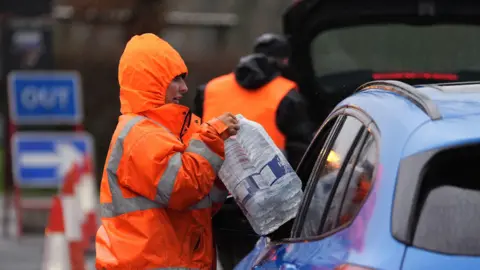
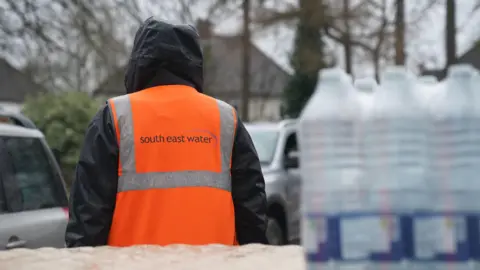
Some 24,000 SEW customers had no water supply or low pressure between November and December following a plant failure, which led to a boil water notice for several days.
Then just weeks later up to 30,000 households faced days of water chaos in a situation which one resident likened to "Armageddon".
SEW said cold weather and Storm Goretti were behind the most recent supply issues.
Its chief executive David Hinton - who is due to be questioned by MPs on Tuesday - later announced critical upgrades had been made to "mitigate the risk" of future supply interruptions as part of a resilience plan.
Some have argued that SEW needs to be brought under state control, though others dispute this.
But would nationalisation solve the woes of South East Water's customers?
'They've got us over a barrel'
James Wallin, editor-in-chief of Utility Week, said the cause of South East England's water problems stemmed from wider problems, such as climate change, urbanisation and population growth, rather than who owned them.
"People forget," he told the BBC. "It's not like we had Perrier water coming out of the taps and the seas were spotless [before privatisation]."
"We don't know what the system would look like if it continued under public ownership."
Wallin continued that a "lot of investment" is needed in the water industry.
"If it is in public hands... and there are big funding back holes in the health service, social care or prisons... would water be a top priority for the government of the day?"
He argues instead better regulation is the answer.
"Strengthening rules on where investments should be made, responsibility and executive pay... could go a long way to addressing people's concerns."
Cat Hobbs, from the campaign group We Own It, told the BBC there was "no alternative" but to bring water companies like SEW into public ownership.
"Water is a natural monopoly as well as an essential service."
"We don't have any choice as households about which water company we use," she said.
"There is just one set of pipes, and one set of infrastructure.
"They've got us over a barrel."
Hobbs said the "whole rationale for privatising water was that it would create competition and efficiency incentives, which would improve the service, but there isn't a market at all".
Approximately nine out of 10 countries around the world have publicly owned water companies, according to her group We Own It.
'Expensive'
Hobbs said SEW should be nationalised as it would stop money being paid out in dividends to shareholders and executive pay.
She claims this has led to "underinvestment" in infrastructure, which is why there is "dangerous raw sewage in our rivers and seas".
"We've been ripped off".
In 2023, SEW paid out £2.3m in dividends during an Ofwat probe.
Hinton, the company's CEO, was awarded a £115,000 bonus last year on top of his £400,000 salary.
"Our priority is improving South East Water in the future," he said, adding that £2.1 billion was being invested into infrastructure and resilience over the next five years.
"Our ultimate shareholders haven't received a dividend since 2019," Hinton said.
SEW said it does not reward poor performance.
 PA Media
Industry bodies argue investment has increased significantly since privatisation, while some say bills have not been kept too low for too long due to political pressure on regulators.
The government said it had ringfenced water company investment, ensuring customers' money is spent on fixing pipes, reducing sewage spills and improving water quality, not dividends or bonuses.
Is society willing to spend that much?
Ketan Jha, senior lecturer at the University of Brighton's School of Business and Law, said one of the biggest questions surrounding whether SEW can be brought into state ownership is the cost.
He suggested the government could step in if it went bust, although it would still be an expensive and complex process.
But, he added, the "biggest expense" for the state - and so taxpayers - is maintaining the system in the coming years and decades.
Supporters of nationalisation claim water is a profit-making business, meaning it can actually generate money for the state.
Bringing water companies into state ownership could potentially eliminate or reduce costs people currently pay for under a privatised system, such as borrowing costs, debt servicing and paying shareholders, they also argue.
SEW is owned by a group of investment and pension funds led by the Utilities Trust of Australia, which holds a 50% stake in the firm.
Its latest annual report shows that SEW has £1.3bn worth of debt.
Pre-tax losses for the year to 31 March 2025 narrowed to £19.8m from £36.7m in the previous year.
Wallin says people in the South East ultimately need to think about how much they are willing to pay for the perfect water system.
"We could have a situation where every watercourse... is suitable for people to go wild swimming... or eradicate the risk of sewer overflows into the sea, but that is going to cost an enormous amount of money.
"Is society willing to spend that much? What are the compromises people want to have? That conversation has not really been happening."
You can watch South East Water's chief executive being questioned by MPs live on the BBC News Website and BBC Kent Facebook page. Coverage begins shortly before 9.30 BST on Tuesday 14 April.
Update 19 May: This article has been updated to include more detail about what the supporters of nationalisation believe are the benefits of bringing water companies into state ownership.
Follow BBC Kent on Facebook, X, and Instagram. Send your story ideas to southeasttoday@bbc.co.uk or WhatsApp us on 08081 002250.
