The bible that saved a WW1 soldier from a bullet to the heart

 MacFarlane family
When Private Duncan MacFarlane finally returned home to Scotland after World War One, his family found bullet wound scars all over his body.
He had been missing in action for six months before his wife tracked him down to a military hospital in Edinburgh.
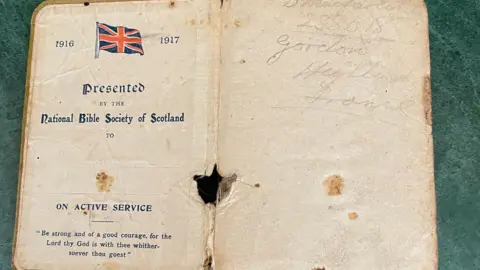
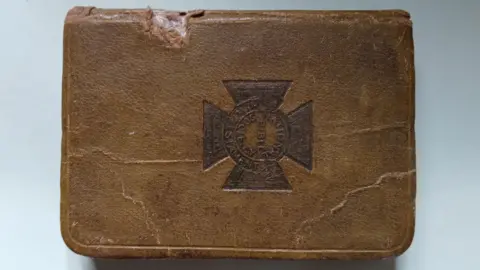
But he still had his bible which he carried in his breast pocket - and which saved him from the full force of a bullet to his chest on the front line.
More than 100 years later, that bible - which shows clear evidence of a bullet hole - remains with Pte MacFarlane's family.
His granddaughter Jo Abbot says it's finally time for the bible and other tokens of his military career to "be taken out of the drawer" and for his story to be shared.
 MacFarlane family
They will go on display at the heritage centre in Dunscore, Dumfries and Galloway - where Jo lives - from next weekend.
''This is the story of a very ordinary Gaelic-speaking man from Argyll who had his life saved by a bible, which basically stopped the bullet that would have hit his heart and killed him," she said.
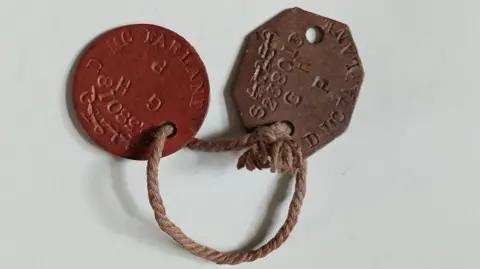
''His name and service number is in the bible so we know it was his and the provenance is beyond reproach. We know it was part of him when he was carried off the field of war."
 Macfarlane family
 MacFarlane family
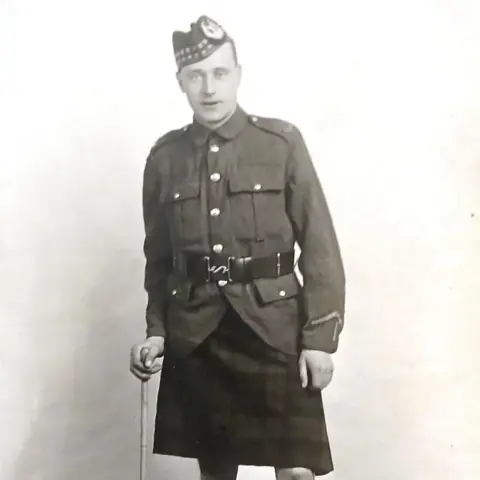
Born in 1890, Pte MacFarlane worked as a postman in Skipness, on the east coast of Kintyre, before being enlisted to the military in 1915, aged 25.
He served with 5th Argyll before transferring to the 4th Battalion, Gordon Highlanders.
Pte MacFarlane was seriously wounded while on the front line during in the Third Battle of Ypres, known as Passchendaele, on 18 October 1917.
The battle became infamous not only for the heavy losses suffered on both sides, but also the appalling conditions in which the soldiers fought.
More than 500,000 men are thought to have been killed or injured during the three month campaign.
Pts MacFarlane was missing in action for six months before returning to Scotland.
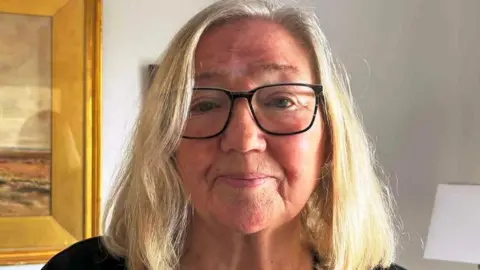 Jo Abbott
Abbott said her grandmother struggled to recognise her husband when she eventually tracked him down to a military hospital for servicemen in Edinburgh.
He was severely injured and had suffered multiple strokes, leaving the left side of his body numb.
''My grandmother only recognised him by his eyes when she finally found him in hospital.
''All I can remember as a child is seeing the bayonet scars on his face and neck, and also seeing the arc of the bullets that traced his body,'' Abbott said.
He was medically discharged in 1919.
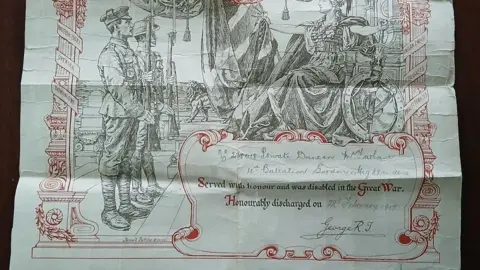 MacFarlane family
It was not just the physical scars of war that the family witnessed first-hand.
After leaving hospital, Pte MacFarlane moved into the family's two-bedroom home in Glasgow, with five adults and two children living under one roof.
Abbott vividly recalls her grandfather experiencing nightmares, which she believes would now be identified as post-traumatic stress disorder.
''By the time I knew him, he was a shadow of his former self," she said.
''I can remember at night being wakened by him shouting and screaming in his sleep - dreadful, dreadful, dreadful things to have happened to any man.''
Pte MacFarlance only once spoke of the horrors of war, when he was visited by the son of one of his fallen comrades. But Abbott said he never revealed the details of the discussion.
He died in 1962, aged 72.
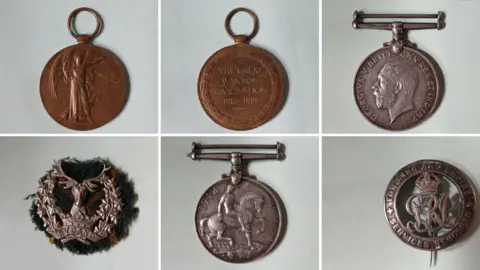 MacFarlane family
Although Abbott said the family is "in no way" religious, her grandfather was.
They felt it was right for the memorabilia to be housed in a church, where the heritage centre is based.
Members of the Gordon Highlanders Regimental Association will join the family for a small ceremony at the centre on 19 April, where the exhibition will remain for the season.
The collection will then be donated to the Gordon Highlanders museum in Aberdeen, where it will be displayed.
'''To me, he was just my grampa but his story deserves to be told," she said.
