'Silence is golden': The WW1 archives of a country mansion

 North Lincolnshire Museums
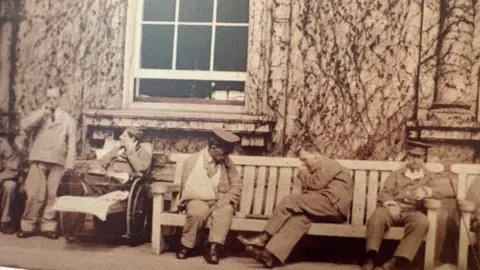
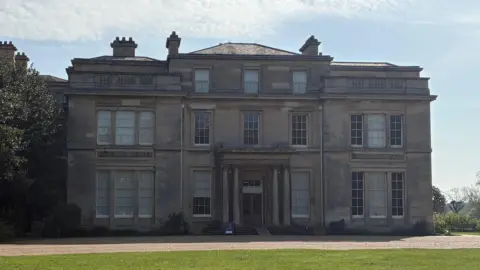
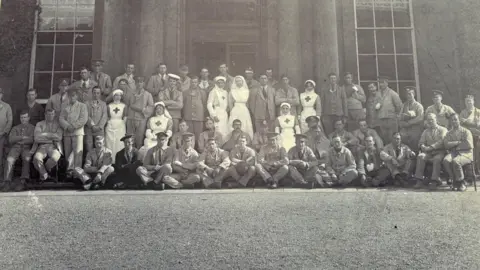
During World War One, hundreds of injured soldiers recovered from their wounds, both physical and mental, at Normanby Hall – a 19th Century stately home in North Lincolnshire. Ahead of its inaugural Armed Forces Festival, marking its wartime role, record-keepers share the archives.
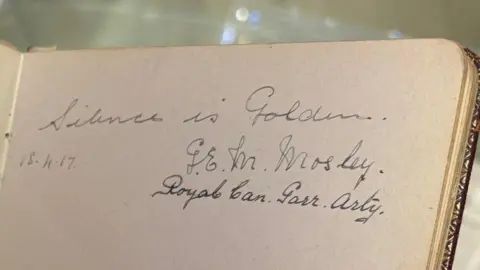
"Silence is golden."
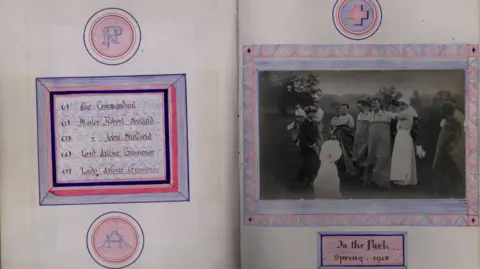
The words, scrawled in pencil by GEM Mosley, one of the 1,248 wounded soldiers from Britain and its allies treated here, stand out in a book of memories kept contemporaneously by nurse Clara Spilman.
For Madeleine Gray, curator of decorative arts at North Lincolnshire Museums, which manages the hall, those words – written in April 1917, three years into the war – never fail to bring a tear.
"It's the thinking about what he and others must have gone through," she says. "Some of the injuries of the men who were brought here were horrific.
"And there is this juxtaposition between the noise, the guns, the explosions, the horror... and the complete silence here... the getting away from it all."
 Kevin Shoesmith/BBC
As the war raged, town halls, recreation halls, schools and private houses were used as auxiliary hospitals for convalescing soldiers before many were shipped back to the front line.
"It was expected that owners of such large country homes as Normanby Hall would do their their bit for the war effort," says Madeleine.
"But looking at the care with which records were kept and the many photographs we have in the collection, it is clear that the owners, Lady Julia Sheffield and Sir Berkeley Sheffield, had a genuine interest in supporting the war effort, as well as the welfare and wellbeing of soldiers.
"A great sense of pride comes through."
It is noted in the records that Lady Sheffield was successful in obtaining larger supplies of tobacco and cigarettes for those in her care.
 North Lincolnshire Museums
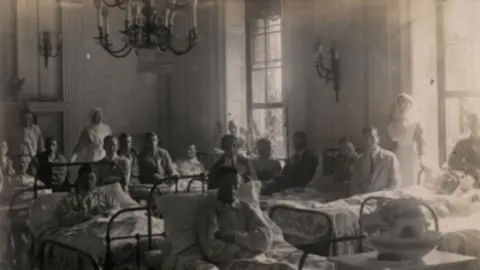
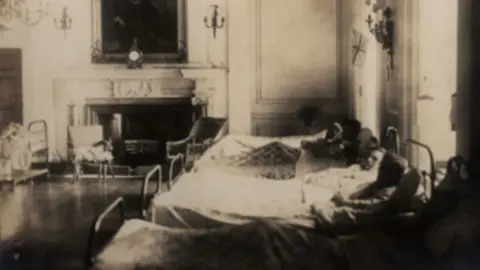
The ground floor of Normanby Hall, built on the outskirts of Scunthorpe in 1825, was assigned to the injured soldiers, with the family's decadent ballroom, complete with chandeliers and the scene of pre-war high jinks, becoming what was known as The 1914 Ward.
Alongside Nurse Spilman's collection of soldiers' notes, poems and drawings is The Hospital Book. It is considered so precious, containing a mine of information, that it is kept under lock and key inside a glass cabinet.
"We know exactly how many soldiers were treated here between 19 November 1914 and 10 January 1919, and it's all thanks to this," says Madeleine, gingerly lifting the book from its plinth.
The names of every soldier who passed through Normanby Hall Auxiliary Hospital, along with their ranks, numbers and regiments, were meticulously logged by Ernest Dain, the household's clerk.
"It's unique," says Madeleine. "I'm certainly not aware of any other stately home that has a record as detailed as this."
 Kevin Shoesmith/BBC
Madeleine – her passion for the job unequivocal – talks about the soldiers who stayed here almost as if she knew them.
Her "favourite" is Frederick William Brush. A gardener from Gloucestershire at the outbreak of war, he joined the 1st Worcestershire Regiment.
On 5 June 1915, Brush was shot in the chest, leading to a month-long stay at Normanby Hall before he was sent back to the front the following year.
He was wounded again and eventually discharged from the Army. His wounds were listed as gunshot wounds to his chest, right arm and foot, left leg and back. His right arm was amputated.
"Frederick went on to have a happy life, worked on a farm, married and had four children," says Madeleine, adding that this also made her happy.
Brush died in a nursing home in 1972, aged 83.
 North Lincolnshire Museums
When the hospital opened on 19 November 1914, it could accommodate 25 patients.
As the casualty tally on the Western Front increased, so too did the number of beds at the hall, with the capacity at 60 in April 1917.
In March 1918, there were 75 beds, including eight for emergency cases.
Many of the patients came from the Third Northern General Hospital in Sheffield, records state.
"We have photographs from 1914 showing just a few beds in one of our rooms," says Madeleine. "By the end of the war, they were really cramming them in."
Though discipline was less strict here than in military hospital, each soldier was still required to dress in "hospital blues" – a reminder they were still soldiers, despite their surroundings.
"The black and white images do not really do justice to the vivid royal blue tunic and trousers," Madeleine notes, pointing to a uniform on display.
 North Lincolnshire Museums
The uniform served another purpose. During the war, groups of women, affronted by men who refused to fight, would attempt to shame men into signing up by handing them white feathers.
"Soldiers would visit the nearby village of Burton-upon-Stather for tea with the locals and sport. The uniform told others, especially the white feather brigade, that the wearer was a soldier and that they had been injured," Madeleine says.
Injured soldiers, whose names are also included on large blinds that adorn the room where the collection is kept, had full use of the golf course, the cricket ground, tennis lawns, the bowling green and the billiards table.
During the summer, soldiers were even taken for motor rides and trips over the Humber Estuary to Hull.
 Kevin Shoesmith/BBC
On 20 June, Normanby Hall will host its first Armed Forces Festival, with military displays, living history, performances and hands-on activities.
"It's right these soldiers and the people who helped them are remembered," says Madeleine.
Today, in the sprawling gardens, where soldiers – wheeled out on trolleys – once filled their lungs with fresh air, silence is broken only by birdsong or a shriek from a child enjoying the Easter holidays.
"This is why Normanby Hall was chosen," says Madeleine. "I can imagine the soldiers' smiles when they approached the long driveway.
"It must have been an absolute world away from the horror and noise of war."
Listen to highlights fromLincolnshire on BBC Sounds, and watch thelatest episode of Look North.
Download the BBC News app from the App Storefor iPhone and iPad orGoogle Play for Android devices
