Men begin legal action against MoD over LGBT payout

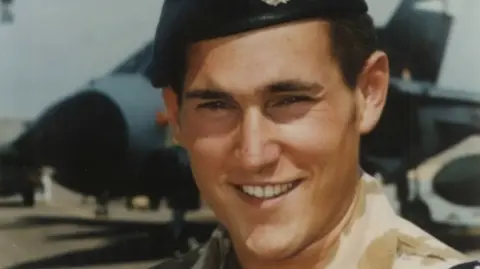 Mark Shephard
Two military veterans who "suffered enduring harm" due to a ban on LGBT personnel in the armed forces have launched legal action against the Ministry of Defence (MoD).
Mark Shephard, from Taunton, Somerset, and Steven Stewart, from south-west England, claim they were effectively forced to resign from the military due to their sexuality.
The pair were later denied full compensation as they were not formally discharged, despite feeling compelled to leave "by way of an ultimatum", their lawyer said.
The MoD said it did not comment on ongoing legal proceedings, but acknowledged that past treatment of LGBT veterans was "wholly unacceptable".
The two men are now legally disputing the rules of the MoD's LGBT Financial Recognition Scheme - which offers up to £70,000 to those discharged under the ban.
Law firm Irwin Mitchell, which is representing the men, confirmed that a legal claim had been filed but said no date had been set for a hearing.
A ban on LGBT personnel serving in the armed forces between 1967 and 2000 meant that those who were - or were thought to be - gay or transgender were subjected to interrogation and dismissal.
This left some without access to their military pensions, shunned by family and friends, and facing diminished career prospects.
The compensation scheme, set up in 2024, was one of dozens of recommendations following Lord Etherton's independent review into the ban in 2023.
It offers two payments: a flat-rate payment of £50,000 for those who were dismissed or administratively discharged under the ban, and "impact payments" of up to £20,000 for those affected by it.
'No real choice'
Stewart had served as a corporal in the Royal Military Police from 1988 until 1995, and said that he was "confused" about his sexuality at the time.
He said he was arrested, interviewed under caution and removed from his unit. He resigned after being told he would face a court-martial and a potential prison sentence.
"I had done nothing wrong, but I was left with no real choice," he said.
"Leaving under those circumstances was devastating. My military career ended overnight. The impact of that decision has stayed with me ever since.
"I rebuilt my life, but what happened has stayed with me for nearly three decades. It affected my confidence, my relationships and how I saw myself."
Shephard served in the Royal Air Force (RAF) from 1995 to 2001, where he said he suffered "persistent and severe bullying" from peers.
In 1999, he was said he was asked "point-blank" by his commanding officer if he was gay. He confirmed he was, as he was unaware of the ban at the time.
He later applied for voluntary release to avoid being dismissed without notice.
Shephard said he only recently told his family and friends the real reason why he left the RAF, and felt that he was "driven out of the career I trained hard to achieve and excelled at".
 Getty Images
Stewart and Shephard received £7,000 and £5,000 impact payments respectively, which was determined by an independent panel.
But their applications for the larger payment were refused, and their appeals were dismissed.
Barrister Kate Gallafent KC said this was despite the pair suffering "intrusive investigation, public humiliation, and enduring psychological and relational harm, as well as the premature foreclosure of their careers".
She added 44% of LGBT veterans who gave evidence to Lord Etherton's review said they were forced to leave the armed forces through "unofficial methods or actions or due to general hostility towards LGBT personnel", but that there had "clearly been a failure" by the MoD to accommodate that scenario.
She explained this meant veterans who "were compelled to resign or retire by way of an ultimatum", including her clients, will receive tens of thousands of pounds less than those who were administratively discharged.
The barrister described the rules as "inherently irrational" and unlawful.
'Deeply regret' policy
Angela Jackman, a partner in the public law and human rights department at Irwin Mitchell, said hundreds of veterans had been "short-changed" and "left to feel even more traumatised and demoralised after applying to the scheme".
An MoD spokesperson said: "We deeply regret the treatment of LGBT serving personnel between 1967 and 2000, which was wholly unacceptable and this is not representative of defence today.
"We are committed to righting these wrongs through tangible actions, including through the LGBT financial and non-financial restorative measures for those affected.
"Whilst we acknowledge the hurt caused to veterans who felt compelled to resign, the dismissed and discharged payment was designed to recognise those who were dishonourably removed from service.
"However, we recognise that LGBT veterans, including those who felt pressured to resign, suffered unacceptable experiences and therefore the scheme was expanded to include an additional impact payment, which we encourage those veterans to apply for."
Follow BBC Somerset on Facebook and X. Send your story ideas to us on email or via WhatsApp on 0800 313 4630.
