Scottish firefighters help earthquake rescue efforts in Venezuela

 SFRS
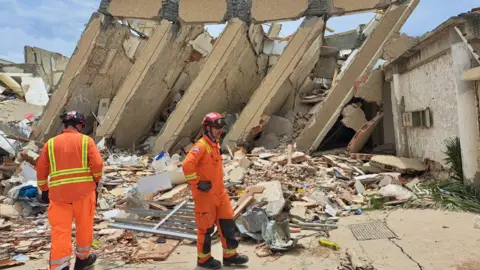
SFRSA team of firefighters from Scotland has been deployed to Venezuela to help communities impacted by two devastating earthquakes.
Gavin Brown, Ian Hodgson and Brian Richards travelled to South America as part of the UK's search and rescue operation after the twin earthquakes struck on 24 June.
More than 2,000 people have died in the disaster and tens of thousands are still missing.
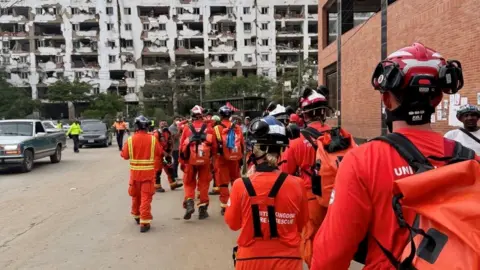
The UK crew, which consists of 68 firefighters and staff from 14 fire and rescue services, has also been joined by emergency service personnel from other countries in attempt to locate survivors in the rubble.
Brown, Hodgson and Richards left the UK last Friday and have been working in Venezuela for the past week.
They have been providing specialist technical expertise where it is needed most during search and rescue operations.
Andy Buchan, Scottish Fire and Rescue Service group commander, told BBC Radio Scotland that the three firefighters have had advanced training in life location and technical searches.
"We have various types of equipment we can use for sound, vibration and drones," Buchan said.
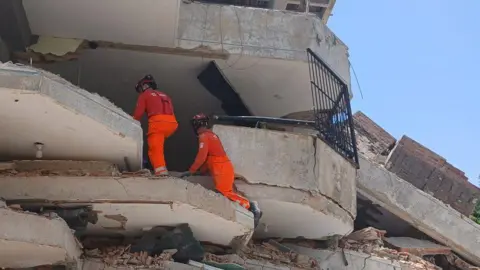
"They are all trained in breaking and breaching which allows us to tunnel into a building, breaking our way through any barriers or walls."
 SFRS
SFRSSpeaking from Venezuela, Ian Hodgson said the crew has been using listening devices to detect "saveable lives" and identify how far away the person is, how long it will take to reach and what resources are required.
But he said the situation on the ground had been changing fast based on information from local police forces and neighbouring teams.
"We have to be open to change and able to adapt quickly," said Hodgson, a crew commander based at North Anderson Drive station in Aberdeen.
"We might have plan A and then quickly have to adapt to plan C, D and E before we know it."
Station commander Gavin Brown was previously part of the team deployed to Morocco following an earthquake in 2023.
Brown said the crew has been working well with other emergency teams, medics and search and rescue dogs, which is "incredibly important" in such a large operation.
"Drawing on the skills we use in our day-to-day roles has enabled us to work effectively as a team and get the job done," he added.
Brian Richards, firefighter at MacAlpine Road station in Dundee, said resilience was a vital skill during long days and extreme temperatures.
"An unexpected valuable skill for me was navigation," he added.
"We found ourselves in a situation where there was poor or limited signal and trying to find your way to a specific work site which had been destroyed proved rather difficult with the current mapping systems that we had."
The crew has had the opportunity to work with teams from France and Mexico, communicating through a translator during outings with the search and rescue dogs.
 SFRS
SFRSThe crew have taken their own accommodation, water, food and sanitation as to not put any additional pressure on infrastructure, which is already struggling.
The team can self-deploy and host themselves for between 10 and 14 days.
Andy Buchan, who is also the UK International Search and Rescue team manager in Scotland, said the commitment, professionalism and resilience shown by everyone involved has been "outstanding."
"What the team will be experiencing there will be very traumatic," he said.
"The scale of the devastation they have encountered is unlike anything they would face in their day-to-day duties back home, and they are dealing with those challenging circumstances every day throughout their deployment."
