Iran war leads to spike in saffron price

 BBC/Jeevan Nerwan
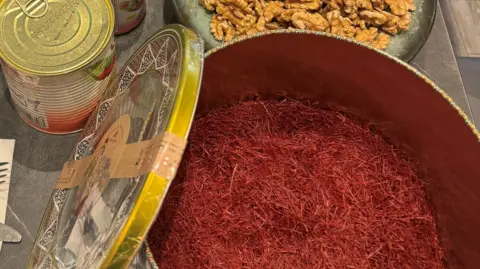
London businesses have said the cost of saffron are rising sharply due to the war in Iran.
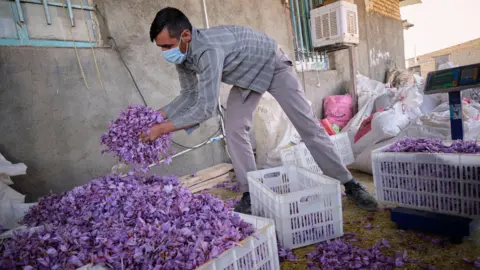
Saffron is one of the world's most expensive spices with 90% of the world's supply grown in Iran.
Due to the blockade of the Strait of Hormuz, supplies have dwindled, along with staples such as chickpeas and zereshk - a type of dried berry used for flavouring - used widely in many Iranian and Middle Eastern dishes.
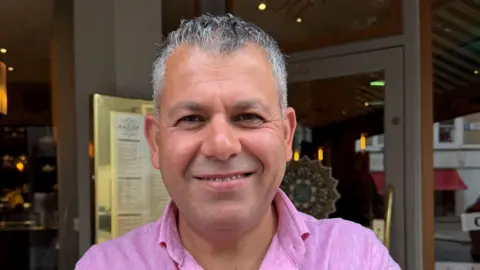
Dilman Mahmoud, the owner of Persian restaurant Sadaf in west London, said despite the pressures, he was trying to keep his prices the same for customers, while supplier, Moin Tiyari, said he was struggling to buy saffron in bulk.
 BBC/Jeevan Nerwan
"Any dishes coming out from the [Sadaf] kitchen with rice, there is layer of saffron on the top of it," said Mahmoud.
He explained that before the Middle East war he was buying saffron at about £1,200 per kilo, but now his supplier told him the cost has risen to about £2,000 to £2,100 per kilo.
"It's quite a lot," he said.
He added: "There is no substitute for Iranian saffron. We can't get the same quality, 85% of our dishes require saffron… we use it in marinades for chicken breast and kebabs, and our saffron ice cream."
'Waiting for the war to finish'
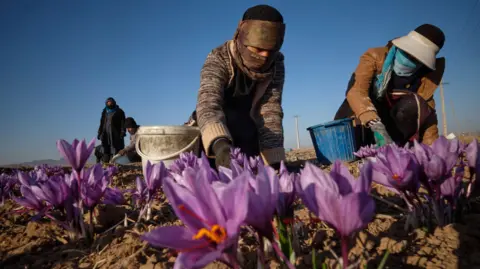
Saffron comes from the Crocus sativus flower which only blooms for a few weeks a year.
The stigmas are hand-picked, but there are only three in each flower and it takes between 75,000 and 250,000 flowers to produce half a kilo (about 17 oz) of dried saffron.
 BBC/Jeevan Nerwan
The current Middle East war started in late February when the US and Israel launched strikes on Iran.
Tehran responded by striking neighbouring countries and closing the vital shipping route, the Strait of Hormuz.
Mahmoud added: "We need to increase the prices… we need to pass it to the customers, but I didn't do it. I'm still not doing it.
"I'm waiting for hopefully [when the war] is finished and we can keep the price as it is, so people can come out and enjoy the atmosphere of the Sadaf restaurant."
Chickpeas and zereshk
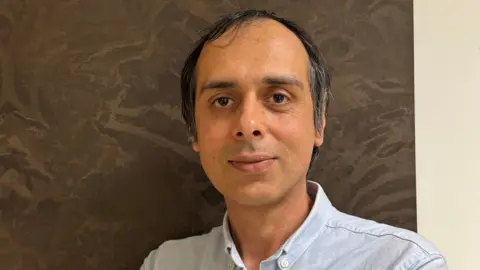
Moein Tayari runs Zoetic Ltd, a UK-based saffron supplier that sources produce from farmers in Iran.
He said the conflict means it is difficult to get product out of the country as there are no flights and so prices have almost doubled. Also the Iranian authorities have shut down the internet so e-commerce is not possible.
"The region is perfect for planting saffron because one drop of rain can destroy saffron. So loads of sunlight, no rain, are perfect," he said.
"We are getting calls from some traders in England [asking] if we can provide them with bulk saffron because they can't connect [online] to the Iranian market.
"But we can only tell them we have enough for 100g of saffron, or 200g maximum, not more than that.
"That won't do them any good, they need more than that," said Tiyari.
 Getty Images
Saffron is not the only ingredient under pressure following the outbreak of war in Iran.
Restaurant owner Mahmoud gets his chickpeas from Iran.
"I was buying it at £33 for the box and now it's £46," he said.
Zereshk, a tart and tangy dried berry often used in Persian rice dishes, has also increased in price.
"I was paying £9.50 per kilo (about 35 oz). Now it's £13 per kilo."
 Getty Images
The fragile truce between the US and Iran has come under further strain recently after President Donald Trump dismissed Iran's response to US proposals to end the war and peace talks as "totally unacceptable".
Iran's semi-official Tasnim news agency said Tehran's proposal, sent via Pakistan as mediator, called for an immediate end to the fighting, a halt to the US naval blockade, guarantees of no further attacks.
According to Iranian state media, the proposal also includes compensation for war damage and the assertion of Iranian sovereignty over the Strait of Hormuz.
On Sunday, Iranian President Masoud Pezeshkian did not directly reference Tehran's proposal but said: "We will never bow our heads before the enemy, and if talk of dialogue or negotiation arises, it does not mean surrender or retreat."
Trump rejected the plan in a post on Truth Social, saying he did not like Iran's response.
Listen to the best of BBC Radio London on Sounds and follow BBC London on Facebook, X and Instagram. Send your story ideas to hello.bbclondon@bbc.co.uk
