Ring unearthed in 'once in a lifetime find' sells

 Stuart Jones
A 400-year-old ring - described by the metal detectorist who unearthed it as a "once in a lifetime find" - has fetched thousands at auction.
The diamond cluster gold ring, which is thought to date back to the late 16th or early 17th Century, was discovered in Wormington, Gloucestershire, in November 2024.
Stuart Jones said he was "absolutely overwhelmed with joy" after finding the ring and added he would split the proceeds of the sale with the landowner.
The ring went under the hammer on Tuesday and was bought by an English phone bidder for £17,000. Jones said seeing it sell for that price was "beyond anything he could have imagined".
The 19.2 carat ring was examined by the British Museum and Laura Smith, a jewellery specialist who said the piece was in keeping with the style of the time which required "grand rings to make an impression from a distance".
"This ring has a flowerhead bezel composed of a cluster of eight hogback diamonds - which is very rare - although two are loose," she said prior to the auction at Noonans Mayfair.
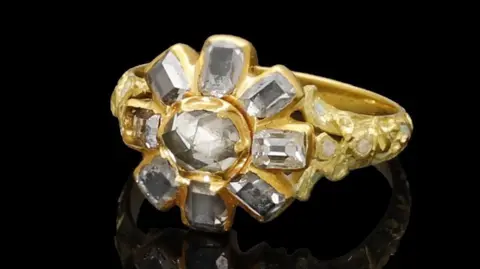 Noonans
Jones, who lives in Solihull, said knowing a "beautiful piece of Tudor jewellery, lost for centuries, had been appreciated by collectors and enthusiasts" was incredibly rewarding.
"From the moment the signal came through on my detector, I knew I had found something special, but I never expected the journey that would follow through the Portable Antiquities Scheme, the Treasure process, and eventually to auction," he added.
The Portable Antiquities Scheme is run by the British Museum and Amgueddfa Cymru - Museum Wales to encourage the recording of archaeological objects found by members of the public in England and Wales, often through metal detecting.
"The sale is not just about the value of the ring; it is about the history behind it and the privilege of being the person who helped bring an important piece of the past back into the public eye," Jones said.
The auction featured 14 metal detectorist finds, including a 17th Century gold ring with a memento mori skull motif which was discovered in a field in Lancashire.
Follow BBC Gloucestershire on Facebook, X and Instagram. Send your story ideas to us on email or via WhatsApp on 0800 313 4630.
