First discovery of an unexploded shell at Culloden Battlefield

 National Trust for Scotland
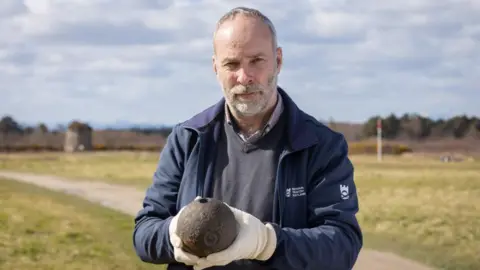
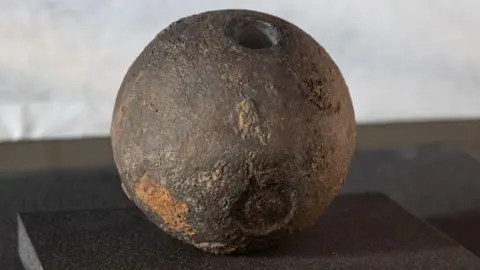
An unexploded mortar shell has been discovered more than 200 years after it was fired at the Battle of Culloden, say archaeologists.
The ordnance is thought to have been fired from one of six Coehorn mortars used by government troops against forces loyal to Bonnie Prince Charlie.
The shell, the first unexploded item to be found at Culloden, is believed to have landed in boggy ground where its fuse fizzled out.
The discovery was made during an archaeological dig last year and made safe by explosives experts. It has been revealed ahead of the 280th anniversary of the battle near Inverness on 16 April 1746.
Charles Edward Stuart, better known as Bonnie Prince Charlie, led a rising in 1745 to win the British throne.
The Battle of Culloden saw the prince and his forces face King George II's government army, led by the king's son, the Duke of Cumberland.
The prince was defeated and about 1,600 men were killed - 1,500 of them Jacobites.
It has been described as the last pitched battle to be fought on British soil.
 National Trust for Scotland
The National Trust for Scotland manages a large area of the battlefield.
Head of archaeology Derek Alexander said: "This is a remarkable - dare I say, explosive - find of the kind archaeologists dream of, but never expect to encounter."
Prof Tony Pollard, of the University of Glasgow, which was involved in the dig, said mortars were among the artillery deployed at Culloden.
A Coehorn mortar was a relatively lightweight, short-barrelled gun designed to fire explosive shells at a very steep angle.
The weapon typically fired hollow iron shells filled with gunpowder which was ignited by a slow-burning fuse.
