Swinney denies SNP grocery price cap is 'potty gimmick'

 PA Media
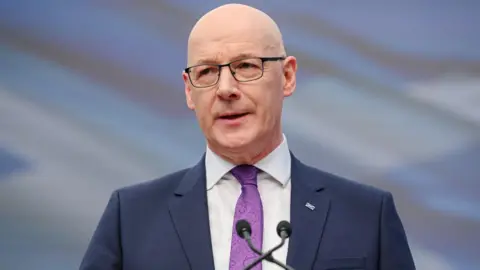
First Minister John Swinney has defended his plan to compel supermarkets to cap the price of some groceries following criticism from business groups.
Under the SNP manifesto pledge, large supermarkets would be compelled to limit the cost of goods such as milk, eggs, cheese and rice to help Scots with the cost of living.
The Scottish Retail Consortium called the policy a "potty gimmick".
Swinney, speaking to BBC Radio Scotland Breakfast, denied that accusation and said his party had proposed "bold" ideas to help people with rising prices.
The SNP manifesto also pledges to expand funded childcare and roll out a £2 cap on single bus fares, with the first minister insisting only his party had a "tangible" plan to help struggling Scots.
The document says the price of between 20 and 50 "essential" groceries would be limited in large supermarkets.
Retailers would be required to cap the cost of at least one variation of the listed items, such as one particular brand of bread, but would not have to cap the prices of all their bread brands.
Asked if the policy was a "potty gimmick", Swinney told BBC Radio Scotland: "No, it's about helping people who are really struggling in our society today."
He raised concerns about the "nutritional impact" of the cost of living, which has increased after the war in Iran pushed up the price of food and fuel.
The SNP leader added: "I'm acutely conscious of the gravity of the cost of living crisis that people are facing in their daily lives, and I'm bringing forward solutions to that in the manifesto."
The Food and Drink Federation Scotland, which represents manufacturers, said the policy had a "real risk of undermining investment, resilience and food security".
The Scottish Grocers' Federation claimed the proposals could create a competitive disadvantage for smaller local shops and "distort the market" by changing consumer behaviour.
The Institute for Fiscal Studies, meanwhile, described the price cap as "very radical and risky" – warning it could lead to shortages or reductions in quality.
To introduce the scheme, the Scottish government would likely have to agree a deal with Labour ministers at Westminster due to UK internal market rules which seek to limit trade barriers between the four nations.
However, a UK government source described the SNP proposals as "incoherent and undeliverable", warning they could face legal challenges.
Swinney told BBC Radio Scotland that his government would consult with industry groups and UK ministers while to find an "agreed way forward".
The first minister insisted he was "unrelentingly focused" on bringing down the cost of living.

He also said his ambition of holding a second independence referendum in 2028 was realistic, insisting there was "precedent" for another vote if the SNP won an outright majority on 7 May.
Any vote would need to be signed off by the UK government. However, Labour ministers have repeatedly refused to countenance a referendum, and have not set out how an SNP government could democratically secure a vote.
Swinney told the BBC there were "fundamental democratic issues at stake here".
He added: "If the UK government accepted in 2014 the result of the election of a majority SNP government in 2011 then that should be good enough in this occasion."
The SNP manifesto includes about £1.4bn in spending plans beyond what the current Scottish government has committed to – including more than £500m to expand childcare provision and more than £200m to subsidise bus travel.
The party said the pledges would be funded by increased tax revenues and extra cash from Westminster, coupled with efficiency savings.
David Phillips, head of devolved and local government finance at the IFS, said the SNP had failed to give a credible explanation of how it would pay for its proposals, warning they would likely require "further tax rises or deeper cuts to lower-priority spending".
The manifesto said that independence would allow the government to build a "fairer and more prosperous" country.
But Phillips warned that while independence could lead to higher economic growth, it would likely add to financial pressures in the short term. He said this is because Scots benefit from more public spending per person than people in the rest of the UK, citing Government Expenditure and Revenue Scotland figures.
