'Tiny' Roman penis charm found at cricket club

 Pete Savin
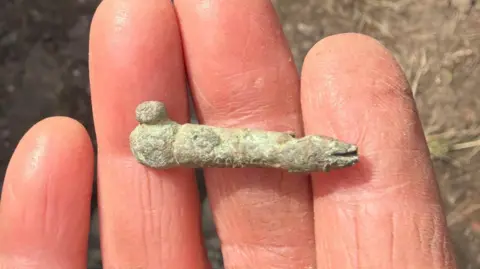
A "tiny" penis-shaped Roman artefact thought to have been intended to bring good fortune has been discovered by archeologists excavating land around a cricket club.
The bronze 1,800-year-old phallus was unearthed at Carlisle Cricket Club in Cumbria during a dig which started in 2017.
Historians believe the site to be home to an ancient bathhouse and have already found pottery shards, pillar fragments and various large stone heads.
Site director Frank Giecco said the Romans were "extremely superstitious" and the phallus was intended to be "a good luck charm".
"It's our first little phallus, it's tiny, it's bout 3cm (1.2in), but beautifully made in bronze," Giecco said.
He said such mementos would often have been attached to belts, carved into walls or worn as jewellery "to protect you".
During their yearly digs, volunteers for the team have found thousands of significant items including from the Bronze Age, the English Civil War and the Edwardian period, Giecco said.
 Anna Giecco
He said: "It's unusual we haven't found a phallus shaped object on the site before, it's so rich in other types of objects.
"It's a beautiful little object"
Giecco said the discovery "gives a fantastic insight into the minds of people who lived in Carlisle 1,800 years ago".
He added "All of us give up huge amounts of time for this project to make it work.
"The joy of pulling a bit of pot out of the ground that hasn't been touched for years is incredible."
New items from the dig have been displayed at the Tullie Museum and Gallery.
