Dog walker finds 3,000-year-old axe head in forest

 Forestry England
A sharp-eyed dog walker made an extraordinary discovery when he spotted what is believed to be a Bronze Age axe head during a walk through woodland.
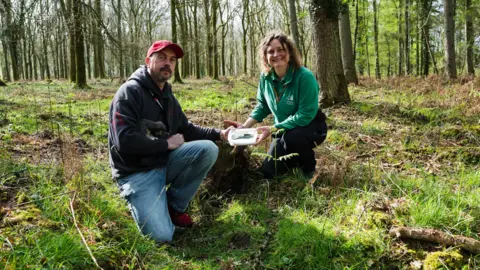
John Smith was walking his puppy through the Forest of Dean, near Brierley, when he noticed the artefact, believed to be more than 3,000 years old, poking out among the roots of a fallen tree.
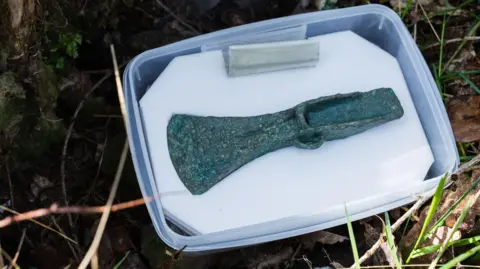
He said the copper alloy axe head "just sparkled the most beautiful green colour" due to a layer of verdigris that had built up over millennia as the metal was exposed to oxygen and other elements in the soil.
Cotswold Archaeology, which is documenting the axe in a virtual museum, believes it dates between 1400-1275 BC, making it about 3,400 years old.
Smith handed the axe in to Forestry England, which manages the woodland, for recording and investigation.
He said: "I knew it was old because of the intensity of the green, so I thought I've got to get it out and hand it in and let everyone else enjoy it."
Smith, who lives in the area, said: "I just decided to bring the dog for a nice walk somewhere I hadn't been for a long time.
"My dog ran off, rooting around, so I went to go and get the dog and, as I looked down in the roots, I saw the axe head - it just sparkled the most beautiful green colour.
"It was just wedged in one of the holes, so I pulled it out and there it was."
 Forestry England
Leoni Dawson, community ranger for Forestry England, said: "It's incredible to think that tools like this have survived for thousands of years, hidden beneath our feet.
"Finds like these help us connect with the people who lived and worked in these landscapes long before us."
The axe will now be cared for by The Dean Heritage Centre.
Objects conservator Kayleigh Spring explained: "Known as a Palstave Axe, it is made from a copper alloy most likely bronze, a mix of copper and tin.
"This tool was originally cast in moulds. Early Bronze Age moulds were simple hollowed stones, but by the Middle Bronze Age, two-part moulds allowed for more sophisticated designs like this one."
Spring added: "Its side loop was used to secure the blade tightly to a wooden handle with cord, preventing movement during use."
The axe is now housed in The Dean Heritage Centre near Soudley.
Follow BBC Gloucestershire on Facebook, X and Instagram. Send your story ideas to us on email or via WhatsApp on 0800 313 4630.
