'Our teachers use AI to mark mock exams'

 Getty Images
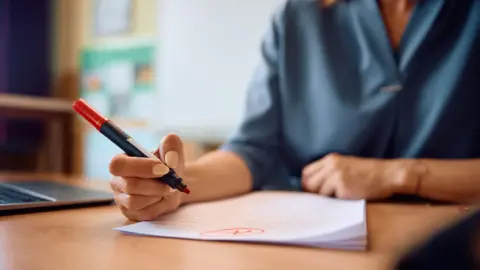
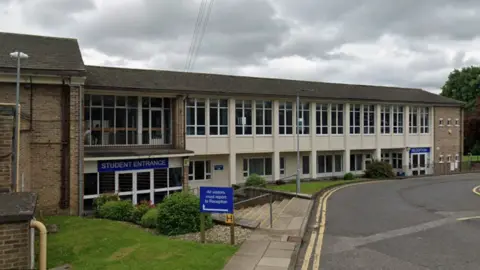
A school in the Yorkshire Dales is trialling the use of artificial intelligence (AI) to mark students' mock exams.
Wensleydale School is thought to be one of the only schools in the north of England to implement the technology.
Headteacher Julia Polley said AI could give pupils more detailed feedback quickly and without any bias that a teacher might have by knowing the student personally.
In the short term, she said it had increased teacher workload rather than cut it because they had still been marking alongside the technology.
The school became aware of a company which was trialling AI marking in English, history, geography and business, which tend to be subjects with longer answers.
"They're quite wordy so you could argue that a lot of subjective marking could happen," Polley said.
"Our staff marked the papers as well so it wasn't like they were just using it as a 'we don't have to do any marking'.
"We just wanted to see whether AI would be accurate, whether it would misinterpret anything and what sort of feedback it would give us.
"We have to say that we were really impressed because AI marking gives detailed feedback to the students, which teachers can do but it takes a long time to do it."
'Staff were aghast'
At a cost of 45p for an extended answer to one exam question, the headteacher said the system could be seen as an expensive option, especially for large schools.
Wensleydale School decided to set an initial spend of £600, purchasing 1,250 credits to be used on English and history mock exam papers.
The technology required teachers to barcode and upload each exam question individually for each credit, which was a challenge initially.
"The only thing I was worried about is some misconceptions that teachers were trying to shirk their duty of marking and that's not the case at all," Polley said.
"Our staff were absolutely aghast to start with, saying 'but we want to mark our papers' because they want to know where their students are at.
"So I think it will always be used as a tool just to reassure and it's like a sense check to make sure what we are saying is right with what exam boards will say."
AI could also help to keep the marks as "depersonalised" as possible, according to the headteacher.
"We don't want our teachers to interpret what the kids have written and give them the benefit of the doubt because they know them and they know they're trying hard," she said.
"That was the bit that we were trying to unpick, AI won't see it that way."
Moving forward, the school hopes to use the technology for end of topic tests and practice exam questions.
 Google
Dr Theocharis Kyriacou, who is associate professor of AI at York St John University, explained government guidelines on the use of AI in schools were only produced a year ago.
The Department for Education made it clear teachers could use AI but they needed to use their professional judgement to check anything generated was accurate and appropriate.
"The final responsibility always rests with them and their school or college," a DfE spokesperson said.
"It's still in its very early adoption phase, so there is interest and experimentation from schools, and that's rising rapidly," Kyriacou said.
"But deployment and use is patchy and uneven at the moment, it's still only used for low stakes tasks, such as drafting feedback, quizzes or resource creation."
According to the professor, pupils would benefit from consistent marking and faster feedback with AI but it could also be a game changer for teachers.
"It's very widely accepted that teachers are overworked. (They work) about 50 hours plus a week and that's unsustainable," he said.
"It's time at the end of the day, it saves them time producing extensive and detailed feedback and personalised feedback for their students."
However, he warned completely outsourcing marking would not be a good use of AI, as it would take the skill out of the hands of teachers.
"On the other side of how the student perceives being marked by AI, I've looked at some conversations on different forums and I can see that there's this distrust and dislike about being marked by AI," Kyriacou added.
"There can be distrust from parents if they don't understand how these things are used."
'Must be transparency'
The National Association of Head Teachers (NAHT) backed the AI marking trials in schools.
Sarah Hannafin, head of policy, said: "AI tools have the potential to deliver opportunities for the education system and reduce administrative burdens on teachers and school leaders - allowing them to focus on areas where their expertise can have the greatest impact.
"The potential for teachers to be supported by AI tools in the marking of mock exams should be explored and trials enable schools to evaluate the benefits and challenges for both staff and students.
"Importantly, there must be transparency for everyone about when and how AI tools are used and they must remain open to challenge."
Listen to highlights from North Yorkshire on BBC Sounds, catch up with the latest episode of Look North.
