AI may speed up search for drugs to treat brain conditions

 BBC
BBCScientists are using AI to accelerate the search for treatments for neurological conditions that may be hiding in plain sight.
Researchers at the UK Dementia Research Institute in Edinburgh analyse patient data including voice recordings and eye scans, as well as lab-grown brain cells, to identify whether existing drugs could be repurposed to treat conditions such as motor neurone disease (MND).
The scientists hope that by using algorithms to detect patterns of disease and predict suitable medicines, effective treatments could be found in "years rather than decades".
That hope is shared by trial participant Steven Barrett, who was diagnosed with MND 10 years ago.
Steven had been planning his active retirement after a long and decorated career in the civil service, when he began to notice a numbness in his leg.
A few years later he was diagnosed with MND - a degenerative neurological condition which does not yet have a cure.
"MND is a horrible disease, it strips you of who you are," he tells the BBC at his home in Alloa, Scotland.
"It rips any sense of future that you may feel that you had planned for yourself - all that goes."
His family also did not see it coming, Steven says - showing us photos of himself at work, at parties and at his son's wedding.
But he describes the trials as a "bright light" of hope for himself and others with MND or similar conditions.
One such trial, MND-SMART, sees several drugs tested at the same time as opposed to one group given a treatment and another a placebo.
"For me the research is much more than taking a tablet - it's taking a tablet with the intention of delivering outcomes, that may or may not help me but help others," he says.
The Institute is also building a database of people with conditions including Parkinson's, Dementia and MND.
Clinicians are gathering iris scans, voice recordings and harnessing AI to crunch through and curate masses of data to spot signs of change that may be early indicators of future problems.
Additionally, they collect blood samples from their volunteer patients to cultivate stem cells into groups of brain cells called neurones.
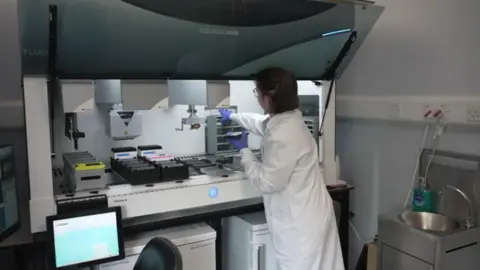
Existing drugs are then tested on multiple batches of those neurones using a combination of robots, traditional lab equipment and computers powering specialist algorithms.
These machine learning algorithms have been trained to identify drugs that could convert the neurological disease signature into a healthy one.
Drugs which the AI suggests might work can then be put into clinical trials involving people like Steven.
Unleashing AI
There are around 1,500 drugs which have been developed and approved to treat other conditions.
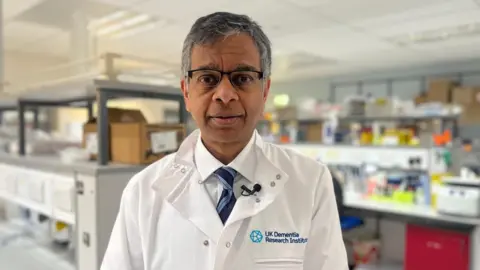
But Institute chief executive Prof Siddarthan Chandran says it is possible that even one of them could also be effective in the brain and we just don't know it yet.
"The brain is the most complicated organ in the body, so we've got to contend with the paradox of that complexity," he told the BBC - adding that until recently, this meant using less sophisticated methods of study.
"A combination of AI and new technologies mean we can now do things which would have been unbelievable when I was at medical school."
Because the drugs have already been developed and approved, redeploying them can be more straightforward than starting from scratch with new formulas.
Discovering new drugs and getting them to market can take a long time - more than 10 years, according to some estimates.
But Prof Chandran and his team believe their work means affordable, effective drugs for neurological conditions could come much sooner.
The research is not the first to explore how AI can surface potential solutions hidden in mountains of health or medical data.
Scientists at the Massachusetts Institute of Technology in Cambridge, US, have used generative AI to identify novel antibiotic compounds that might be able to treat superbugs including gonorrhoea and conditions such as Parkinson's.
And in 2024 researchers at Harvard University developed a neural network model called TxGNN to surface existing drugs which could be used to treat rare conditions.
But there have been setbacks in the wider field of research.
A recent review of lecanemab and donanemab, once hailed as "breakthrough" drugs to treat Alzheimer's, found despite slowing its progression it was not significant enough to make a meaningful difference to patients.
It looked at 17 studies, involving 20,342 volunteers, of drugs that remove amyloid - a misfolded protein present in disease - from the brain.
Its conclusion sparked a backlash from other scientists.
But Professor Chandran remains confident "we're at the tipping point of change" in neurological research and understanding.

Sign up for our Tech Decoded newsletter to follow the world's top tech stories and trends. Outside the UK? Sign up here.
