Our son's final days were transformed by a hospice, but we only discovered it by chance

 Venture Studios Cardiff
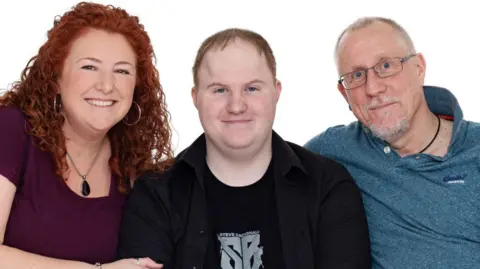
Daniel Bugg was just 16 when he died from cancer.
His final three months were transformed by the care he received at a children's hospice, his parents Catherine and Jonathan have said.
But they only found out the hospice could help them after they started taking Daniel for a shower at a local leisure centre when they became unable to get him up the stairs at home.
His story is similar to many young people with life-shortening conditions who are being "pushed to the limits" by a lack of awareness about hospice care, according to a new report published by Wales' child hospices.
The Welsh government says it wants to ensure that people get the care they need, including hospice care for children.
Daniel, from Barry, was diagnosed with osteosarcoma in 2021 shortly after his 14th birthday.
When his right leg was amputated above the knee two years later, Jonathan and Catherine had to take him to their local leisure centre for a shower because he could not go upstairs to the family bathroom.
They said it was only then that an occupational therapist told them about Tŷ Hafan children's hospice in the Vale of Glamorgan, where Daniel would go on to spend the final few months of his life.
 Family photo
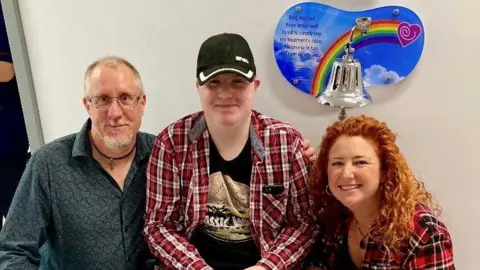
Jonathan and Catherine said the hospice care meant they were able to concentrate fully on being a loving mum and dad, making every moment matter with Daniel, his brother and two sisters.
"When you say, 'it's where children are ill and go to die' you expect it to be gloomy and everyone walking around with sad faces [but] it's just an amazing place," said Jonathan, 61.
"It was somewhere that Daniel, in his last months, grew to love and instead of it being that place where children go to die, it was that place where our son went to live for the last months of his life," he said.
"That difference doesn't sound as huge as it actually was, but that's the best way I can say it."
Daniel made his first visit to the hospice in August 2023 before deciding to go to the hospice for full-time care in December.
He died on St David's Day, 1 March 2024.
"I can't even begin to imagine it without that gift of Ty Hafan, without that team around us who guided us through the fun and the awful," said Catherine.
"I can't imagine if we didn't have them what this would have looked like for us and so what this looks like for other families, it's almost too awful to try and imagine really."
Wales has two children's hospices, Tŷ Hafan and Tŷ Gobaith in Conwy.
A joint report has found that families are "routinely" left to navigate a "fragmented and complex system of health and social care, and often reaching crisis point before support arrives".
It found that healthcare professionals did not always feel confident talking to families about hospice care and needed more support with "difficult conversations".
It also suggested "a lack of information from the outset" leaves many missing out on support entirely.
The report has called for urgent, system-wide change so families can get the help they need earlier, and more easily.
'Not everyday conversations'
Tracy Jones, director of family wellbeing and outreach services at Tŷ Hafan, said she could understand why some healthcare professionals did not want to suggest hospice care to families of children and young people with life-shortening conditions.
"These are not everyday conversations," said Tracy.
"Having that conversation, to say to a family, 'We think your child may not live into adulthood, have you thought about using a hospice service?' is a really difficult conversation to have and that's one of the things that comes out really strongly.
"What can we be doing as a sector to help the professionals who are in daily contact with these families feel more confident about having those conversations?"
Tracy said she hoped the publication of the report would lead to a more formal partnership between health and care professionals and the hospices, with awareness about hospice services becoming part of induction programmes for staff.
She said those working with families should be actively encouraged to visit the hospices to see and understand what they can offer.
A spokesperson for the children's commissioner for Wales said Daniel's family's story "closely echoes what we have heard time and time again for families with children with complex health as well as life-shortening conditions".
"What families need is a joined up system where health, social care, education and other services work seamlessly together. Families should not have to fight for the care and support their children need."
The Welsh government said it was committed to working with health boards, care providers and other relevant stakeholders "to develop a sustainable, long-term funding model".
"The new hospice commissioning approach seeks to promote fair access, long-term sustainability and high-quality, compassionate care across Wales," it added.
