What does uni merger mean for students and staff?

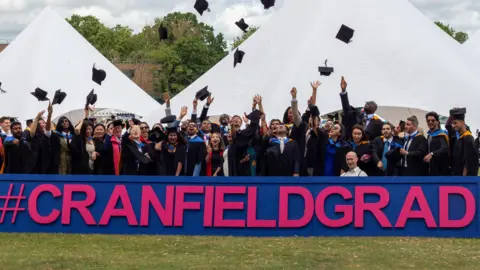 Cranfield University
Cranfield University is becoming part of King's College London, despite its location in north Bedfordshire.
Prof Dame Karen Holford, chief executive and vice-chancellor at Cranfield University, said the merger would "create a global university" delivering excellence with "purpose, drive and scale".
So what do these plans – due to take effect in August 2027 – mean for staff and students? And will more mergers follow?
'Staff need reassurance'
 Cranfield University
Cranfield said it had briefed the University and Colleges Union (UCU) on the merger.
A spokesperson for UCU said: "Staff and students from both institutions will rightly be concerned about future provision, and the universities now need to provide guarantees that no jobs or courses will be cut."
The BBC also spoke to Frances Miles, regional organiser with union UNISON, shortly after the merger was announced.
She said staff were "worried" about what it would mean for them.
"Generally, there are risks in any merger that staffing will be cut to save money, and we need reassurance that this isn't a smokescreen for more cuts and that the jobs are secure," she added.
However, Holford said that staff and unions did not need to be alarmed.
"We don't anticipate job losses – the merger is not predicated on job losses, so people should feel secure in that," she said.
Holford pointed out that the university had previously made a series of staffing cuts.
She added: "Cranfield has already been through an exercise where we focused on our core strengths. We cut some courses, and we did have to have some job losses along with that.
"We're hoping to recruit more people, and actually, the five-year plan is for growth in the number of people, not for shrinkage."
Campus and courses
 Cranfield University
Although the institution will no longer be called Cranfield University when the changes take effect, Holford said "all of our campuses will remain the same".
"We will be located at Cranfield, and we will retain brands such as Cranfield School of Management, Cranfield Defence and Security," she said.
"In fact, our campuses are part of the attraction for King's to work with us: you can imagine delivering engineering in London is pretty hard - you don't have much space to deliver large-scale facilities."
Holford said "nothing changes" for current students, whose courses would "carry on".
However, Cranfield, which exclusively offers post-graduate courses, could "have the exciting opportunity of perhaps considering undergraduate courses focusing perhaps on engineering".
'A shock, but exciting'
 Kate Bradbrook/BBC
Zahra Karimi, president of research and education at the Cranfield Student Association, said the merger was "very exciting news for all of our students, because it's about growth and collaboration with another university".
The third-year PhD student said her fellow students were also "excited".
She continued: "To be honest, we thought that the university was going to become smaller and smaller. But now we are so happy it is going to be joined to a bigger university.
"Research culture is very strong in Cranfield, and we have strong collaboration with the industry and with government. So I think it will be a complementary part for both universities.
"We're happy about the future effect on teaching and research, which will be great because we will be part of a bigger scientific community."
A sign of things to come?
 King's College London
Holford was keen to portray the merger as a no-brainer for both institutions.
"It was actually truly remarkable when we looked through all the portfolios and realised there's very few areas where we overlap. King's offers things that we don't, and we offer things that King's don't," she said.
However, with 40% of English universities believed to be in financial deficit, could mergers become more common, with Cranfield following on from Kent and Greenwich?
"I do think that there will be other universities, probably as we speak, considering mergers," Holford said.
The regulator for higher education in England, Office for Students, said it was seeing a growing interest in universities collaborating, including through potential mergers.
A spokesperson said this could be "for a range of reasons, not just financial".
"It's always exciting to see institutions forge strategic partnerships, and we wish Cranfield University and King's College London the best as they set out a new vision for the future", they added.
 Cranfield University
However, the UCU saw it in a less rosy light.
"Once you strip away the positive spin, it is clear university mergers are often a symptom of severe financial pressure, and this is being felt across the sector," their spokesperson said.
"Instead of mergers and acquisitions designed to paper over cracks, we need a proper response from government that protects jobs, student provision and local economies," they added.
A Department for Education (DfE) spokesperson recently said the government was committed to creating a secure future for universities so they can deliver for students, taxpayers and the economy.
Do you have a story suggestion for Beds, Herts or Bucks? Contact us below.
Follow Beds, Herts and Bucks news on BBC Sounds, Facebook, Instagram and X.
