Universities merger to create 'global' institution

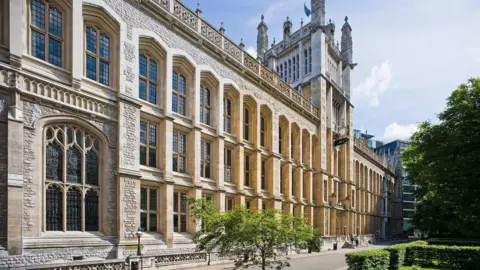 King's College London
Two major universities are to merge in a move that will build on their collective strengths in engineering, energy and defence.
Cranfield University in Bedfordshire will become part of King's College London from August 2027.
Prof Shitij Kapur, vice-chancellor and president of King's College London, said it was "a deliberate step to bring some of the best of UK to compete with the best in the world".
He added that the merger "would bring new educational possibilities for students, new discoveries from academics and a clear focus on working in partnership with industry and government to support national resilience".
 Cranfield University
The proposed merger will create a UK university specially equipped for the changing world, building on the existing individual strengths of each institution across:
- Engineering and Technology- aerospace, advanced manufacturing, AI and robotics
- Environment and resources – water, soil, food systems and climate
- Energy – hydrogen, batteries and net zero systems
- Economy, industry and leadership – productivity, skills and innovation
- Society and policy – health and life sciences, regulation and public leadership
- Security and Defence – expertise spanning science, strategy and operations.
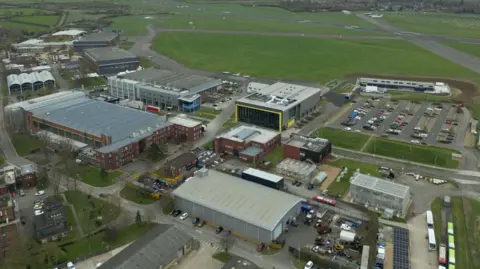 Cranfield University
The move follows the merger of the universities of Kent and Greenwich in 2025.
As a specialist postgraduate university, Cranfield will benefit from the interdisciplinary breadth and scale of King's.
King's, in turn, will be strengthened by Cranfield's world-renowned expertise in technology, engineering and management, alongside its deep and long-standing partnerships with industry and government.
Prof Dame Karen Holford, chief executive and vice-chancellor at Cranfield University, said the merger would "create a global university" delivering excellence with "purpose, drive and scale".
She added that they would continue their mission to tackle real-world issues with "Cranfield University's outstanding applied research... and long-standing industry links to King's".
Lord Patrick Vallance, science minister, said the merger "creates an extraordinarily powerful university".
"It holds huge potential for the Oxford-Cambridge Growth Corridor" and gives "King's a place at the heart of one of our most important regions for science and technology", he said.
Do you have a story suggestion for Beds, Herts or Bucks? Contact us below.
Follow Beds, Herts and Bucks news on BBC Sounds, Facebook, Instagram and X.
