England's largest forest marks its centenary

 Neil Denham/Visit Kielder
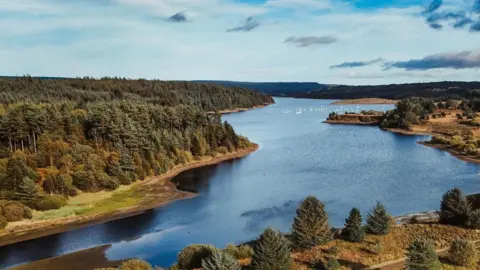
In April 1926, a small area of experimental planting of trees took place in a remote area of northern England. It would lead to the country's biggest forest, which a century later spans 250 sq miles (447 sq km) across Northumberland and Cumbria, with 158 million trees mostly planted by hand. So how did Kielder Forest become what it is today?
Forestry England's Alex MacLennan has worked at Kielder for more than 20 years.
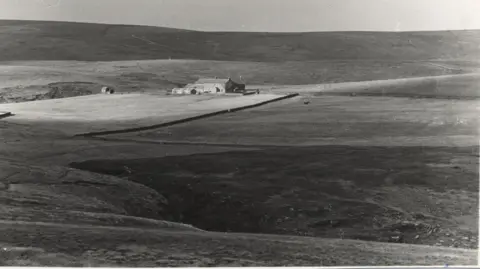
"It was quite a foreboding place before, not great for farming, the site of lots of feuding, what we know now as the Border Reivers," he said.
"An area of low population density, little valleys tucked away, almost hidden really."
 Woodhorn Museum
After the demands of World War One, woodland covered just 5% of Britain and the Forestry Commission was set up in 1919 to change this.
Roy Lister Robinson, who would later become Lord Robinson of Kielder, was despatched from London and identified the area of moorland around Kielder Castle as a possible site.
After trials, large scale planting began in the 1930s.
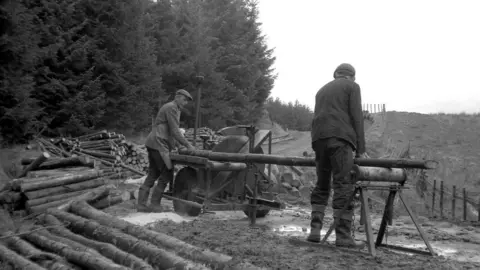
But it was not until after World War Two in 1948 that the first mature trees were felled.
 Forestry England
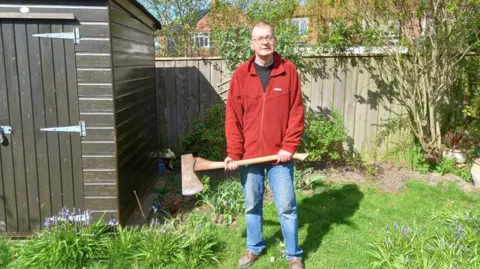
Ian Fraser's grandfather Jack Anderson was there from the beginning.
Employed from 1926 at the site of the first experimental planting at Smales Farm, he and his family lived at Stannersburn until 1950.
"They all loved it there," Fraser said. "Although there was a lot of travelling to school for my mum.
"I remember asking how my grandfather coped with all the midges and mum said he was as hard as nails."
A tree will be planted above Stannersburn, near Falstone, on Saturday to commemorate the moment when the forest began.
 Ian Fraser
Additional labour for the planting came from the Government Instructional Centre, which opened just south of Kielder in 1933 and offered courses to the long-term unemployed from Tyneside and Scotland who were housed in hutted camps.
After the end of the Second World War, chainsaws began to replace the handsaws as the work became more mechanised.
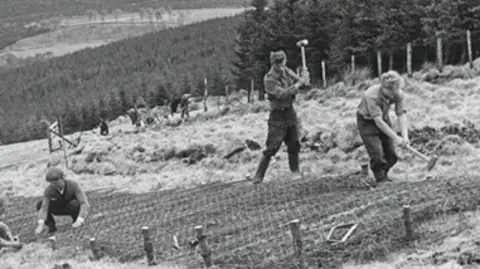 Bellingham Heritage Centre
Eight new villages were planned for the workers, but in the end only three were built: Kielder, Byrness and Stonehaugh.
The main buyer for the timber was the National Coal Board for pit props used to hold up the roofs of underground mine tunnels.
Another big change came with the construction of Kielder Water which opened in 1982, making it the biggest constructed lake in northern Europe.
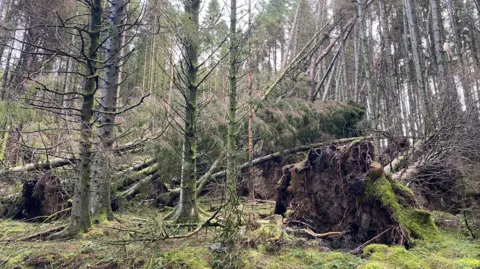
A century after the first tree was planted, Kielder Forest produces half a million tonnes of timber a year used in construction, furniture and biomass plants generating renewable energy.
But MacLennan says Kielder is also an important centre for tourism and wildlife, home to 50% of England's red squirrel population, alongside ospreys, wild goats, otters and water voles.
"The dark sky economy alone is worth £28m each year with hundreds of star-gazing events and we also have the largest collection of off-road cycle trails in the UK," he said.
"We owe so much to those early pioneers who saw the potential of the area and who knows what Kielder Forest will be in another hundred years time?"
