Meet the South East Water staff trying to keep the taps running

 BBC
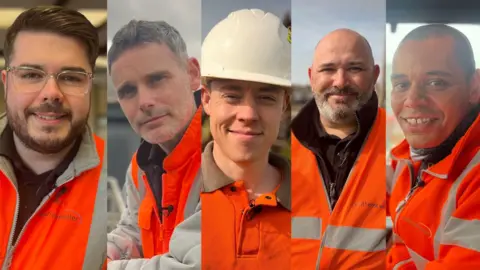
BBC"We've got a good team," says Steve Judson who works for South East Water as a leak detection technician.
He is one of hundreds of front-line staff at the water company working to try to keep the taps running.
After multiple water supply failures in recent years, across Kent and Sussex, South East Water is facing a £22m fine from Ofwat, three ongoing investigations from water regulators and a huge amount of criticism from politicians and customers.
The people working on the water tankers, at treatment works and fixing leaks are not highly paid executives receiving large bonuses, they are the people who don hi-vis and work night and day in a system that is often failing.
South East Water's chief executive, David Hinton, is due to be questioned by MPs later.
The BBC spent several days following South East Water staff to see what goes on behind the scenes in a company trying (and not always succeeding) to supply its 2.3 million customers with drinking water.
The leak detective
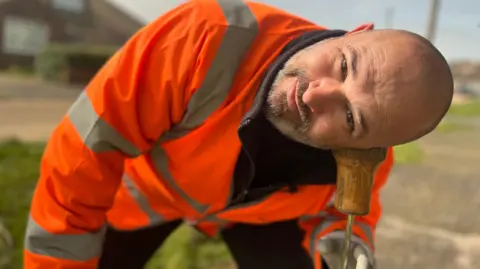
"Sometimes you can't beat the old tools," says Judson. He is methodically moving down a street in Peacehaven, lifting every inspection hatch and putting his ear to a wooden block attached to a long metal pole.
He is listening for the sound of running water; on the hunt for a leak.
A team back at base have analysed data on water flow rates and know there is a leak along the road somewhere - it is his job to find it.
"Generally speaking all year round there's always leaks out there to be found," says Judson. But he says after storm Goretti in January it was "all hands on deck" after a series of pipes burst, leaving thousands of people without a supply.
"You were literally finding a leak, raising the job with the repair team then moving straight on to the next one," he says.
 Fiona Irving / BBC
After picking the leak up on his listening stick, Judson puts two small audio monitoring devices down the inspection hatches to try to pinpoint exactly where it is.
He wants to get as much evidence as possible about the location of the leak before the repair team are called in.
"Otherwise we'll end up with holes everywhere [on the road] and we don't want that," he says.
Once, Judson says, it took him two weeks to find a leak. He admits it was "horrible" to know that water was going that amount of time.
Today's leak has been fairly straightforward to find.
Judson thinks it is right by the mains stopcock - he marks up the area with blue spray paint and calls in the repair team.
The leak repairer
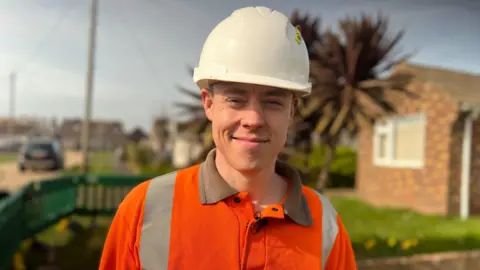
Lee Pickett is an expert at digging holes. "I find a lot of china for some strange reason," he says.
As he peels off the tarmac around the area that Judson has identified he cautiously starts to dig down.
"We don't want to hit our own pipes," he explains. "We'll potentially make the leak worse."
It is not just the water pipes Pickett has to be careful of. Gas pipes, electric and internet cables are all a potential hazard.
Water pipes are often the deepest pipes in the ground to try to stop them freezing.
At a certain depth Pickett starts to dig by hand. "Sometimes it's easier," he says.
 Fiona Irving / BBC
Pickett says he enjoys his job but agrees that the public are not always that welcoming of the roads being dug up.
"No one likes disruption, we've all got places to be," he says.
But he says the job is rewarding: "It's good getting that satisfaction, going home at the end of the day that you've made someone's day a little bit better by repairing the leak for them."
After digging for over an hour he pulls out a faulty mains stopcock and replaces the whole system with a new one.
"There you go," he says, "no more leak."
The tanker driver
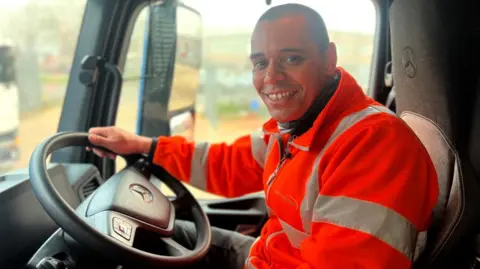
Driving a huge tanker with 30,000 litres (6,599 gallons) of drinking water sloshing around in the back can make you feel a little sea sick, but HGV driver Alex Colston says "you get use to it".
Colston has worked for South East Water for just over a year and was hired after the company bought a fleet of new tankers to help support the water network in times of crisis.
Since then the tankers have been used in multiple incidents, injecting water into the network to try and keep the taps running.
Colston admits "it can be demoralising" working in a company that is facing so much criticism and pressure. But he says: "We like to think that we're able to make a difference."
During the Tunbridge Wells supply issues before Christmas, Colston says it was "pretty full on".
The South East Water tankers were used "extensively" to support critical services like Pembury Hospital and the dialysis centre.
 Fiona Irving / BBC
Colston also tests the turbidity or cloudiness and chlorine levels of water he is transporting.
"It's a really important part of the job," he explains, as he has to make sure the water is still safe to drink before putting it into the network.
Colston says driving a huge tanker around the South East's narrow country lanes can be "quite tricky".
"The assets and the infrastructure definitely pre-date the concept of fresh water tankering," he says.
The treatment works team
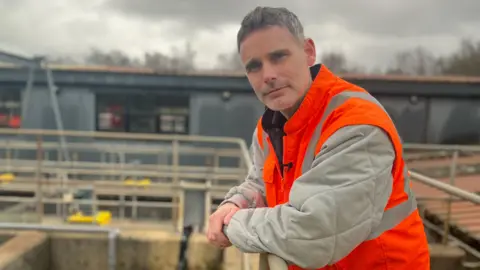
A year ago Tom Exeter was a builder, now he's in charge of Bewl Water Treatment works, a South East Water site that is more than five decades old.
"I've sort of been thrown straight in, in the deep end," says Exeter. "It's been a bit of a learning curve." But he says he likes the challenge.
 Fiona Irving / BBC
And the 1970s works has proved a challenge.
After storm Goretti in January, water coming into the site off the boreholes and reservoirs reached turbidity or cloudiness levels four times higher than they would normally hope to see.
"It's not great to be honest, the filters were struggling with the higher turbidity. Basically the whole site was struggling," Exeter said.
In late February, problems again at the site led to 1,700 homes in the area losing water supply.
Exeter explains that he could not put into supply some of the water that was being produced because of the high turbidity.
"I do understand the customers' frustrations," he says.
He says though things do not go wrong too often, when they do it can be fairly stressful.
 Fiona Irving / BBC
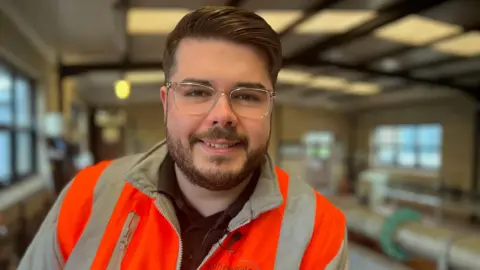
Lewis Huston is working on a £61m upgrade project at Bewl Water Treatment Works.
"We have a myriad of issues as a treatment works," he says.
"It's a complicated process, so doing good maintenance is something that just keeps everything running."
In the main control room of the site a log book lists the daily faults at the site, including failing valves and problems with power.
"I wouldn't say something goes wrong every day," says Huston.
Huston says part of the upgrade words is replacing valves on machinery and putting in an "uninterruptible power supply".
He has also helped work on the installation of two new pumps, which now pump drinking water to Cottage Hill reservoir in East Sussex, as part of trying to build resilience.
In the summer of 2023, that treated water reservoir ran critically low after a prolonged heatwave and thousands of people in the Wadhurst, Rotherfield and Mayfield area lost supply.
"It's never nice waking up in the morning and seeing the company on the news," he admits.
But he adds: "I quite like solving problems and issues and I want to be involved."
You can watch South East Water's chief executive being questioned by MPs live on the BBC News Website and BBC Kent Facebook page. Coverage begins shortly before 9.30 BST on Tuesday 14 April.
Follow BBC Kent on Facebook, on X, and on Instagram. Send your story ideas to southeasttoday@bbc.co.uk or WhatsApp us on 08081 002250.
