Nurse's life changed by pioneering heart surgery

 The Royal Wolverhampton NHS Trust
A nurse with an irregular heart rhythm has said her life has been transformed after undergoing a new form of heart surgery.
Judy Lloyd, 63, was diagnosed with atrial fibrillation (AF) seven years ago which left her too fatigued and weak to carry out her everyday activities.
"I started getting very tired and would have to stop the car on my way back from meetings to rest. I had very little energy," the ear, nose and throat nurse from Oswestry recalled.
In an attempt to treat the condition, she underwent an all box clamping (ABC) procedure, a minimally invasive operation, at New Cross Hospital in Wolverhampton.
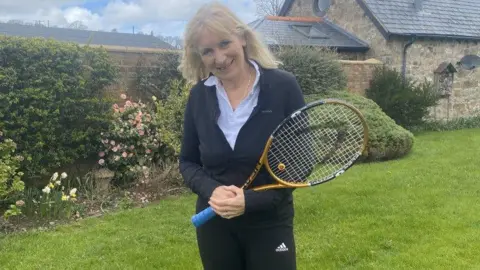
"I used to love playing tennis but had to stop as I was really struggling to play," she said.
"There were also several times when I could feel my heart fluttering, which felt like someone was banging on my chest from the inside. I was even struggling to pull an empty wheelie bin back on to my drive. I had to pace myself."
Atrial fibrillation is estimated to affect more than 30 million people worldwide, according to the Royal Wolverhampton NHS Trust.
Symptoms include palpitations, dizziness, fatigue and chest pain. Major risks include stroke and heart failure, often caused by high blood pressure, heart disease or ageing.
The new keyhole surgical procedure does not require the heart to be stopped and aims to remove tissue from the back of the heart using special clamps.
'Completely transformed'
"At the same time, a clip device (AtriClip) is applied to close off the left atrial appendage. This not only helps restore normal rhythm but also reduces the risk of AF‑associated stroke by 33%," explained consultant cardiac surgeon Nicolas Nikolaidis.
He added: "Recovery time is very quick, and the majority of patients go home the next day."
The procedure was first introduced at the hospital in June last year, and so far 16 patients have been treated with it.
Lloyd said: "I feel so much better now. I am working three days a week with a heavy workload, and I am playing tennis again in the Cheshire League. I have even started pickleball.
"It has completely transformed my life. I hardly have to take any medication any more, and I have so much more energy."
Follow BBC Wolverhampton & Black Country on BBC Sounds, Facebook, X and Instagram.
