The fight to stop history vanishing in flames

 Up In The Sky Droneography
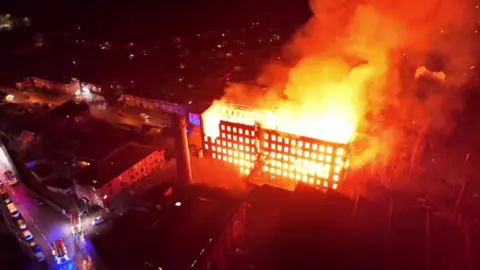
Sad, emotional, a major loss – some of the words used by a community after a disused 19th Century mill was gutted by fire.
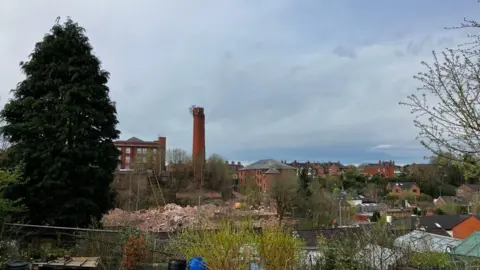
The Big Mill in Leek, Staffordshire, had stood since 1857 until it caught fire on 27 March and was then demolished for safety reasons.
Those evacuated from their homes returned to see what was once a cherished monument to their town's industrial heritage reduced to nothing more than a pile of charred rubble.
"This was probably the best of Leek's mill buildings. It certainly lived up to its name. It is undoubtedly a major loss to the skyline," said Mike Gledhill, leader of Staffordshire Moorlands District Council.
An 18-year-old man was arrested on suspicion of arson shortly after the fire and was later released on bail while investigations continue.
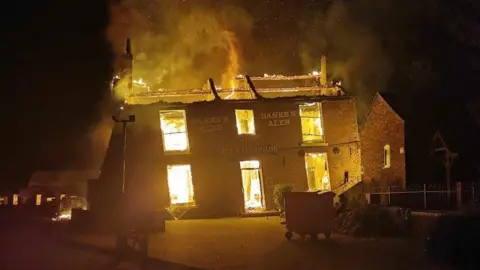
The blaze was the latest in a number of unconnected cases in which historical buildings in the West Midlands have been lost or damaged in blazes.
The Crooked House in Himley, near Dudley, The Leopard in Stoke-on-Trent, The Bilston School of Art in Wolverhampton and The Raven in Droitwich, Worcestershire, are just some examples.
Losing such buildings can have a major effect on communities, experts say.
 Chris Green
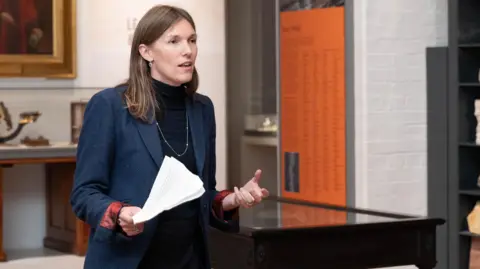
Dr Faye Sayer, associate professor in heritage and history at the University of Birmingham, said such historical buildings were vital for a community's wellbeing and sense of pride, despite many being disused for long periods of time.
"These buildings played a really pivotal role, not only economically, but also socially and to our sense of wellbeing, which is linked to our sense of pride and our connectivity to each other," she said.
"Some are places where families have spent time. They're part of our sense of community, where we meet people, where we forge connections and where our stories are made."
Sayer said seeing such historical sites lost or damaged made her wonder what professionals like herself "have not done right".
"It makes me reconsider some of our past approaches to what we've valued as heritage assets," she added. "It's really sad, I'm pretty devastated by it."
 Faye Sayer
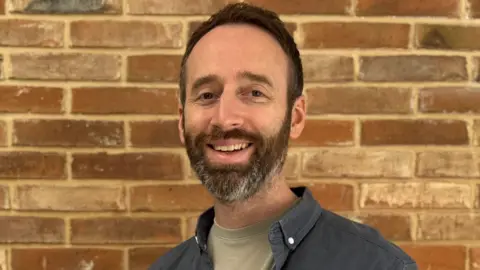
Peter Jenkins, head of projects at West Midlands Heritage, said it was vital to make sure our history was preserved.
He said more awareness and education were needed around the risk to disused historical buildings, which could become targets for vandals.
"Communities often know of these buildings," he added. "Maybe they have memories attached to them and they might be aware they have fallen into disuse.
"That doesn't necessarily trigger a warning sign for your average member of a community. They don't think the buildings are actively at risk.
"People often don't react until the point there's a real crisis."
 Peter Jenkins
The Big Mill fire came after plans to convert it into flats were submitted in 2019.
Following the fire, its owner Atique Choudhury told the BBC: "I'm very sad and emotional having been on a journey putting in time, effort, and resources and was getting close to seeing the building developed."
Both Sayer and Jenkins spoke of the barriers faced by those trying to bring such buildings back into use, particularly when it comes to cost.
Sayer said funding models for groups bidding for things like heritage grants needed a "shake-up", with more input from communities in terms of what they valued and what such sites could be used for.
"These funding models we've put in place ask communities to put in big applications that take a lot of time and require professional support," she said.
"That's a huge barrier to people who are saying 'we love this building, we want to preserve it and do something with it'."
But Sayer said there needed to be some thought over which ones should be preserved.
"We need to figure out what aspects of our heritage are important to these communities and then start to understand how we preserve," she added.
Jenkins said more also needed to me done around what funding was available as well as on what enforcement measures were taken to ensure security of heritage buildings.
"Our understanding of history is absolutely vital to us in terms of being able to make decisions about the future and where we're heading," he added.
"So many of the buildings that we [West Midlands Heritage] deal with in our region - they represent that history in a kind of perfect form."
Follow BBC Stoke & Staffordshire on BBC Sounds, Facebook, X and Instagram.
