World Cup history will be made on this grass. These scientists have spent decades perfecting it

 Steven Bridges/University of Tennessee
The 2026 World Cup kicks off in just a few weeks. The grass on which the tournament's 104 matches will be played has a vital but often overlooked role. Scientists have fed, mowed and stamped on miles of turf to get it right.
It happened just eight minutes into the match. Ángel Di María stole the ball from a Canadian defender and took off toward his opponent's goal. One of Argentina's greatest footballers of all time had only the keeper to beat in a decisive moment in the group stages of the 2024 Copa America football tournament. But as he dribbled the ball towards the goal, he seemed to struggle to control it. Confronted by the Canadian goalkeeper at the edge of the penalty area, all Di Maria could muster was a relatively weak toe poke. The keeper blocked it easily.
After the match, the Argentinean coach and players offered an explanation for what might have gone wrong. The reigning World Cup champions claimed the quality of the grass on the pitch in Atlanta, Georgia, in the US, affected their performance.
The stadium where the match was being played – normally home to NFL side the Atlanta Falcons and Major League Soccer team Atlanta United – usually has an artificial pitch, but it had been replaced with a temporary grass surface just days before the tournament.
Players complained that the ball jumped like "a springboard", describing the pitch as a "disaster". Concerns about the quality of the pitches continued to dog the tournament as games were played in other stadiums around the US.
With the 2026 World Cup approaching, it is criticism that co-hosts US, Canada and Mexico will be eager to avoid. And they have brought in a team of specialists to make sure there are no complaints.
Over the past eight years researchers have bounced balls, stomped boots and abused patches of grass in the search for the perfect turf. They've fed, watered and nurtured different mixes of grass species to see how they'll cope. And they've measured blades of grass millimetre by millimetre to find their perfect length.
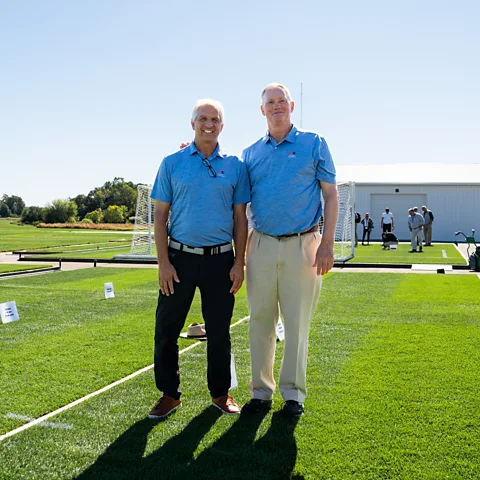
"It's a lot of pressure," says John Sorochan, a professor at the University of Tennessee, who has been contracted by Fifa to help oversee the growth, installation and care of the grass pitches at all 16 World Cup stadiums, including five that are covered by domes.
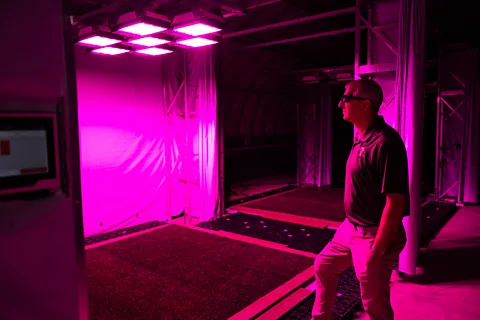
"Those are the ones that really have me worried," Sorochan says, "Because the Sun's gonna come up, but it's not going to come up inside. Plants need light, ideally sunlight, to grow."
Velcro or carpet
With the 2026 men's World Cup now just weeks away, the cumulative result of more than 170 different experiments conducted by Sorochan and his fellow researchers is about to be put to the test. They have built on decades of research on the science of cultivating and installing turfgrass on sports pitches.
Yet the grass pitches they have developed for the different stadiums across the US, Canada and Mexico will be trampled by 22 players at a time (plus match officials) for more than 90 minutes per game, across 104 matches. The ambitions of the world's top football players and billions of fans around the world will rest on how the grass holds up.
 Getty Images
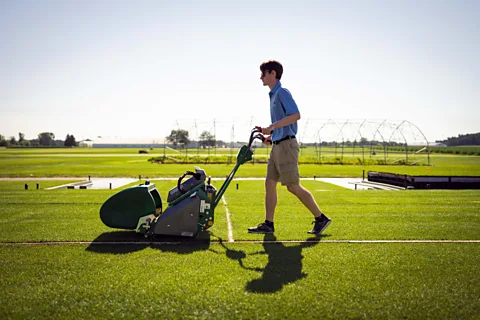
Just five millimetres can determine if a pitch plays like "velcro" or a pristine natural carpet that aids the quick passing of the ball needed for exciting play, Sorochan says.
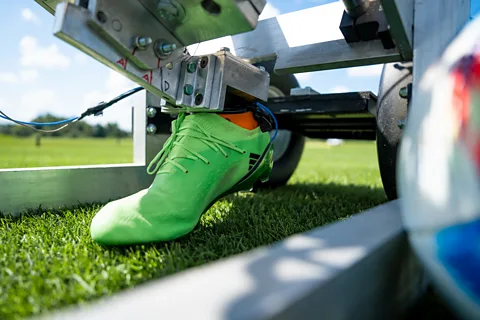
It took him and his colleagues hours of experimentation to determine the exact height at which each pitch should be mowed. On miniature pitches at their research facilities in Knoxville, Tennessee, US, they shot footballs out of bright red machines, carefully observing and measuring their speed and bounce. They wheeled a boxy, steel contraption across the grass so that a football boot attached to a post could pound the surface and test its springiness.
The researchers tested the turf for not only how the ball interacts with the surface but also the traction it gives players. They looked for ways to minimise divots during matches and avoiding wet spots that might interrupt the flow of a game. Worst still, a poor surface could have catastrophic consequences – leading to career ending injuries for players worth millions.
The geographic spread of stadiums also means the pitches have to flourish in dramatically distinct climatic zones – from the humid heat of Mexico City and Miami to the cool of Toronto and Boston.
To cope with this, the researchers have developed root systems, irrigation methods and maintenance schedules that are specific to each location. They have also tested different grass species to find the ideal type for the conditions. In warmer climates the turf will consist of Bermuda grass while cooler climates will have a mix of Kentucky bluegrass and perennial ryegrass.
Sorochan and his team determined that Bermuda grass pitches should be cut slightly shorter, because they're denser and dry more quickly than pitches of Kentucky bluegrass and perennial ryegrass.
To help make the pitches more uniform and durable, plastic fibres similar to those used in artificial turf, have been woven into the sod.
 Nick Schrader/Michigan State University
Still, footballers who play in Europe, where pitches are typically cool climate grasses, might be surprised walking onto a Bermuda grass pitch in Miami or Kansas City.
" They'll look at this and say, 'This isn't what I have in Germany – this is more like a putting green,'" Sorochan says. Each pitch will be slightly different, he admits. But because of his research he believes the variation will be minimal.
"It's just the massive scale of temporary fields that are gonna be built at one time" that makes Trey Rogers III, a professor at Michigan State University (MSU), anxious. He has been aiding Sorochan in preparation for the World Cup.
The pitches must be perfect, almost miraculous. Fifa has put its faith in Sorochan and Rogers, celebrities in the obscure field of grass science. The pair have never faced a challenge like the 2026 World Cup – and the stakes are high.
But it isn't the first time they've laid down turf for football's biggest stage.
 Nick Schrader/Michigan State University
The 'Guru of Grass' and his protégé
Rogers fell in love with grass working on a golf course in the American South. But his move to football came in 1992 when Fifa was looking for help installing a grass pitch inside the Pontiac Silverdome in Michigan for four matches during the 1994 World Cup. The stadium was home to an NFL team, the Detroit Lions, who played on artificial turf.
Like many Americans, Rogers knew nothing about the biggest sporting event on the planet. "I uttered the famous words that nobody ever lets me forget," Rogers says. "'What's the World Cup?'."
Even so, Fifa selected Rogers to be in charge of growing and installing a grass pitch inside the stadium. After a series of experiments, his team at MSU decided to grow a mix of Kentucky bluegrass and perennial ryegrass in a sandy soil. The sand would aid drainage while the two grass species could grow in a cool climate with relatively little direct sunlight. Rogers and his colleagues planted seed outside the dome in 1,994 hexagonal trays. It took thousands of hours of labour, much of it done by hand.
Sorochan was a student working on the project at the time. " I was literally the person that was tamping the sand," Sorochan says.
 Nick Schrader/Michigan State University
The hexagonal modules were one of the team's greatest innovations. The roots of the grass could be kept intact when the sections of turf were moved into the dome. It would be the first time a natural grass field was installed on top of an artificial pitch in a domed stadium.
When Rogers watched a team enter the dome for their first practice, they didn't inspect the pitch. Apparently, it felt normal to them. Like little boys, they tried to punt footballs high enough to reach the roof of the gargantuan dome. Rogers considered the project a success. It would earn him a nickname: the "guru of grass".
But at the end of the 1994 World Cup, Sorochan climbed to the top of the dome and looked down at the pitch.
"You could see the wear on the field," Sorochan says. "I thought, wow, how do we make that better?" Sorochan spent the rest of his time as a graduate student researching how best to grow grass indoors.
And when Fifa contacted Sorochan in 2018 for help with the 2026 World Cup, he asked Rogers and MSU to join him. What they'd have to pull off made their work at the Silverdome in 1994 seem like a child's science fair project.
Sea kelp and silica
Typically, sod is grown as locally as possible in soil similar to where it will be installed. The act of cutting and moving the turf can stress the plants and they often need several weeks to recover.
At the World Cup, however, many of the pitches will be installed just 10 days before their first match.
Joe Wilkins III's sprawling sod farm outside Denver, Colorado, US, is responsible for the World Cup pitches in Dallas, Atlanta, and Houston. These three stadiums will host more than a quarter of the tournament between them. The stadiums are all domes, where no direct sunlight reaches the pitch.
"They're the biggest challenges," Wilkins says, whose grandfather founded the Green Valley Turf Company in 1962.
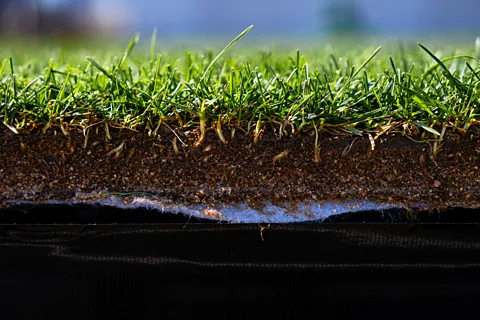
Bright green grass covers hundreds of acres at the company's farm. To prepare the sod, Wilkins' staff planted seed in sand on top of thin plastic. This helps to protect the roots when it is harvested and reduce the shock the plants experience.
Over the following weeks, workers water and mow the grass meticulously, adding fungicide, fertiliser, humates, sea kelp and silica.
"The grass never takes a day off," Wilkins says.
Sorochan has visited Green Valley Turf Company several times in the last few years, and Wilkins shipped sod to the University of Tennessee to help Sorochan's experiments. There, the team had built a state-of-the-art shade house to replicate conditions inside a domed stadium while MSU used a 2,100sq m (23,000sq ft) asphalt pad to replicate laying turf on stadium floors.
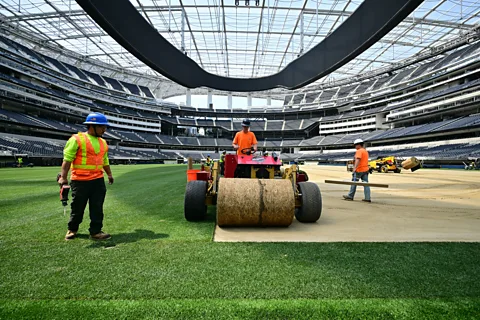
To stabilise the turf at outdoor stadiums, a gravel base is laid below a firm layer of sand, which the sod is then rolled out onto. For the temporary pitches laid on top of artificial pitch surfaces in NFL domes, an interlocking plastic grid and woven plastic sheeting is used instead of the gravel base to provide adequate drainage.
 Nick Schrader/Michigan State University
Just weeks before the World Cup begins, Wilkins and his staff are now undertaking the laborious process of cutting and rolling up the grass. Using what Wilkins describes as "giant pizza cutters" attached to farm vehicles, they slice the sod into 1.2m (4ft) strips. They wait until the Sun is setting so the grass is dry, then roll it up and load it onto refrigerated trucks.
At the same time, dozens of other refrigerated trucks are hauling over a million square feet of grass from a handful of rural sod farms to stadiums across North America.
" I've never done anything as big in my career," said Alan Ferguson, Fifa's senior pitch management manager.
At those domed stadiums, when the grass finally arrives, it may be the last time it's touched by sunlight, but it still has to thrive for weeks more.
Feeding the grass
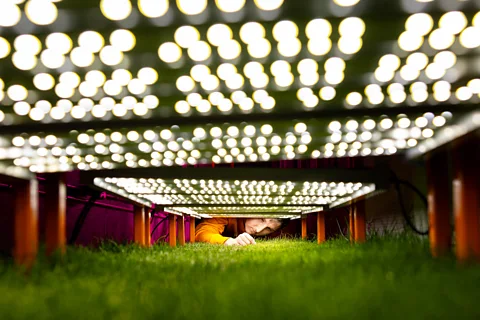
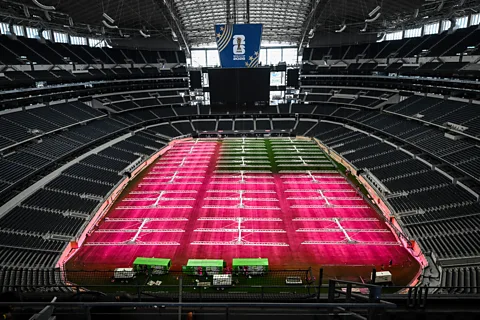
After the sod is unrolled at the covered stadiums, a magenta glow will blanket the entire pitch, emanating from dozens of white, metal bars just a few metres above the grass. These retractable LED grow lights can be moved into position to provide the grass with the energy it needs to grow. In Dallas, at the home of the Cowboys NFL team, for example, the grow lights descend from the roof.
"You can be working underneath them and mowing and doing all you need to be doing, and the grass is just growing," Sorochan says.
 Getty Images
Growing grass without direct sunlight is much easier today than it was at the Silverdome in 1994 because of advances in light emitting diode (LED) technology.
Sorochan isn't worried about a repeat of what happened at the Copa America. At the Mercedes-Benz Stadium in Atlanta, where Argentina and Canada faced each other, the distance between the grass pitch and the artificial turf used for American football games underneath was too shallow, creating the kind of trampoline effect the players reported, he says. Fifa has asked for more of a buffer in 2026.
More like this:
The 2025 Club World Cup also provided a partial rehearsal. The turf researchers deployed many of the same materials, techniques and workers used this year.
"The Club World Cup was a tournament in its own right," said Fifa's Ferguson. "But it also naturally offered us the opportunity to test and try some of these logistics."
While there were a few complaints still about quality of the pitches at the club tournament from players and coaches, Fifa insisted they met international testing standards.
 University of Tennessee
Fifa has spent more than $5m (£3.7m) on grass research for the 2026 World Cup, according to Ferguson. It's a lot of money for something that few people even think about when watching the drama of football's most prestigious competition.
Rogers hopes that in the long run, the research he and Sorochan have done will lead to wider improvements in how grass is used in sport at many levels. It may even persuade some American football teams to switch from artificial turf, even in domed stadiums, he says.
"There will be techniques and things that they're developing that you could even take to the local high school," adds Elizabeth Guertal, a professor of turfgrass management at Auburn University who isn't involved in the World Cup project.
Meanwhile, Rogers and Sorochan know well-tended grass, like a child, is tender and resilient. It can brace a striker as they make a sharp cut with a ball and cushion a goalkeeper at the end of a sparkling save. They have created the stage for the drama to unfold.
Now it's up to the players to see whose dreams will come true.
--
If you liked this story, sign up for The Essential List newsletter – a handpicked selection of features, videos and can't-miss news, delivered to your inbox twice a week.
