How Eurovision pioneered transnational broadcasting

 Getty Images
As fans around the world prepare for the 2026 Eurovision Song Contest, a new exhibition charts the history of the technical innovations that helped make the competition a global phenomenon.
Essentially an experiment in transnational live broadcasting, the first Eurovision Song Contest was no easy feat.
Engineers had to work out how to transmit live pictures from the Teatro Kursaal in Lugano, Switzeralnd, via microwave relay towers and terrestrial links that had to cross mountains, borders and incompatible national broadcast systems across Western Europe.
"It really was groundbreaking, because it was a really early example of a live simultaneous broadcast across Europe," Sarah Rawlins, public programme developer at Bradford's National Science and Media Museum said.
"Everyone in France and West Germany, Italy, they were all watching the same thing at the same time and when you think that was happening in 1956, that is actually remarkable that they had the technology to do that."
 Jessica Bayley/BBC
Over the decades, as the competition grew from seven to now 35 countries, the equipment has had to keep pace with the growing global demand, from satellite technology to digital fibre connections.
Eurovision is now one of the biggest live broadcast events in the world, reaching 166 million viewers worldwide in 2025.
Rawlins says there were other broadcasts that came before the first Eurovision Song Contest that showed there was an audience for transnational broadcasts.
"One of the bigger broadcasts, which was still an experiment, but it was more widely seen across Europe, was the coronation of Queen Elizabeth II," she said.
"Once they realised that had worked - it worked really well, so people in West Germany, Denmark and the Netherlands had seen it - they realised that there was actually an appetite for programmes across Europe sharing television content, but also that technologically this could actually be done."
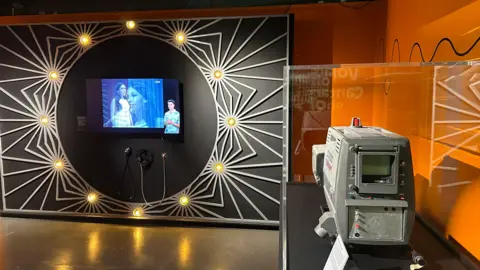
From 1969, the first year that satellite broadcast was used at Eurovision, through to a time-lapse film showing the installation of the contest in the Rotterdam Ahoy Arena for 2021, the exhibition takes a look at the technology used to deliver the contest over the years.
The contest has also set the stage for landmark moments of cultural change and broadcast innovation, from the transition to colour television to ABBA's career-launching victory in 1974.
It also pioneered large-scale televoting systems, which, following a successful trial in 1997, helped coin one of the competition's most enduring phrases "nul points".
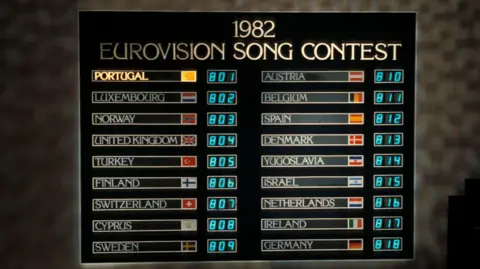
Whilst the main focus of the exhibition is on the technology behind the broadcast, there is also a section about fans of the competition.
"When you are talking about why it has been going for 70 years, a lot of it is down to the fans," Rawlins said.
"A lot of the time when we speak to fans, they talk a lot about their love of the competition, but also how it brings them together.
"I have spoken to a lot of people who have essentially made friends for life and the community around Eurovision is a really big part of what they enjoy."
Setting the Stage: 70 Years of the Eurovision Song Contest runs until February 2027.
Listen to highlights from West Yorkshire on BBC Sounds, catch up with the latest episode of Look North.
