The eerie abandoned vehicles in Chernobyl's 'dead zone'

 Phil Coomes/ BBC
A huge armada of vehicles were used to clean-up the radioactive aftermath of the Chernobyl disaster 40 years ago. Many of them still lie rusting inside the exclusion zone.
In the early hours of Saturday 26 April 1986, a safety test at the Chernobyl Nuclear Power Plant in what is now Ukraine went horribly – almost apocalyptically – wrong.
Technicians cooling off one of the Soviet power plant's four reactors during a test to simulate an accidental loss of power were unaware of a crucial design flaw in the reactor. The power spiked, causing a thermal reaction when the cooling system was offline. Components inside reactor number four ruptured, causing steam explosions and a reactor meltdown, which destroyed the reactor building.
Radiation from the debris and the smoke from the reactor fire drifted across Ukraine, other states in the USSR, and eventually the furthest reaches of Northern Europe.
The explosions, and the resulting radioactive cloud, caused panic around the world. But the effects were most keenly felt in the area around Chernobyl, especially the "model city" that had been bult for its technicians, Pripyat.
 Phil Coomes/ BBC
This city of 49,000 people was surrounded by farmland and forest, dotted with villages and small towns. After initial paralysis – officials did not want to believe that a reactor in one of their model nuclear power plants could fail – an enormous evacuation plan rumbled into life.
In little more than 36 hours after the explosion, Pripyat's entire population was bussed out of the affected area, never to return to their homes. Another 68,000 were removed from other smaller settlements. And after the evacuation came the clean-up.
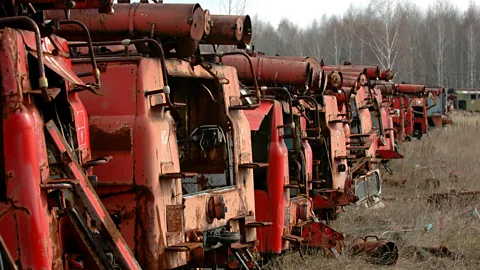
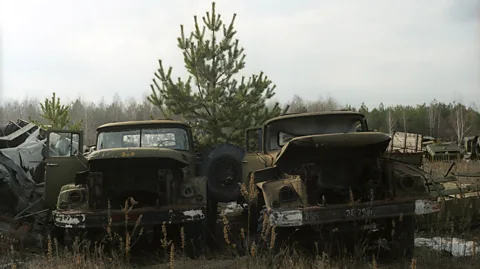
The full weight of the Soviet Union's civil defence network was brought in to deal with the disaster, the most serious nuclear event to have happened in peacetime. Countless trucks and buses were used to bring in the 500,000 military and civilian personnel who would have to deal with the zone's radioactive contamination, given the grisly designation "liquidators". A significant chunk of the Soviet Air Force's helicopter fleet was used to douse the reactor fire and cover other irradiated areas. Army scout cars and demolition vehicles – designed to work in the radioactive aftermath of nuclear explosions – were also brought in to monitor the "hot zones".
The work to clean up the toxic aftermath took many months. At the end of it, this enormous fleet of vehicles themselves become a poisonous problem with no quick fix.
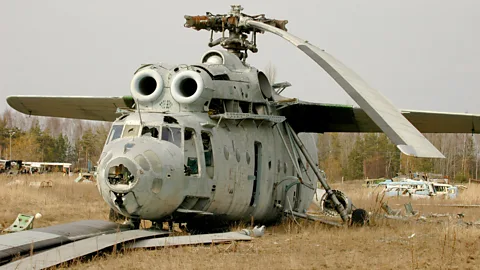
The radiation made them too dangerous to return to service out of the zone, and so Soviet authorities set up vehicle graveyards for them, including the giant heavy-lift helicopters that had flown over reactor number four's fuming pyre. Two enormous sites were prepared in Rassokha and Buryakovka within the exclusion zone, and the vehicles were flown or driven there – and left to rust in the open air for at least 100 years until the radiation levels fell to normal levels.
 Phil Coomes/ BBC
When the zone around Chernobyl became one of Ukraine's unlikely tourist attractions in the late 1990s and early 2000s, the vehicle graveyards became a surreal highlight, an almost science-fiction setting.
The BBC's former online news picture editor, Phil Coomes, was one drawn to the site at Russokha during a visit to mark the 20th anniversary of the disaster in 2006. He headed over to Ukraine for a 10-day trip with fellow BBC journalist Stephen Mulvey.
"I think there'd been a few tourist trips into the zone, but not many," Coomes says, shortly before the 40th anniversary. "I think the actual explosion happened more or less when I started at the BBC. So we pitched it, off we went, with our little dosimeters to make sure we didn't get too much exposure."
Coomes says he stayed for about three days in the exclusion zone, staying in the hotel that had been specially set up for guests and workers at the plant – which still had one reactor producing electricity.
 Phil Coomes/ BBC
"You forget how big the space is, you think, 'Oh, we've got two days there, that'll be great, we can see everything.'" He says of the two young guides who were showing them around "I think they just spent their life in the zone, they didn't seem to be bothered about any dangers whatsoever.
"You think, 'Oh, it's like 10 minutes up the road, but it's not, it's like a half-hour drive over completely destroyed roads and potholes, in the back of this car [where] the doors would fly open occasionally.
"Eventually, we went to the sort of graveyard place where they dumped all the kit."
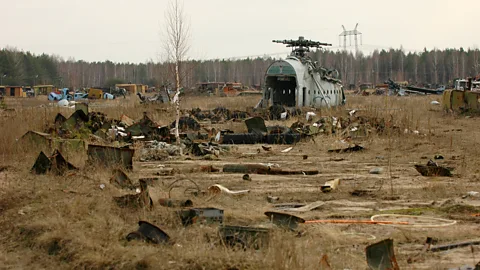
Coomes was taken to Rassokha, where large amounts of rusting equipment was still laid out. One of the images he took was of a huge Mi-6 helicopter, once the largest helicopter in the world and capable of carrying up to 90 passengers at a time.
"The helicopter's obviously the main focus, because that's the most interesting thing," Coomes says.
"There was a line of fire engines and a line of buses, and it'd all been quite nicely compartmentalised together." Near the helicopter, there were some of the blades that had been taken off the rotor assembly, and on the other side a long line of debris. Despite being highly irradiated and a potential risk to health, looters had spent years pillaging the dilapidated vehicles. Over the years, the vehicles at Rassokha were stripped of valuable parts.
In around 2013, the Ukrainian authorities moved much of the material left at Rassokha. Look at satellite pictures today and you won't see the hulks of the giant Mi-6 and Mi-26 helicopters that had been left to rot. But many of the irradiated vehicles used in the clean-up are still in the exclusion zone.
 Kamil Budzynski
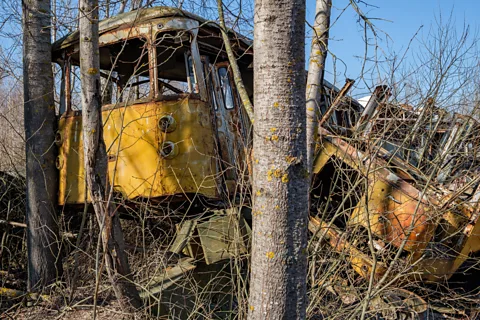
Kamil Budzynski is a Polish photographer based in Edinburgh, Scotland, who has visited the exclusion zone several times since the mid-2010s, and runs the website Forgotten Chernobyl.
"I moved to Scotland pretty much when I became an adult, so never had many chances to visit Ukraine, but when I heard that finally the new safe confinement will be covering the old sarcophagus, [built over reactor number four], I decided, well, this is the chance to see it for the last time. Probably just like many people, I thought I'll visit once, and that would be enough. I got hooked."
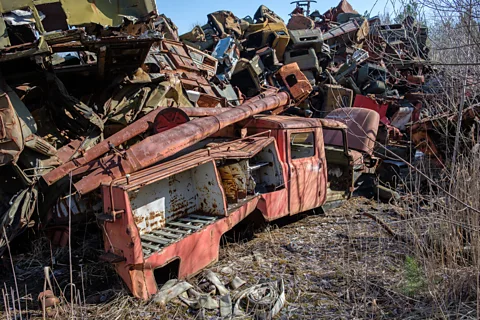
By the time he visited Rassokha in 2018, most of the vehicles were gone. The main field, where Coomes had seen helicopters and the rows and rows of military tracks and fire engines, was deserted.
 Kamil Budzynski
"When I was there, that was pretty much empty," says Budzynski. "I've noticed on satellite photos around 2012, 2013, that that main field was gone, cleared."
Budzynski says Ukraine allowed for some of the scrap metal to be mixed in with other metal for re-use. Last year, this even included some decontaminated metal from the power plant itself.
"I've read somewhere about regulations that allowed a certain amount of very mildly radioactive material to be mixed with, you know, very clean steel and raw materials, and that way they basically diluted the civil contamination so much that it wasn't posing any risk."
More like this:
Budzynski is aware that looting was a much bigger problem in the early years of the vehicle graveyards, when the parts much more valuable. "I can imagine poverty back then was enormous; everyone could make a living by selling some contaminated engine parts. In Pripyat itself, there were quite a few famous photos from early on, lots of personal belongings simply just thrown out of the buildings and then buried, because people were returning for them."
Budzynski noticed that while the main site at Rassokha had been cleared, studying satellite maps showed a new site that appeared to be full of vehicles, not too far from the former site. He visited it on his next trip to the zone. "That's where I found a lot of other buses, some… some military vehicles, most of them weren't that bad."
Ukraine now faces a different threat – not radiation, but ongoing attacks from the Russian military, who launched a full-scale invasion in 2022. Ukraine is technically still open to tourism, but many governments advise their citizens to stay away, tours to the Chernobyl Exclusion Zone have stopped. Away from the gaze of journalists, scientists, tourists and explorers, these rusting reminders of a nuclear accident will continue to decay.
--
For essential climate news and hopeful developments to your inbox, sign up to the Future Earth newsletter, while The Essential List delivers a handpicked selection of features and insights twice a week.
