'A remarkable time capsule': The enchanting history of Oxford University's 750-year-old medieval library

 Courtesy of the Warden and Fellows of Merton College Oxford
Predating the Aztec Empire, Merton College Library in Oxford has been used by everyone from celebrated 14th-Century mathematicians to JRR Tolkien. In an exclusive interview with the BBC for its 750th birthday, its librarian describes what makes it so special.
At Merton College in Oxford, there is an antique chest. In the Middle Ages, three key-holders had to be summoned to reveal the riches within. But this treasure wasn't gold or jewels. It was books.
Such strict security may sound overly cautious for mere parchment. But in an era before the printing press, books were a valuable commodity. They could take months to produce, as the entire text had to be painstakingly written out by hand. So, just as universities solicit cash from their alumni today, Merton College insisted its 13th-Century fellows donated books.
The Archbishop of Canterbury issued a decree in 1276 introducing this requirement, which marked the beginning of the library at Merton College. It has been running continuously ever since. To put that length of time in context, Merton's library predates the Aztec Empire. Its unbroken history stretches from before the Black Death to beyond the Covid-19 pandemic. And its users have encompassed everyone from famous 14th-Century mathematicians to Lord of the Rings author JRR Tolkien.
This month marks the library's 750th anniversary. It's a major milestone. But Merton's extraordinary lifespan has been recognised since the Victoria era, when it was routinely described as the oldest library in England.
In the 20th Century, writers like Rudyard Kipling and John Buchan referenced it in works of historical fiction, bolstering its reputation as a particularly venerable library. As the cultural recognition of "the famous Merton Library" grew, claims about its longevity became exaggerated. Some overzealous Oxonians even declared it the oldest library in the world.
The origins of the historic library
Historians today are more careful about making such bold declarations. "It's a complicated question," says Prof Teresa Webber from the University of Cambridge. "There's no single definition of a library. And there were all sorts of stages in the development of what we think of today as a library."
 Courtesy of the Warden and Fellows of Merton College Oxford
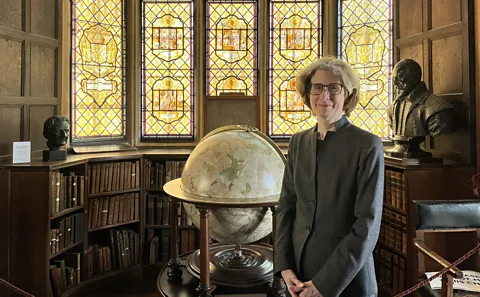
The origins of the library at Merton are certainly different from how we think of such institutions now. There was no librarian and there were no shelves for browsing. "There was a system of loaning and returning books from the chest," Merton's librarian, Dr Julia Walworth tells the BBC. "It would have been a formal thing. Rather than just saying, 'Oh, go rummage and find the books you need,' the whole community would come together to open the chest."
Merton's collection started evolving into a modern library quite quickly. Just a few years after the Archbishop's decree, several books were stored outside the chest for the first time. They were chained to a table in the college, making them available at any time. According to Walworth, this innovation "anticipates the modern distinction between loan and reference library collections".
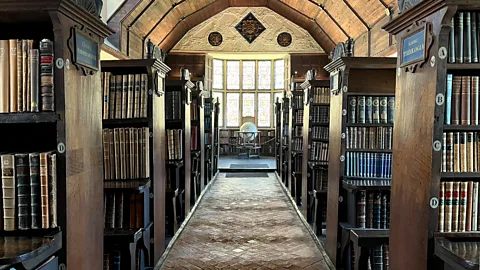
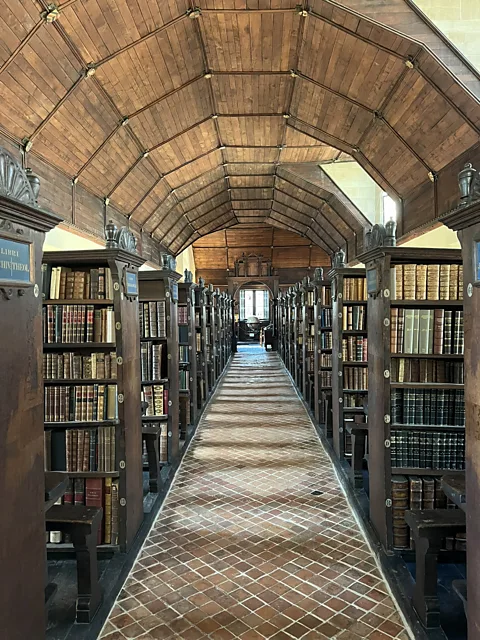
Merton's book treasury moved closer to becoming a modern library in the 1370s, when a purpose-built room was constructed to house the growing collection. It was here that Merton introduced a vital improvement in book storage. "Horizontal shelves were installed for placing books upright," Walworth says. "Merton is the first recorded use in Britain of this method of storing books."
Curiously, Merton's books were shelved with their spines inwards and their titles inked on the paper facing out. This was due to the continued use of chains, which were clipped on the fore-edge of each book's cover. "The fellows were aware that chained books had a better chance of survival than books that went out on loan," Walworth explains.
 Courtesy of the Warden and Fellows of Merton College Oxford
Today, just a few volumes in the library are chained – purely for display purposes. And the remaining books are now placed in the modern fashion with their spines out. But otherwise, the medieval room remains a remarkable time capsule of the library's history. Near the entrance, visitors can even see the 13th-Century chest, which Walworth believes is the original. During term time, the historic library room is still used by students. And this ongoing use is a major factor in the superlatives that are often applied to the age of Merton's library. "It's hard to think of an earlier library room that's been in continuous use," Webber says.
The library is mythologised
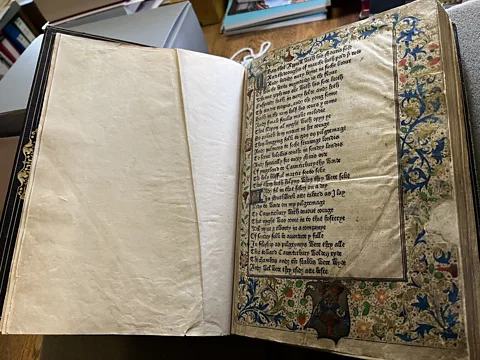
Claims about Merton's longevity first gained traction in the Victorian era, as it became more of a tourist destination. Visitors would marvel at its stained-glass windows, as well as rare books like its 15th-Century edition of The Canterbury Tales. "It's one of the earliest books printed in England," Walworth explains. "What's unique about Merton's copy is the hand-illuminated borders." Among those who visited the library was American writer Ralph Waldo Emerson, who mentioned it in his 1856 travelogue English Traits. In 1884, a young Beatrix Potter visited, describing the library's "beautiful oak roof" and "ancient, dusty smell" in her diary.
By this time, books and magazines were increasingly describing the library in record-breaking terms. An 1878 guide to Oxford called Merton's library "the most ancient now in England". The 1885 edition of the Encyclopaedia Britannica described it as "the oldest existing library in England". Gradually, these claims were inflated. A 1928 article in The Times recounted an event held by the Oxford Preservation Trust in which it was declared "the oldest library in the world".
 Courtesy of the Warden and Fellows of Merton College Oxford
This growing perception of Merton's longevity was even referenced in F Scott Fitzgerald's classic novel The Great Gatsby. In the book, the multi-millionaire title character fills his mansion with imitations of history's most prestigious rooms. So, it's only natural that his books live in a recreation he refers to as "the Merton College Library". As Walworth puts it, "Merton's library had become a byword for the 'best' ancient library" by that time. She even points out that Fitzgerald's fictional scenario had roots in reality. "The dining clubs at Princeton University have historical imitation rooms. One of them is based on the Merton College Library."
But today, Walworth rebukes any suggestion that Merton's library is the world's oldest. She prefers to describe it with several qualifiers, calling it "one of the oldest still-functioning academic libraries in Europe". That more measured description recognises that not all historic libraries can be categorised in the same bucket – monastic libraries functioned very differently from private subscription libraries, for instance. But it also acknowledges ancient institutions around the globe. "It's not that people weren't aware of other parts of the world in the past," Walworth says. "But there was a tendency for people to think of their own world as having primacy. Our outlook tends to be more global now, quite rightly."
The debate over the world's oldest library
Among these global institutions, there are several candidates for the contested title of world's oldest library. When the Al-Qarawiyyin library in Morocco underwent a major restoration in 2016, it was described by several media outlets as "the oldest library in the world". But Guinness World Records cites Saint Catherine's Monastery in Egypt as the oldest continuously operating library.
 Alamy
AlamyIn both cases, it's difficult to establish an exact starting date. For the Al-Qarawiyyin library, some scholars have cast doubt on the library's claims of Ninth-Century origins, saying the "story has much myth about it". In the case of Saint Catherine's Monastery, the building was constructed in the Sixth Century. But ancient writings suggest that the library's collections could date from two centuries earlier. "It depends how you count it," Walworth says. "When are you going to start the timeline? What is the beginning of a library?"
However, Prof Richard Gameson from Durham University tells the BBC that the library at Saint Catherine's Monastery "is probably the one with the longest continuous history". But he caveats this by adding that "the nature of the 'library', how it was used and how it was understood changed over time". So, any claim to be "the oldest" needs to be accompanied by an appropriate explanation of what a library is. Finding a single definition that allows for one conclusive record-holder seems a near-impossible task.
More like this:
"You can think of the oldest library as the oldest coherent collection of books that stayed together," says Webber. "Or you can think of it in terms of the survival of the physical space. Or you could ask, 'What's the oldest space and collection of books which has been there continuously?'"
She offers the Dunhuang Library Cave in China as an example. This secret chamber was filled with manuscripts and sealed sometime around the 11th Century. It was only opened again after its rediscovery in 1900. "But the books were still in continuous storage there," Webber says.
 Alamy
AlamyFinding a common definition of a library will only become more challenging now, as digital institutions offer physical spaces that do not even contain any books. "The definition of what a library is has always needed to be a capacious one," says Webber. "The introduction of new technology is simply a continuation of that. But I don't think the library as a physical space will disappear."
Walworth is similarly optimistic, as she embarks on a project to digitise Merton's manuscripts. "People will be able to access them anywhere. But I think they will still want to come and see the library and understand how people used books in the past."
Reflecting on the 750-year span of Merton's library, this digital phase seems like just another step in a long evolution. Just as the books moved from the Archbishop's chest to chained desks to horizontal shelves, now they will enter the virtual realm. "I suppose that's why I now find it less useful to talk about libraries as 'the oldest'," Walworth says. "For me, the story is not about how long a library has been running. It's more about the sense of community."
She points out that the tradition of donating books introduced by the Archbishop of Canterbury in 1276 persists to this day. "What started when he laid down those injunctions was the idea of a common collection built by the people. So, it's just remarkable that for 750 years people have maintained this connection with an institution and its books."
Perhaps that proves that books really are the most durable treasure – whether they are handwritten on parchment and sealed in an antique chest or distributed as pixels in the cybernetic ether.
Images are provided courtesy of the Warden and Fellows of Merton College Oxford.
--
If you liked this story, sign up for The Essential List newsletter – a handpicked selection of features, videos and can't-miss news, delivered to your inbox twice a week.
