Whistler's Mother is a US icon - here's why the artist would've hated his 1871 masterpiece's success

 Musée d’Orsay
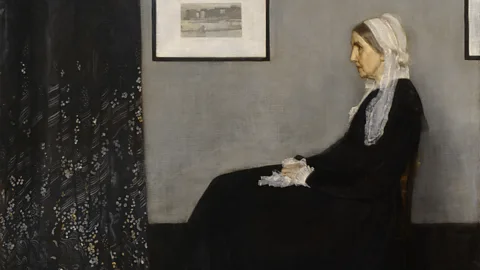
Whistler's Mother is one of the world's most recognisable artworks. Like a viral meme it has been reproduced endlessly, including a Donald Duck cartoon, a Simpsons episode, and Nabokov's Lolita. How and why did it become so famous?
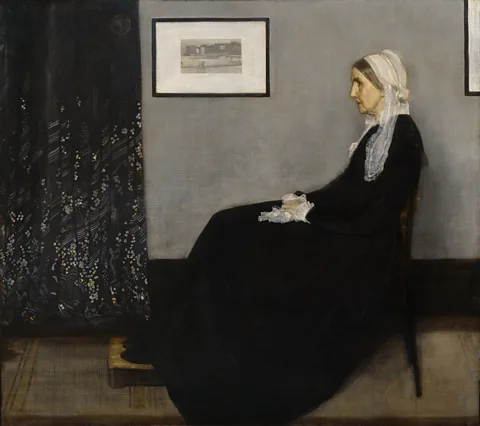
Whistler's Mother, originally titled Arrangement in Grey and Black: Portrait of the Painter's Mother (1871), is on display at Tate Britain for its latest exhibition: James Abbott McNeill Whistler. This show is the largest retrospective of the artist in three decades, and a rare opportunity to see Whistler's Mother in the city in which it was created.
It's also an opportunity to ponder why this painting, and not any of the other 150 artworks on display at the exhibition, became so notorious.
The saga of Arrangement in Grey and Black: Portrait of the Painter's Mother begins with a sick-note and a setback. One day in late October 1871, Whistler, a 37-year-old American artist living in London, received the news that his model, Maggie, was unwell and couldn't attend her sitting. Anna McNeill Whistler, the artist's mother, reluctantly stepped in, and posed for her beloved son instead. Later reflecting upon the happenstance surrounding the painting's genesis, she wrote "disappointments are the Lord's means of blessing".
But many disappointments would arrive before the eventual blessings. Arrangement in Grey and Black narrowly escaped destruction by fire on a train in 1871. The next year it was almost rejected from the annual Royal Academy exhibition, until Whistler's friend and academician Sir William Boxall came to its defence and demanded its acceptance.
But even when it was displayed at the RA in 1872, the critics and general public were less than impressed.
The painting's inauspicious start makes its eventual superstardom all the more unlikely – and remarkable.
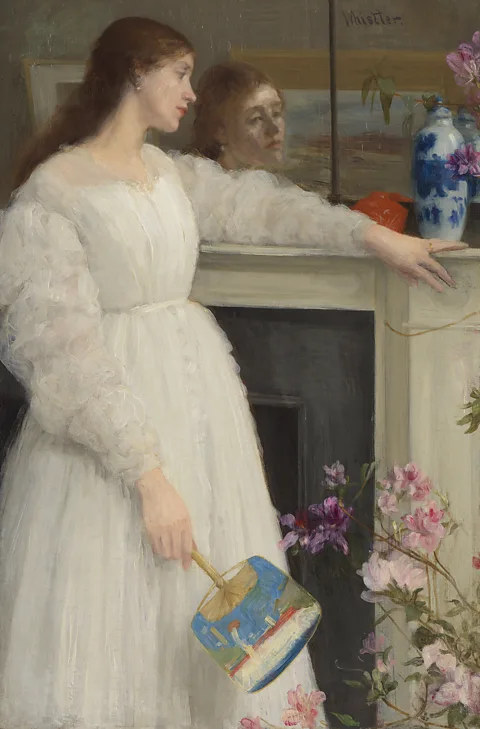
An ongoing criticism of Whistler's artworks concerned their titles. The Victorian public adored stories, particularly familiar ones from drama, poetry, myth or history, and paintings with names that clearly defined what they showed. By contrast, Whistler's paintings came with ambiguous descriptors like "harmony", "nocturne" and "symphony".
 Tate
TateSo, his 1872 offering at the Royal Academy came across as emotionally distanced, more interested in "arranging" greys and blacks than exploring the inner life of the artist's mother. But Whistler thought he was ahead of his public. He preached the gospel of "art for art's sake", believing that paintings shouldn't fixate on storytelling but instead revel in their own abstract language of colour and shape.
From obscurity to fame
It was a radical approach to art-making at the time. But Whistler embraced his identity as a provocateur and played up to it in his public life with his flamboyant behaviour, colourful anecdotes and memorable put-downs. Whistler was one of the first artists to cultivate himself as a media personality, courting controversy and frequently making himself available to the press with a pithy bon mot or sarcastic quip, and entering verbal scuffles with critics like John Ruskin.
To an extent, the later fame of Arrangement in Grey and Black: Portrait of the Painter's Mother stemmed from Whistler's own notoriety. However, through the 1870s and 1880s the painting remained largely unknown, and for a period, Whistler even had to deposit it with his creditors after declaring bankruptcy.
But a group of admiring fellow artists instigated a successful lobbying campaign to have it acquired by the French government. And so, in 1891 it became a national possession of the French state and went on display at the Musée du Luxembourg.
 Musée d'Orsay
For the first time, Whistler's Mother had stepped out of the grey and black of obscurity and into the golden light of fame.
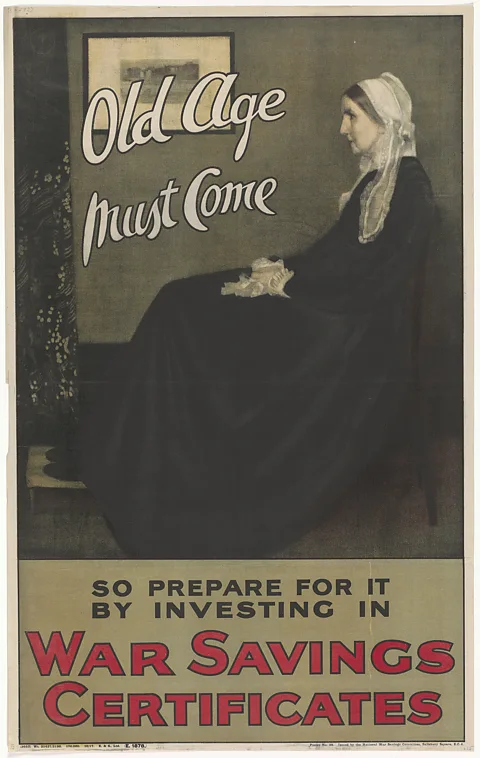
The French acquisition of the artwork sparked interest in the US media, and it soon appeared in multiple newspaper and magazine reports. One heralded it as "the most unquestioned and unquestionable masterpiece of the last half of the 19th Century". So, a sense of national pride helped boost the painting's prominence. But advertisers also leveraged the sentimental aspects of the painting as an image of doting motherhood. During World War One, posters for recruitment and war savings certificates repurposed Whistler's Mother to remind the public of the homely values that soldiers were fighting to defend.
 Alamy
AlamyAnother turning point in the painting's prominence came in 1932 when Alfred Barr, the Director of New York's Museum of Modern Art arranged to borrow the painting and took it on a two-year tour of 18 US cities, where it was seen by two million people. For Barr, Whistler was an important pioneer in painting's progress towards abstraction, and he intended the tour to help establish the artist as the US's contribution to the evolution of modern art.
More like this:
But the timing of the tour was also significant. It took place during the years of the Great Depression, a period of immense economic hardship for many families across the US. With its restrained simplicity, Whistler's painting had the ingredients to be an icon of the resilience and strength of maternal figures – a revival of its role during the last period of suffering, World War One. Its last stop on the US tour was Whistler's home state of Massachusetts, which coincided with Mother's Day 1934.
 Alamy
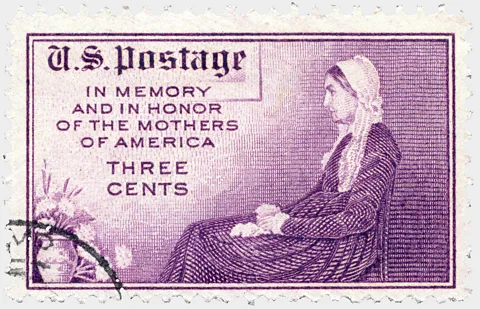
AlamyThat year a stamp was also issued featuring a version of Whistler's Mother with the inscription "In Memory and in Honor of the Mothers of America" which helped add further rocket fuel to its celebrity status. When the Ashland Boys' Association in Ashland, Pennsylvania had to select a subject for a large public sculpture on the theme of motherhood in 1937, it was Whistler's painting that they selected.
The real key to its success
Once the snowball of fame began for Whistler's Mother, it became impossible to stop. Acts of homage and caricature appeared in innumerable and highly diverse forms. Fine artists borrowed its distinctive format for their own portraits; cartoon-makers teased its air of dignified repose; novelists and film-makers cited it as the epitome of middlebrow taste.
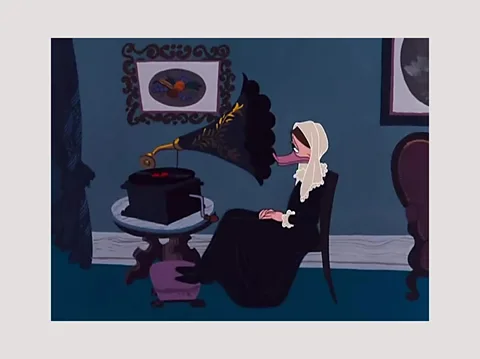
Like all successful memes the original concept is easily understandable. Its theme of motherhood is universal, and the composition and colour of Whistler's painting is simple enough for it to be copied easily. Because it lacks any narrative content, the image also has an open-ended quality, making resilient to endlessly remixes, particularly ones done in a subversive spirit. The mother's air of rectitude and stoicism can be effectively juxtaposed with any form of silliness, and her old-fashioned air contrasted with up-to-date technology. Even switching her with a cat or dog continues to be surprisingly amusing. Its popularity as an image was launched by its appearance in printed media in the early 20th Century, and it was perpetuated in Disney cartoons, magazine covers and adverts, and today you can easily discover reenactments involving a host of unlikely personalities, including Muppets, Ninja Turtles and Sesame Street characters.
 Mickey Mouse & Friends
This process of memeification utterly clashes with Whistler's original artistic principles. "Art should be independent of all clap-trap," he once wrote, and should avoid "devotion, pity, love, patriotism, and the like".
How ironic that the enduring popularity of Whistler's Mother was based on a sentimental view of motherhood and US national pride. Fame on those terms would have been anathema to Whistler.
But the renown of an artwork is so often out of the control of its creator. Whistler's bombastic personality and artistic proficiency lay the foundations of the later fame of Arrangement in Grey and Black: Portrait of the Painter's Mother.
But the real key to its later success was timing. It had an unpromising start in life and had to wait until the US was most in need of a national masterpiece – and a maternal figurehead. When the moment arrived, Whistler's Mother transformed from an "arrangement" into an icon.
James Abbott McNeill Whistler is at Tate Britain in London from 21 May to 27 September 2026.
--
If you liked this story, sign up for The Essential List newsletter – a handpicked selection of features, videos and can't-miss news, delivered to your inbox twice a week.
