Starry new drama Fjord pits conservatives against liberals - and is set to divide audiences

 Courtesy of Cannes Film Festival
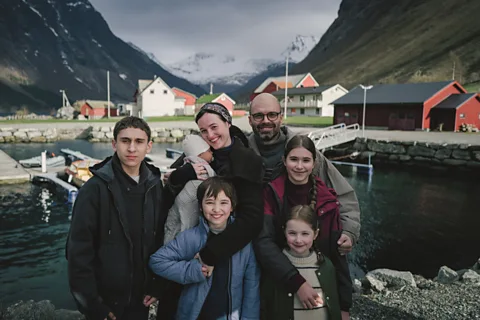
Sebastian Stan and Renate Reinsve star as a Christian couple whose parenting is attacked – the film has become one of the 2026 Cannes Film Festival's biggest talking points.
Sebastian Stan is best known for playing Marvel's bionic-armed Winter Soldier, but he isn't afraid of more controversial roles. Most obviously, he was a young Donald Trump in a contentious biopic, The Apprentice, which debuted at the Cannes Film Festival in 2024. And at this year's Cannes, he's in a drama that is proving to be even more divisive.
Written and directed by Cristian Mungiu, a Romanian writer-director who won the Palme d'Or at Cannes in 2007, Fjord pairs Stan with Renate Reinsve, the Oscar-nominated star of last year's Sentimental Value. They're both at a point in their careers where they could be Hollywood's hottest new romantic-comedy couple, so it's impressive to see them going in a very different direction.
Stan plays Mihai Gheorgiu, a bald, bespectacled and entirely un-Winter-Soldier-ish engineer who, like the actor himself, comes from Romania. Reinsve plays his Norwegian wife, Lisbet. Together with their five children, the couple has just moved from Romania to a village in Norway, with spectacular, snow-capped mountains all around them and the titular fjord on their doorstep.
Mihai helps with the IT at the local international school (the dialogue is in English, Norwegian and Romanian), and Lisbet works as a nurse in a care home. Their eagerness to contribute to the community, they say, is bound up with their intense Christian faith. Daily prayers are mandatory; homosexuality is seen as a grievous sin.
None of this sits well with the school's headteacher, Mats (Markus Tønseth), who is also their next-door neighbour, and the father of one of the children's new friends. He prides himself on being welcoming and tolerant, but religious evangelism is a no-no in the school, so when Mihai plays Amazing Grace on the canteen piano, Mats isn't happy.
Then one of the Gheorgiu children comes to school with bruises on her face and back. Before the family knows what is happening, the children are whisked away to live with foster families, the baby included. The situation is every parent's nightmare, but maybe Mihai brought it on himself. As mild-mannered and loving as he is, he does admit to slapping his children's behinds when they misbehave. It's standard practice in Romania, he argues, even if it's illegal in Norway.
Is he guilty of more severe physical punishments? Are the authorities right to shield his children from this strict, uncompromising patriarch? Or are they jumping to the wrong conclusions because, on one level, they don't approve of what he would describe as traditional Christian values? For that matter, could it be Romanian immigrants they don't approve of? Wasn't there a hint of xenophobia in Mats' jovial remark about there being no Count Dracula in Norway?
Who is most at fault?
Mungiu makes the point that people on both sides of this heart-rending dispute have prejudices and blind spots. But it's clear that he favours the Gheorgius. The quiet, reserved couple are condemned by the other characters because they don't let their children have mobile phones or watch YouTube videos, and yet Mats' daughter self-harms and gets into fights, so maybe his own parenting is less than perfect.
Meanwhile, Norway's child-protection system is presented as a purgatory of grindingly slow and callous bureaucracy, presided over by unbearably condescending lawyers. One critic told me that they disliked Mihai early in the film, but later wished that Stan had gone into Winter Soldier mode, and dished out some bionic reprisals.
More like this:
It's unusual for the kind of arthouse fare that is shown at international film festivals to be so sceptical about its liberal characters, and so sympathetic towards its conservative Christian ones. And this slant is one reason why Fjord has been so divisive. In Screen International's round-up of critics' reviews at Cannes, Fjord has a slew of four-star reviews (the maximum in this context), one-star reviews, and everything in between. It's "an anticlimactic, underpowered movie", says Peter Bradshaw in The Guardian. Or it's a "Palme d'Or-worthy… fiercely intelligent and gripping movie", if you believe Pete Hammond in Deadline. I wouldn't call it Palme d'Or-worthy myself: too many plot holes, too many sketchy caricatures in place of rounded characters. But I must admit, I was desperate to find out how the climactic civil-court case would be resolved.
It will be fascinating to see how Fjord goes down in Norway, as well as elsewhere around the world. For now, no other film at Cannes this year has got people talking and arguing at such length. Is Fjord balanced or biased? Is it reactionary propaganda or a shrewd satire about progressives? The only thing everyone can agree on is that Stan is becoming one of the most interesting and versatile actors around.
--
If you liked this story, sign up for The Essential List newsletter– a handpicked selection of features, videos and can't-miss news, delivered to your inbox twice a week.
