'Astronaut wanted. No experience necessary' - the surprising story behind the first British person in space

 Courtesy of Helen Sharman
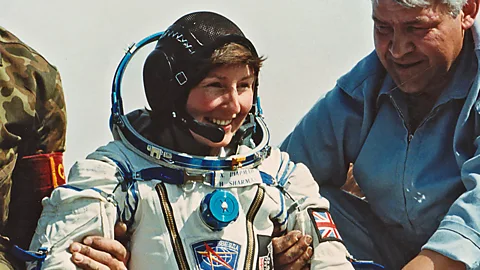
It's 35 years since the first British person went into space. Helen Sharman was a 27-year-old food scientist when she stumbled upon a job ad to be part of an Anglo-Soviet commercial venture, Project Juno. Sharman told BBC News in 1991: "All along the selection process, I never really believed that it could be me."
One of the lesser-known moments to take place during the Cold War space race involved the Russian cosmonaut Yuri Gagarin. On his way to the launchpad in 1961, just before he became the first man in outer space, he asked to stop the bus and took a last-minute toilet break.
It grew into a tradition that all cosmonauts flying from the Baikonur cosmodrome in Kazakhstan repeat just before take-off, as recounted by Helen Sharman, the first British astronaut, in her 1993 autobiography. "This was one tradition they would not expect me to join in," she writes.
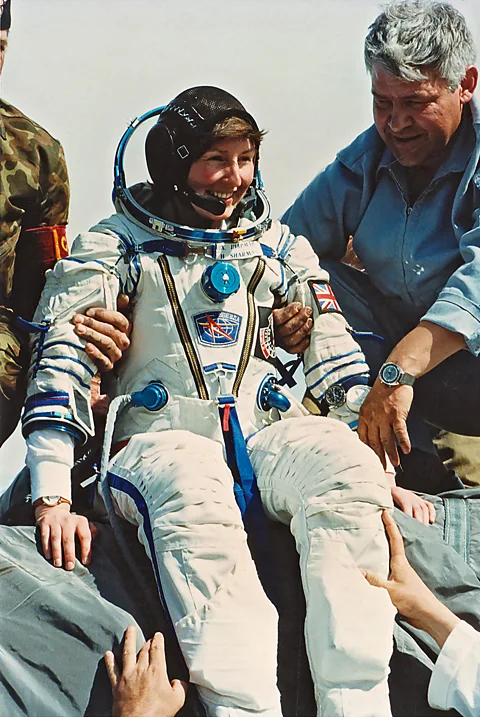
Yet the food scientist from Sheffield was treading in the footsteps of cosmonauts when she launched into space aboard the Soviet Soyuz TM-12 space capsule on 18 May 1991. She was to spend eight days on the Mir space station, making British history – with the help of a Soviet space programme. At the time the British government wasn't involved in space exploration, so paying for a spot on a flight was the only way to get there.
And she was only there because of an advert. "One pleasant evening at the end of June 1989, I was driving home from the Mars factory in Slough, listening to the car radio," she writes in her memoir. "While I sat in a traffic jam, I flicked through the radio stations trying to find something to listen to."
It wasn't the most auspicious of moments – but as she goes on to recount, her attention was caught by an ad on one of the channels she tuned into: "Astronaut wanted. No experience necessary."
Sharman had stumbled upon the recruitment slogan for a project that marked the thawing of Cold War relations. The Juno mission was a commercial venture to send a Briton to Mir funded by a private consortium – with a Soviet space crew.
"I know, with hindsight, that the minute or so I spent listening to this advertisement is the crucial, pivotal moment in my life," she writes. "After it, nothing from my old life could ever quite be the same."
From Slough to Star City
That moment was to kickstart a process that took Sharman from the London suburbs to what was known as Star City in Russia. She would exchange rush-hour commutes back and forth from her studio flat in Surbiton for 18 months of intensive training at a facility originally known only as Military Unit 26266, in an area designated "closed military townlet No 1".
During the Soviet era, the location – on the outskirts of Moscow – was a guarded military installation, access to which was highly restricted. According to Nasa astronaut Michael Barratt, speaking in 1998: "Star City has always kind of felt like the forbidden city or the hidden city. It wasn't on any maps, certainly. It was a secret cosmonaut training base. Of course, everyone knew where it was, but it was considered a closed and secure city."
Yet by 1990, as a result of the reforming regime of Mikhail Gorbachev in the dying days of the Soviet Union, a few foreigners were allowed in. While carrying out training to help prepare for zero gravity, Sharman lived in a spacious apartment there, with access to chauffeur-driven Volgas – although she preferred to have her own car, and arranged for a Ford Escort to be transported from Finland.
The 27-year-old had been picked from 13,000 applicants, with only the final four travelling to Star City. "All along the selection process, I never really believed that it could be me," she told BBC News from Star City in 1991. "I never really knew exactly what they were looking for. And even now, I can't say what it is that maybe they thought that I had that maybe some of the others didn't."
 Courtesy of Helen Sharman
Her father, John, gave one possible reason in a 1991 interview with the BBC's Gloria Hunniford, referring to a press cutting that described how all the crew had to train daily on tilt tables to prepare them for weightless conditions – except for Helen, who only needed to do that twice during the week as she had quickly mastered the techniques for managing weightlessness.
In her memoir, Sharman describes her time in Star City as "probably the most significant period of my life, in its own way even more influential on my outlook and ideas than the time I spent in space".
Camaraderie with cosmonauts
As well as pioneering British space travel, Sharman's time on the Juno mission revealed much about how space programmes can transcend national boundaries.
She describes her fellow cosmonauts Anatoly ("Tolya") Artebartsky and Sergei Krikalyov as "the closest and most important friends I had ever had". While at Star City, she also became close to some of the pioneers of Russian space flight, including the cosmonaut Alexei Leonov, the first man to walk in space.
Sharman recounts in her memoir how Leonov accompanied the three cosmonauts to the launch on 18 May, and gave her an elasticated pink chiffon jumpsuit with "a wonderful frilly front and billowing sleeves" – which she nicknamed "the dream-garment".
He told her: "The first night you're on the space station, it's traditional for all the crew to eat a proper dinner together. I thought you might like to dress for dinner." When they made it to Mir, she donned it for their celebratory meal, with Sergei wearing a tie that floated horizontally for the evening.
She reflects today on Leonov, telling the BBC that he was "a bit of a joker" and "a great social architect, who brought people together. He enjoyed his status as the 'international cosmonaut', having been part of the Soyuz-Apollo crew." He would sometimes use a few words of English that he picked up during his training in the US. "My enduring memory of his informal speeches when an American was present is Leonov describing the American guest as a 'Top Banana'. It always got a laugh."
The Cold War thaws
Sharman's groundbreaking flight to the Mir space station in May 1991 came at the end of the Cold War, taking place months before the Soviet Union was dissolved. While Tolya returned to Earth after five months, Sergei was asked to stay on, finally landing after 310 days in space. He became known as "the last Soviet citizen", returning to a country that hadn’t existed when they had launched.
And the backdrop to Project Juno was one of perestroika (reform in the Soviet Union). Facing criticism over the high costs of the space programme, on the 30th anniversary of Gagarin's flight, Gorbachev said that Moscow needed foreign investment to maintain its leadership in space.
In History
In History is a series which uses the BBC's unique audio and video archive to explore historical events that still resonate today. Sign up to the accompanying weekly newsletter.
The Juno mission was meant to be financed by private sponsorship, creating a new scientific partnership between Britain and the Soviet Union. But despite all the publicity, the sponsorship fell flat, and the Soviet-owned Moscow-Narodny Bank had to underwrite the mission.
More like this:
As the BBC correspondent Carole Walker said in 1991, "The Soviet Union is desperate for foreign investment to continue its flagging space programme, and is keen to promote commercial flights as the way ahead. It cannot risk damaging its reputation by pulling out of the highly publicised Juno mission."
In another 1991 report, BBC correspondent Martin Sixsmith argued that "The romanticism of the Gagarin era has now been overtaken by the lure of Western currency."
Despite the issues with funding, Sharman's eight days in space represented a leap forward for Anglo-Soviet relations. The UK government congratulated her with the message that "this mission symbolises peaceful scientific co-operation between nations".
And her time at Star City offered Sharman a counternarrative to that of space travel as pioneered by Nasa. Recalling her visit to the space museum in Moscow, where the floor space had been converted into a second-hand car salesroom, she tells the BBC: "It was an education because there was so much that I had not known about from my UK schooling and Nasa's domination of UK space news.
"It felt as though I was being included in something much bigger than my space mission alone. And I could feel the pride in their space prowess of every Soviet citizen around me: the first animal in space, the first person, the first woman, the first spacewalk. Nasa didn't talk much about those achievements."
The history of space exploration has often been framed in terms of a "race" – competition fuelling innovation. Yet much of the time humans have spent in space has seen collaboration across borders.
Looking back now on her prevailing memories of being in space, Sharman recalls: "Feeling weightless – which is the most natural, relaxing feeling imaginable; camaraderie with my crew – which came from openness and trust; and the views, which we often experienced together, grouped around a window."
She believes the collaboration of space programmes can be "a great way to break down barriers when politics allows", saying that "trust is built on personal relationships – and that can be lifelong".
--
For more stories and never-before-published radio scripts to your inbox, sign up to the In History newsletter, while The Essential List delivers a handpicked selection of features and insights twice a week.
