'Slick, suave and a little sexy': Herb Alpert - the unlikely kitsch 1960s act that dominated the US charts

 Getty Images
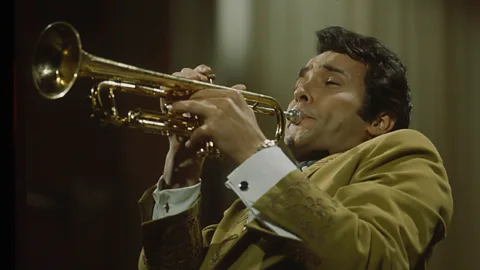
In the middle of the 1960s rock revolution, a jazz trumpeter smashed chart records and briefly became bigger than the Beatles. Now aged 91, Herb Alpert talks to the BBC.
In April 1966, the US was in the middle of a rock revolution. The Beatles, halfway through a run of 20 Billboard number one singles, had just released Rubber Soul, their gateway to a more experimental, album-oriented sound. Fellow British invaders the Rolling Stones were about to score their third chart-topper with the sitar-driven Paint It Black. Over in California, the Byrds had two recent number ones and were entering their own psychedelic era.
But the biggest act in the US exactly 60 years ago wasn't a bunch of hip young guitar-slinging longhairs with mind-expanding intentions. It was a 31-year-old jazz trumpeter and record executive who made smooth, vaguely Latin-flavoured instrumentals that sold by the absolute bucketload.
On 2 April 1966, Herb Alpert's Tijuana Brass held the number two spot in the US with their latest album Going Places. Alpert's previous record, Whipped Cream & Other Delights, was number three in the charts. His third and first albums, South of the Border and The Lonely Bull, were number nine and 10 respectively.
The only entry in Herb Alpert's discography not to feature in the top 10 of the Billboard 200 that week, 1963's Volume 2, made the top 20. It was a display of chart dominance that went unmatched for decades. By the end of 1966, those four top-10 records from April were the year's first, third, 11th and 14th best-selling albums. What Now My Love, the new Tijuana Brass album released in May, was fifth.
Alpert's April 1966 chart record was only equalled by another living artist in July 2023, when Taylor Swift issued Speak Now (Taylor's Version), and it shared the top 10 with Midnights, Lover and Folklore. "I didn't think much about it but I was happy for her," Herb Alpert tells the BBC. "She's smart, she's talented, she writes a good song. She absolutely knows her audience. And she plays right into them."
 A&M/ Alamy
Herb Alpert grew up in a musical household. His father played the mandolin and his mother the violin. All three Alpert children took up instruments, and Herb honed his trumpet skills through high school, college and a spell in the military. After discharge, Alpert took a multi-pronged approach to breaking into the music industry. He formed a songwriting duo with Lou Adler, co-composing Sam Cooke's Wonderful World and doing production for surf duo Jan and Dean and others. He was briefly signed to RCA Victor as a vocalist. In 1962 he made what would be his most lucrative move, more so even than his creation of The Tijuana Brass a few months later, forming A&M records as the "A" to Jerry Moss's "M".
"I had a bad experience with [RCA Victor]," Alpert, now aged 91, tells the BBC. "They treated me like a number. I didn't even have a name in the studio. It was, '78452, take one.' So I said, 'Man, if I ever had my own record company, it would revolve around the artist.' And that was the concept of A&M. It was all about the artists." A&M went on to become one of America's biggest independent record labels, the home of the Carpenters, Carole King, Peter Frampton and more, but its initial success was fuelled by Alpert himself.
Capturing the mid-1960s zeitgeist
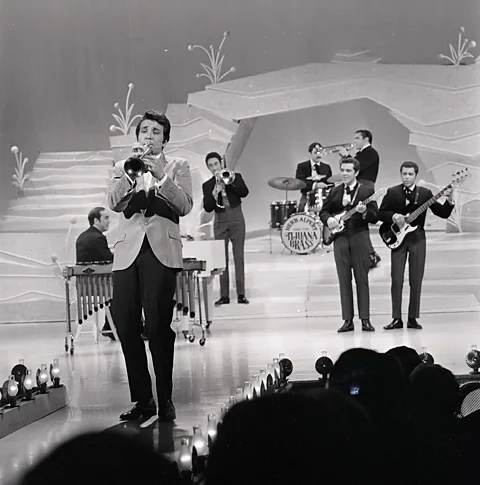
Despite the name, The Tijuana Brass weren't Mexican. They weren't even a "they". For the first three albums, "The Tijuana Brass" was just Herb Alpert's trumpet, multitracked and overdubbed, and backed by session players, before popularity compelled him to put together a touring band.
A visit to a bullfight in Tijuana had prompted Alpert to write The Lonely Bull, a cinematic instrumental drenched in mournful Mariachi-esque trumpet. The track was a hit and became the basis for an all-instrumental album for A&M, some of it Latin-influenced, the rest straightforwardly lounge-y exotica. Several more albums followed the same template. None were huge successes on first release, but they lingered around the charts. Finally, in the spring of 1966, it all came together for The Tijuana Brass.
Today, Alpert struggles to put his finger on exactly what prompted to Americans to start buying his records in such enormous numbers. "I was at the right place at the right time," he suggests. "I was pretty much embarrassed by the whole thing, to tell you the truth. It was a very strange feeling to turn on the radio and all I could hear was my music. I had to get used to it. That wasn't my goal, to be famous. I just wanted to be successful."
 Getty Images
You could see Alpert's popularity as a last hurrah for the sort of jazz-inflected easy listening that ruled the airwaves in the pre-Elvis era. But there was clearly something in these breezy instrumentals that captured the mid-60s zeitgeist, too. "I played A Taste of Honey in Seattle, Washington, and people went crazy over it," Alpert recalls. "I would play it twice. Sometimes in a row."
Jerry Moss saw the track as a B-side, but his partner pushed him to reverse the running order. "I said, 'I'm telling you, there's a focus group up here [in Seattle], and every time I play that song, it connects.' He turned it over, and it took about two months for it to really take off, and when it did, it got me on all the major shows, all the exposure I could ever ask for."
This wasn't music for teen rebels or young proto-hippies. It was a grown-up sound for swinging sophisticates, made to accompany cocktail parties and carousing in conversation pits. Slick, suave and a little bit sexy. Album sleeves featured Alpert, handsome and plausibly Latin-adjacent, alongside a suitably groovy female co-star.
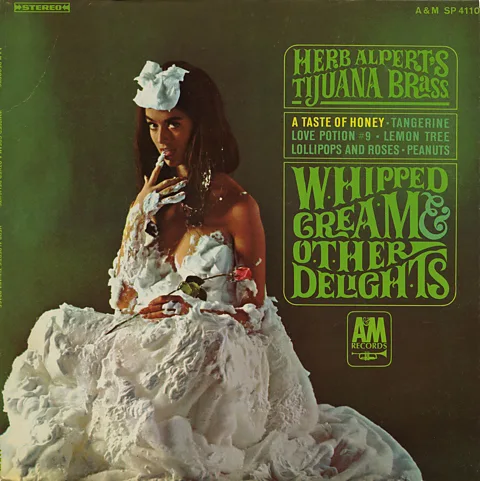
For the fourth record, loosely themed (at Moss's suggestion) around the concept of taste, Alpert didn't appear at all. Instead, he ceded the cover to model Dolores Erickson seemingly wearing nothing but a dress made of cream. It's an infamous, iconic bit of album art, stranger than mere cheesecake, and inspired countless parodies and tributes over the years. In the short term, it helped ensure that Whipped Cream & Other Delights found its way to bachelor pad record shelves across the US.
Television was another cross-cultural factor in Alpert's ascent. Several Tijuana Brass tracks soundtracked new game show The Dating Game, which debuted at the end of 1965. A version of Mexican Shuffle became the long-running advertising jingle for chewing gum brand Clark's Teaberry. The 10th Tijuana Brass album, The Beat of the Brass, was promoted by a CBS TV special.
One segment featured Alpert doing a rare vocal turn, singing the Bacharach-David composition This Guy's In Love With You to his then-wife Sharon Mae Lubin. The performance went down so well with viewers that Alpert was convinced to release the track as a single in the summer of 1968. It spent four weeks on top of the Hot 100, a first number one for A&M and Burt Bacharach, as well as for Alpert.
It also served as a coda to The Tijuana Brass's years of chart dominance. None of the next eight albums came close to the top 20. But those mid-60s LPs remained part of the cultural fabric – a physical presence if nothing else. Having been pressed and distributed by the millions, they were a staple of parents' record collections and secondhand vinyl stores. And Alpert himself kept re-emerging into the spotlight, in often surprising ways.
In 1979, partly at the behest of his nephew Randy Alpert and partly to test out a new 32-track digital recording machine that had been loaned to A&M, he went into the studio to lay down some disco reworkings of Tijuana Brass songs that Randy had arranged. When these didn't work out how the pair hoped ("It was driving me nuts, I said 'Randy, I can't do this, let these songs rest in peace, man'"), Alpert had a go at one of Randy's own compositions, a disco instrumental called Rise, but slowed it down into something smoother and funkier. "I was getting goosebumps listening to the playback," Alpert says. "I don't know what a hit record sounds like. But I know what a good record sounds like."
Rise was a hit record, helped by another TV push, this time via a scene in soap opera General Hospital. It eventually reached number one, earning Alpert another chart milestone: he was, and remains, the only artist to top the Hot 100 with both a vocal and instrumental track. Six years after that he collaborated with up-and-coming A&M artist Janet Jackson on an R&B song called Diamonds and scored another top five hit.
Then, in 1997, Rise topped the charts again, in sample form. Randy Alpert had turned down several requests from rappers to use the track, but agreed to let Sean "Puff Daddy" Combs sample the song's strutting bassline and signature echoing guitar stab after hearing a rough demo version of Notorious B.I.G.'s Hypnotize. The finished track, released just five days before Biggie Smalls' murder, spent two weeks at number one.
Having sold A&M records to PolyGram in 1989 and leaving in '93, Alpert could have stepped away from music, focusing perhaps on his side career as a painter and sculptor, or his philanthropic work with the Herb Alpert Foundation. But he has continued to record and tour, performing with his wife Lani Hall (formerly the lead singer of another A&M act, Sergio Mendes & Brasil '66) right up to the present day. And the old Tijuana Brass tunes continue to find new audiences.
Today, Alpert's most popular release on Spotify, with almost triple the streams of his next most listened song, is Whipped Cream album track Ladyfingers. The lilting tune found new life on TikTok in the 2020s, as a dreamy piece of background muzak soundtracking everything from sourdough bread appreciation to montages of wedding photos.
It's not the most obvious cut from Alpert's back catalogue, and it was never a single, but – as so often with his career – it's found its way to unlikely but startling success. "I've had over four billion streams on it," Alpert marvels. "And just out of curiosity, I looked at the census for when I was born in 1935, and there were 2.7 billion people in the world… So let's back up, put that in perspective, and be like, wow, man."
Herb Alpert and a "brand-new" Tijuana Brass are playing US tour dates throughout 2026.
--
If you liked this story, sign up for The Essential List newsletter – a handpicked selection of features, videos and can't-miss news, delivered to your inbox twice a week.
