Your bad habits are destroying your charging cables

 Serenity Strull/ BBC/ Getty Images
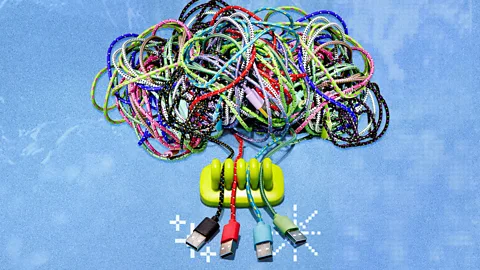
Charging cables are the most overlooked technology in your life, until they break and you're stuck with a dying phone. You're the reason they keep failing. Here's how to take better care of them.
Michael Pecht tortures charging cables. He's the founder of the Center for Advanced Life Cycle Engineering at the University of Maryland, a laboratory where tech companies send gadgets to learn why they break. "We're like the morgue," Pecht tells me, "but for electronics".
His team has subjected USB cables to unspeakable horrors, smashing, stretching, plugging them in too many times, you name it. As if that isn't enough indignity, he sticks the busted cables under X-rays to study the damage.
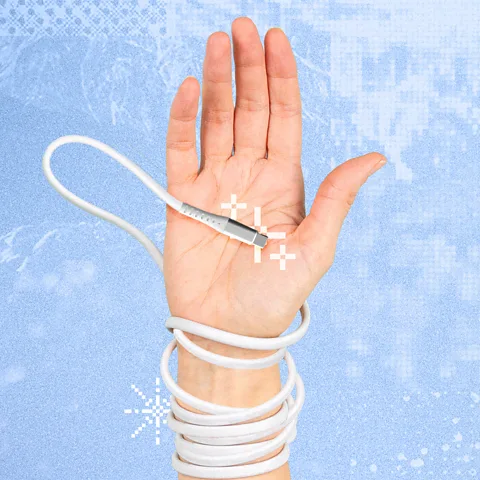
I called Pecht with what I thought was a simple question: what's the perfect way to wrap a charging cable? My whole life, I believed you need to wrap your cables in loose concentric circles – not too tight! – because over constricting or tangling is a shortcut to ruined wires. It's an extremely common idea among people I know, so I expected to hear a bit of science to support my cable wrapping technique. Instead, I found that I – and probably millions of other people too – have been wasting our time.
"It just doesn't matter," says Pecht. "We've done work for some of the big computer companies, the ones you're thinking of when I say that. We've never seen any failures from wrapping them up wrong."
This was so difficult to square with my cable philosophy that I contacted other experts, who all told me the same thing: wrap your charging cables however you want. There are, however, some other bad habits that have been shortening the lifespan of my cables. Things I've been doing every day for decades. My poor wires. I wish I'd known.
The good news is I'm here to share what I learned so you can stop making the same mistakes I did. Our cables work hard for us, but we rarely realise until they stop working and we are left without a way of charging our devices. Don't they deserve a little respect? If you aren't convinced, then know that caring for your cables is better for your wallet and the environment too.
Be nice to your cables
"There're two types of people in this world: people who destroy cables and people who don't," says Kyle Weins, co-founder of iFixit, a sustainability and consumer rights company that helps people repair their own electronics. It's painful to admit it, but I think I'm in the destructive group. "When cables break, it's almost always because it fails where the cable meets the plug."
Ready for an anatomy lesson? Your cables are full of little metal wires wrapped with insulation. On the far end, they thread into a connector with a plug at the end. That joint is where things go wrong. It makes sense if you think about it. When you're using a cable, the connector acts like an anchor, and all the bending happens right at the end of the wire.
Imagine a paper clip. Bend it at the same point over and over and it breaks. "On a microscopic level, bending beyond the elastic range makes the bonds between the atoms break and reform as they shift positions," says Robert Hyers, head of the mechanical and materials engineering department at Worcester Polytechnic Institute in the US. "You get this accumulation of defects called dislocations where the atoms don't line up, like wrinkles in a rug." Too many dislocations hardens the metal, then it snaps, and your paper clip is ruined. The metal wires inside a cable work the same way.
Hopefully you'll feel bad enough for those atoms to avoid some of these common problems. "One thing a lot of people do, including me sometimes when I'm lazy, is just pull on the long part of the cable to unplug it," Pecht says. "That's causing additional stress where it wouldn't if you just pulled on the connector itself."
A key source of strife comes from cables that are too short for the job, Hyers says. If you're stretching the cable out to make it reach a socket, you're hurting it. Or, if you find yourself lying in bed (or anywhere else for that matter) with your phone plugged in, pulling the connector at a sharp angle to keep using it, you're asking for trouble.
"Another thing we see people do is plug their phone in and then stick it in the cup holder in their car to prop it up," says Weins. "So, the phone is sitting on the cable and all the pressure of the phone weight, including bouncing as you drive, is right on that point." Stop it. That's just cruel.
 Serenity Strull/ BBC/ Getty Images
Here's the thing: it actually does matter how you wrap many longer heavier cables. Ask anyone who works in film or audio, and they'll tell you about the "over-under" cable wrapping technique professionals swear by. But Weins and others tell me the rules don't apply to your flimsy flexible charging cables.
Go for the braids
Weins says it certainly isn't good for your cables to wrap them up too tightly. But unless you're folding the cable at a sharp angle like a weirdo, or pulling on the connector or bending while you coil it up, a bad wrap job is very unlikely to cause a problem. It all comes down to abusing the connector.
Treat that part of the cable with respect, "and it'll last longer than I will", says Hyers.
But that's assuming the cables are up to the job in the first place. Everyone I spoke to told me a lot of the problem is cheap, poorly made cables. You can probably skip the dinky options you can get for a couple of bucks at the gas station. Invest in more robust cables and you'll spend less money replacing them.
More like this:
One thing to look for is braided cables, which use tight textiles or a nylon mesh woven over the wires instead of a plastic exterior. "That's a good rule of thumb," Weins says. "Even Apple has gone to braided cables in their most recent models just because the strength and the shielding of the braids is going to protect it better."
All of this is, objectively, small stuff. Cables are probably the least glamorous piece of technology in your life. They exist to be functional. And if they function, they can be ignored.
But ignore them the wrong way, and they'll quietly fail on you, one microscopic crack at a time.
--
For timely, trusted tech news from global correspondents to your inbox, sign up to the Tech Decoded newsletter, while The Essential List delivers a handpicked selection of features and insights twice a week.
