Who is Northern Ireland's new school behaviour tsar?
 Department of Education
Bad behaviour in schools is an increasing issue and has to be addressed, Northern Ireland's new school behaviour tsar has said.
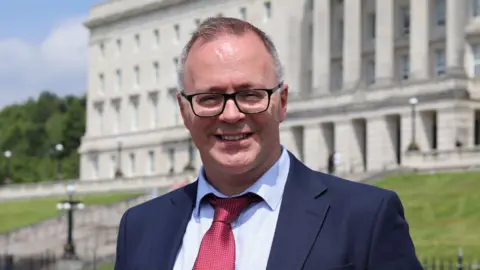
Tom Bennett has been appointed to review the behaviour policies of schools and how useful they are.
He said children can lose up to one hour per day through low-level disruption, and behaviour was about teaching children "really robust habits of doing things even when they're hard".
Bennett told BBC News NI there was "as much evolution as revolution involved in this".
So what is the new tsar's background and what does he stand for?
Who is Tom Bennett?
He is a former teacher and behaviour expert who was appointed by the then Conservative government in 2015 to look at how schools in England managed pupil behaviour.
That led to some critics to call him Tory Tom and claim that his approach to behaviour was too hardline.
He said the Tory Tom name came about after he was asked about it in a newspaper article.
"On one level I couldn't give a hoot because that's not true," he said.
"I've been appointed by Labour ministers, I've been appointed by Tory ministers.
"My job itself is non-political I hope."
Bennett was subsequently appointed as an attendance and behaviour ambassador by the Department for Education under the Labour minister Bridget Phillipson in 2025.
So what is his approach to behaviour?
His review of behaviour in schools in England was published in 2017.
It said a culture of good behaviour must be well-established in schools, which should include clear rules, consequences, sanctions and rewards.
When asked by BBC News NI whether he thought that many schools were not strict enough, Bennett said strict was a loaded word but that schools needed "to make sure to do what they said they were going to do".
He said that meant "clear boundaries" and "predictable consequences".
"The core of behaviour management is teaching people how to do the right thing," he said.
"But you do need to have boundaries and you do need to have penalties and children need that more than most people."
That included removing students from class, detentions, expulsions and other sanctions.
He said: "There needs to be a system of that, but it needs to be a predictable system, it can't just be 'I feel like it,' or 'I'm cross.'
"The schools need to be as rigorous as possible.
"There needs to be a wee bit of wriggle room round the edges for children who need additional support.
"But I always use the comparison of the roads - everybody should drive on the correct side of the road and keep to the speed limit, but there are exceptions and exemptions like emergency services vehicles."
A zero-tolerance approach?
Bennett said his approach was not a zero-tolerance one, describing that as a "PR scam by some schools".
"There's no such thing as a zero-tolerance approach," he said.
"Every school I've worked with that say they're zero-tolerance always have exceptions, and permit accommodations for children who need it."
But he said schools should deal with what seem like small instances of poor behaviour like arriving to class late.
"People sometimes categorise low-level disruption versus high-level disruption which might be a fight or something like that," he said.
"Fights are dramatic but they're less common but low-level disruption like lack of attention or coming in late or throwing a pen at somebody, this is kryptonite to a lesson."
Is behaviour in schools getting worse?
Bennett said there was a perception that behaviour was becoming increasingly problematic and that was not unique to Northern Ireland.
"Some people would attribute it to things like social media, Covid, increasing complexities of needs, greater prevalence of special educational needs," he said.
"What we're hearing a lot from people in schools - leaders, teachers, principals, people who are child-facing - is that there is an increasing issue.
"And that's not something that can be ignored, that's something that needs to be addressed because behaviour is fundamental to a child's success at school."
According to the Department for Education (DE) 4,756 pupils were suspended from schools in Northern Ireland in 2025/26, fewer than the previous school year.
Persistent infringements of school rules was the most common reason for a pupil to be suspended, followed by a physical attack on a pupil and verbal abuse of staff.
Meanwhile 35 pupils were expelled from school in 2025/26, all of whom were in post-primary school.
'Is this the best use of resources at this time?'
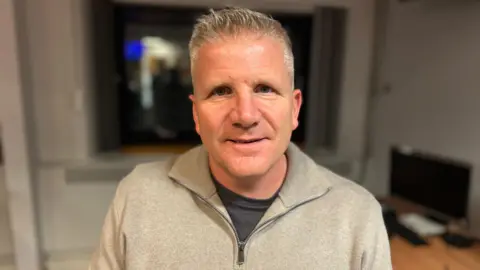
Northern Ireland Commissioner for Children and Young People Chris Quinn said behaviour can be a consequence of things like children not being in the right place for them.
"It's not a simple fix but I really think we need to focus on the root causes," he said.
Quinn said when he visits schools he hears "a lot of criticism about existing behaviour support and we need to invest in that".
"I'm struggling to understand the rationale behind this appointment. I am concerned about is this the best use of resources at this time," he added.
Quinn said there were already "well-established recommendations that have been sitting there for a long time" and "there's a well versed argument for legislative reform already".
"I would prefer if the minister focused on them as opposed to bringing in a tsar."
Teachers reporting worse behaviour
Justin McCamphill, from the teaching union NASUWT, said members were "reporting behaviour getting worse".
He added that low-level disruptive behaviour and increased misogyny in schools were also issues raised by teachers.
"Female teachers are now reporting, in ever greater numbers, due to the Andrew Tate effect that they are actually finding it harder to carry out their jobs in schools," he said.
He said it is important Bennett also "finds out what is working well".
"If there are schools that are doing things well they should be held up as models of good practice."
He said Bennett should make recommendations about additional support, especially financially, so "schools who have more vulnerable children can actually get that support".
 Department of Education
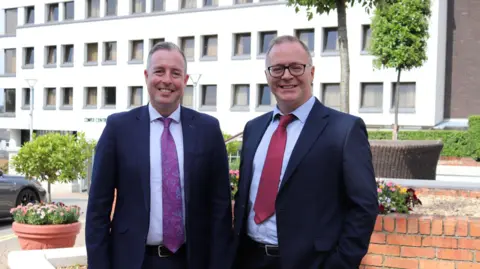
Education Minister Paul Givan said Bennett brings "a wealth of experience" and "his expertise will be invaluable".
"Increasingly complex behaviour is placing significant pressure on our teachers and school leaders," Givan said.
"Creating safe, calm and purposeful learning environments is essential to ensuring that every child and young person can succeed.
"This review will help ensure our approach to behaviour is clear, consistent and underpinned by the best available evidence, while giving teachers the practical support they need in the classroom."
