'It gives me freedom I never thought I'd have' - breaking down barriers to water sports

 BBC
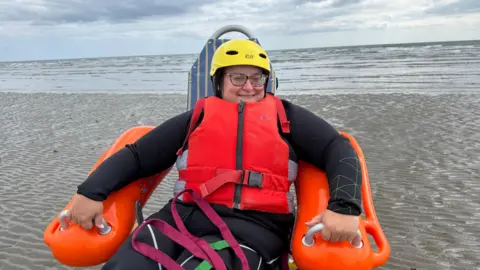
BBCNaomi Herron had not been on a beach since she was a child.
She has cerebral palsy which meant it was difficult for her to the access the beach as she grew up.
Naomi only returned five years ago after campaigning with a charity for beaches to become more accessible for those with disabilities.
The Mae Murray Foundation works to remove physical barriers to activities like water sports.
Now, the 35-year-old enjoys supported swimming and inclusive paddleboarding.
The adapted paddleboards allow people of all physical abilities to take part in water sports alongside family and friends.
"[Being in the water] makes me feel on top of the world," Naomi said.
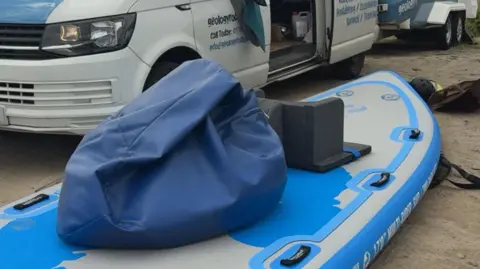
The specialised sit-down paddleboards have a supported seat mechanism that is bolted on. The seating can vary from a racing style sliding bucket seat, to foam or beanbag seats.
Some of the paddles have grips to help participants.
"I loved it because I felt like a fish in there and a wee mermaid."
Naomi successfully campaigned with the Mae Murray Foundation to have inclusive beaches created in the Newry, Mourne and Down district council area.
"I never actually thought that I would've gotten on this beach if it wasn't for my campaign," she said.
"Now I feel as if I'm part of a whole big community."
The charity has set up six inclusive beaches across Northern Ireland, with two in the Newry, Mourne and Down area. These provide access, parking and disabled toilets, which have hoisting and adult sized changing bench facilities.
Naomi said she goes to Mae Murray events almost every time there is an opportunity to paddleboard.
"I absolutely love it because it gives me freedom that I never thought I would have had before."
She encouraged younger people to try paddleboarding as "you never know what it's going to feel like till you do".
Nerve-racking but exciting
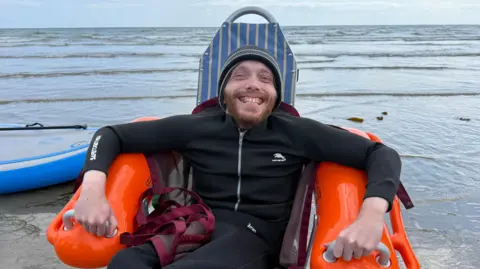
Jordan McGarel, 34, loved his first paddleboard experience and is already looking forward to trying it again.
He also has cerebral palsy. To get down to the beach, Jordan, like many others, was brought via a specially adapted wheelchair, called a floating chair.
Jordan was guided into the sea by volunteers who then carefully lifted him from the chair to the board with a beanbag seat.
"It's good to try something new. It's a bit nerve-racking but exciting as well," he said.
"I was scared about going in at the start but once I was in, I enjoyed it, and once I came out, I was proud of myself for doing it."
The guides, who are trained to keep participants safe in the water, went out with everyone ensuring the paddleboard stayed balanced.
'We can take part as a unit'
For Kelvin Kasapatu and his family, the opportunity meant a lot.
His 14 year-old son Oscar is non-speaking and earlier this month was his first time on a paddleboard.
"As a family it's good because we can take part as a unit so we do things altogether and it doesn't separate him from other activities," he said.
"My daughter also loves doing things with her brother."
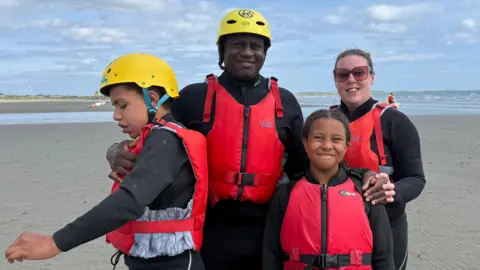
Kelvin said it makes a difference for his son, making him happy and improving his sleep.
"He loves the water. He was laughing all the way, and he was very calm."
Oscar was on a paddleboard with his father and had four guides to help with balance.
"He's capable of a lot of things," he said.
"Sometimes he doesn't take to them, sometimes he does.
"Mostly when it comes with something to do with water, he's always up for it."
'Life changing' for people
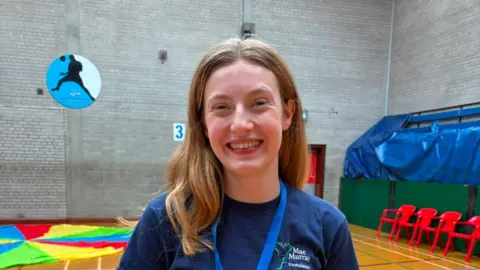 The Mae Murray Foundation
The Mae Murray Foundation introduced the first sit down paddleboard to Ireland in 2024 and has acquired more since.
Staff member, Catherine McBarnet, said these opportunities can be life-changing for people.
"We've had people who have just been stuck on the car park, who haven't been able to get down and access the water."
She added that because children often get too heavy to carry as they grow up, their childhood is often the last time they are on the beach.
"It's about breaking down barriers... to enable them to have that access again, to be fully safe in the sea."
The Mae Murray Foundation holds several family fun days, paddleboard sessions, or even surfing sessions throughout the summer.
"Seeing children with the waves splashing in their face, and just the shock and the joy, it's just so magical to see," McBarnet added.
"Over time we're getting more and more equipment and we're hoping to grow every year."
The Mae Murray Foundation has a free resource library for all members.
Becoming a member is free and involves filling out a short form.
It gives access to free equipment to borrow throughout the year.
This includes wheelchairs, buggies, an explorer wheelchair with a freewheel, an all terrain wheelchair and even trikes.
